

You've sent two quotes, blocked out the time, and promised the customer you'll get back to them shortly. The technical work might be identical to what another tradie offers, but the customer is judging more than the price and the proposed fix. They're noticing whether you communicate clearly, explain the work without bluffing, arrive when you said you would, and leave the property looking respected.
That's where professional standards become real. They aren't limited to licences, qualifications, or the quality hidden behind a wall. They show up in every customer interaction, document, vehicle, safety decision, online post, and follow-up. Tradies who make those details repeatable give customers a reason to choose them again and recommend them to someone else.
Table of Contents
- The Moment a Customer Chooses You or Someone Else
- What Professional Standards Mean for Tradies
- Legal and Regulatory Duties That Set the Floor
- Five On-the-Job Pillars Tradies Control Directly
- How Your Online Presence Now Counts as a Standard
- Real Examples of Standards That Win or Lose Work
- Quick Audits and a Maintenance Rhythm That Sticks
The Moment a Customer Chooses You or Someone Else
A homeowner has two quotes open on the kitchen table. One arrived as a short message with a total price and almost no explanation. The other arrived as a clear, itemised document with the proposed work, assumptions, inclusions, exclusions, and a sensible timeline. Neither quote guarantees perfect workmanship, but one already feels easier to trust.
The first tradie might be highly skilled. The second might be less experienced. The customer can't know that from the quote alone, so they use the signals available to them. Was the enquiry answered promptly? Did the tradie ask the right questions before pricing the job? Did they explain why a particular repair or installation was needed? Did they turn up at the agreed time, or leave the customer wondering whether they'd been forgotten?
Practical rule: Customers often experience your standards before they experience your workmanship.
A clean quote doesn't replace competence, and a punctual arrival doesn't excuse unsafe work. It does, however, reduce uncertainty. A customer choosing between plumbing, electrical, carpentry, or HVAC contractors is trying to protect their home, budget, and time. Clear conduct tells them you understand that responsibility.
The small details continue after the decision. A tradie who confirms access arrangements, protects nearby surfaces, explains changes before doing extra work, and documents what was completed makes the customer feel in control. A tradie who leaves tools scattered, changes the price without warning, or disappears after sending the invoice creates doubt even if the repair works.
The standard is visible before the result
Referrals usually come from the full experience, not from a technical result considered in isolation. Customers remember whether they had to chase an update, whether the invoice matched the conversation, and whether the tradie treated their property with care.
That doesn't mean every job needs polished corporate language or expensive branding. It means your normal process should be dependable enough that a customer doesn't have to guess what happens next. Professional standards are the habits that make the right impression before, during, and after the work.
What Professional Standards Mean for Tradies
For a tradie, professional standards are the repeatable expectations that govern how you sell, plan, perform, document, and stand behind work. They bring together three layers that need clear separation.
Customers expect timely communication, fair pricing, respectful conduct, tidy work, and explanations they can understand. Laws, regulators, licensing bodies, insurers, and professional organisations set another layer of requirements. The third is the level you choose to maintain when nobody is checking.
Standards are the habits beneath every job. They shape decisions about competence, safety, honesty, records, permissions, and accountability. Customers see those decisions through the quote, messages, arrival, site setup, workmanship, invoice, and follow-up. One weak habit can make the whole experience feel unreliable.
“Professional” can describe anything from wearing a branded shirt to belonging to a regulated profession. Appearance may support confidence, but customers judge the standard through conduct. A useful standard becomes specific enough for someone to check: confirm the scope before starting, protect the work area, record changes, explain delays, and leave clear paperwork.
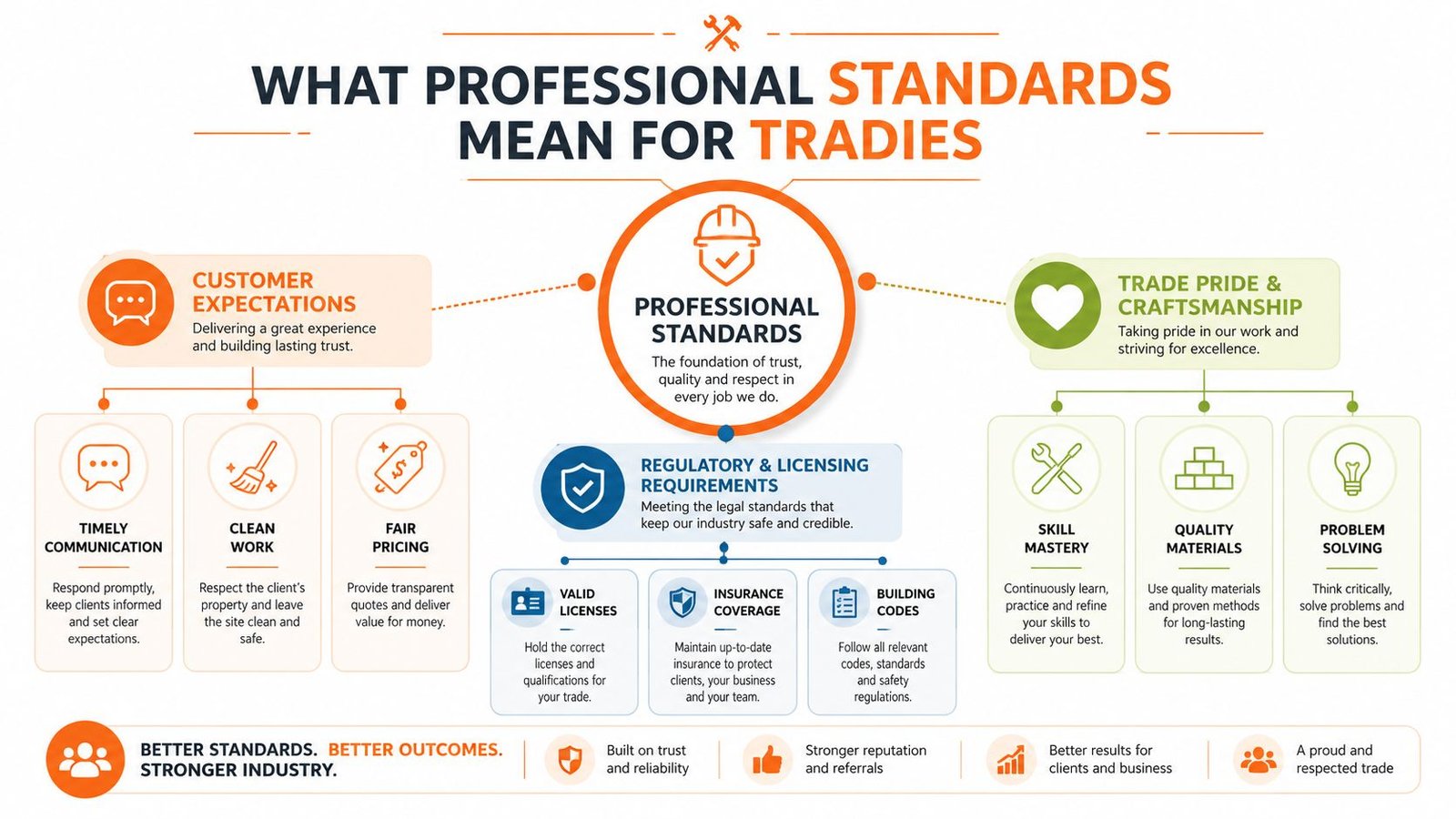
Separate the floor from the standard you choose
Legal and licensing duties create the minimum floor. Customer expectations determine whether the process feels trustworthy. Trade pride raises the quality of the result and your response when something goes wrong.
The ISO 9000 family became a global reference for structured quality management, with ISO 9001 at its centre. ISO formalised a major international benchmark in 1987, issuing the ISO 9000 series as five related quality-system standards. The series was later expanded and revised in 1994. The standards had reached more than 96 countries by the early 1990s, according to the National Academies account of ISO 9000's development and spread.
A small trade business does not need a corporate quality system. Write down the promises you make, define how you deliver them, and check whether the finished process matches what the customer was promised. That method turns professionalism into working habits rather than a personality label, and gives AI tools or online content a clear standard to follow when they represent your business.
Legal and Regulatory Duties That Set the Floor
A business registration doesn't automatically authorise every activity a trade business might perform. The UK government's guidance on licences and regulations explains that approval may be required before trading, and that approval can include a local council licence, registration or accreditation with a professional body, or authorisation from a national regulator.
The requirement depends on the activity. The guidance identifies areas such as food preparation and sale, alcohol, tattooing, piercing, massage, cosmetic treatments, animal services, market and street trading, taxi and private-hire services, entertainment, overnight accommodation, and betting or gaming machines. For trade businesses, the wider lesson is straightforward: check the permissions attached to the work itself, not only the status of the business.
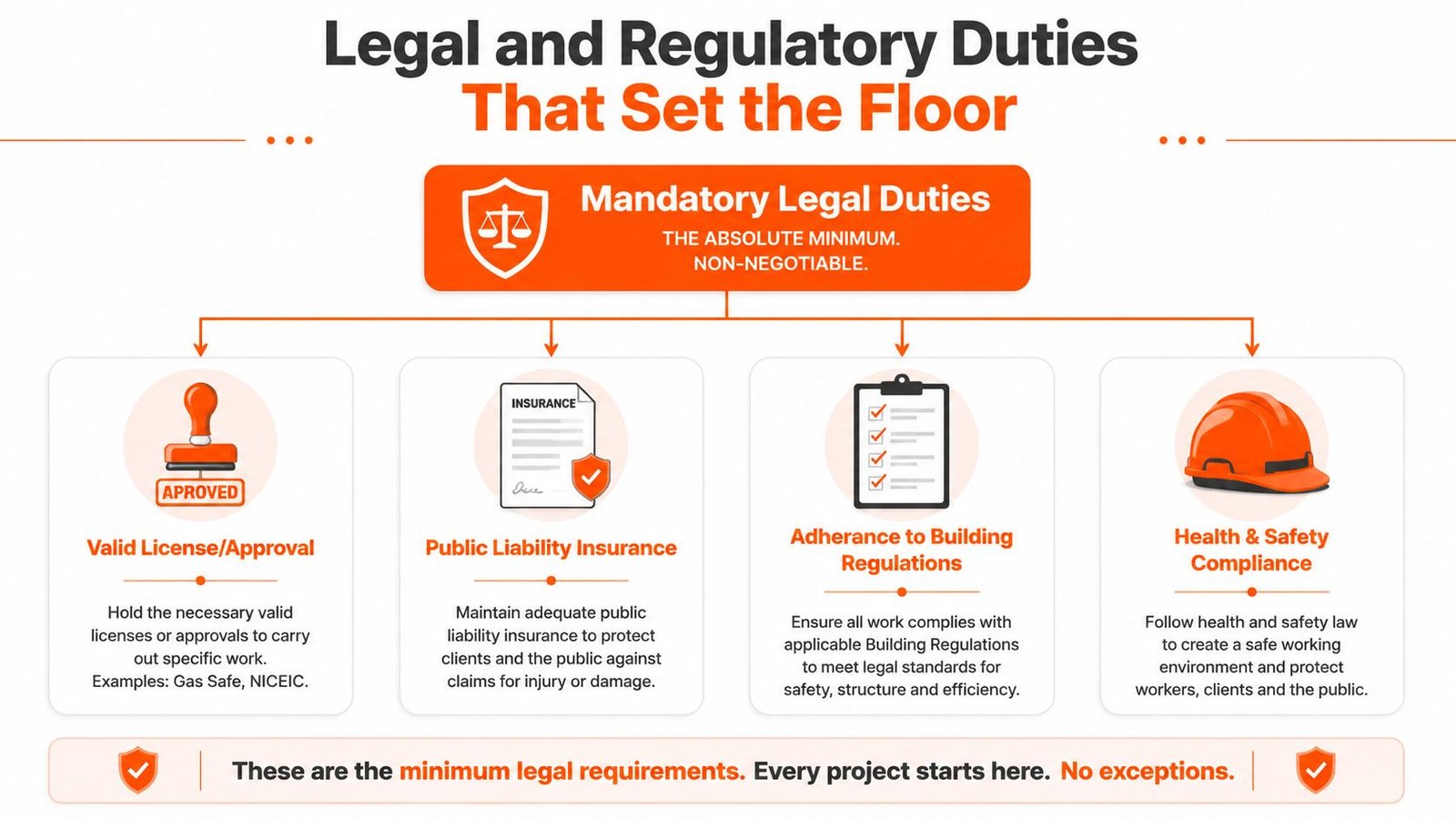
Treat approval as protection, not decoration
A licence, accreditation, or regulator authorisation can reassure a customer that a trade activity has a defined entry point and oversight. It also gives you a practical checklist before accepting work. If you're unsure whether a project needs a particular authorisation, confirm it with the relevant council, regulator, or professional body before quoting.
For broader context, review this guide to what a general contractor licence covers, then verify the rules that apply in your own location and trade.
The Chartered Trading Standards Institute code provides a useful model for turning professional conduct into explicit duties. Its members are expected to serve the employer or client to the highest professional standards, remain honest and courteous, follow prevailing laws, treat people fairly and reasonably, challenge suspected unlawful or unethical conduct, and avoid bias or undue influence that could compromise judgement. Those expectations are practical because they tell a person what to do when a situation becomes difficult.
The Institute of Science and Technology code takes the same operational approach. It prohibits misleading claims about qualifications, experience, competence, or references, requires clear and honoured business terms, and requires properly licensed software for commercial projects. It also addresses fair fees and competitive conduct. Together, these examples show why the legal layer should be treated as the floor, not the ceiling. Meeting it protects the customer from avoidable harm and protects your business from promises, tools, or work arrangements you had no right to provide.
Five On-the-Job Pillars Tradies Control Directly
Professional standards become easier to maintain when you attach them to the parts of the job you control every day. These five pillars cover the customer experience without pretending that every trade operates in exactly the same way.
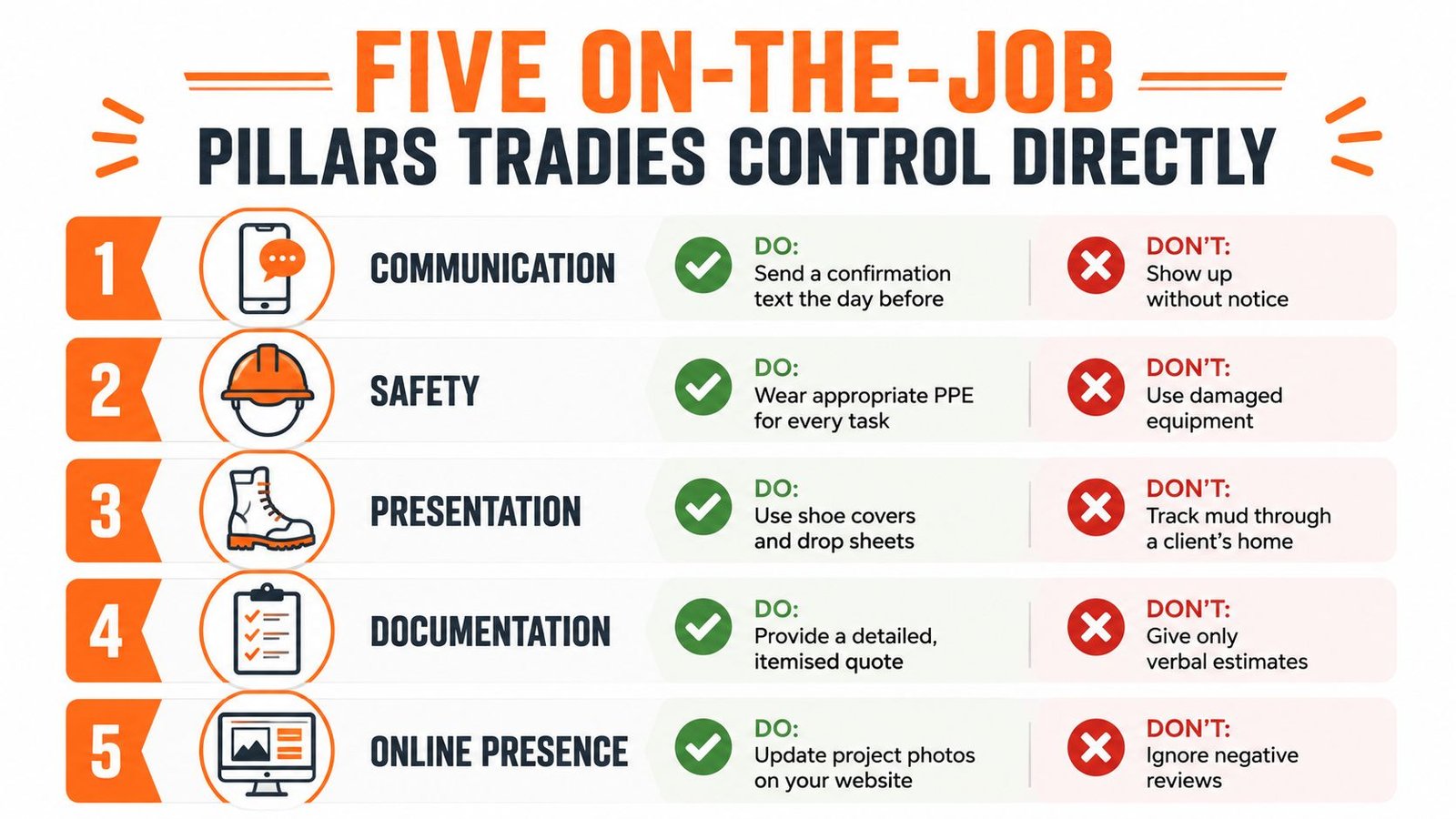
Communication
Send a confirmation message before the appointment, state what access you need, and tell the customer when you expect to arrive. If a previous job runs late, update them before the agreed time passes.
The common slip is silence. “I was busy on the tools” explains the delay, but it doesn't remove the customer's uncertainty. Use the same standard in messages as you would in person: be honest, courteous, and clear.
Safety
Plan the task, use appropriate protective equipment, isolate hazards, and stop when conditions change. A damaged extension lead, unstable ladder, or rushed isolation decision isn't a minor presentation issue. It can put people, property, and the business at risk.
Keep your safety wording practical rather than dramatic. The guidance on safety messaging for trade businesses can help you explain safe work in language customers understand.
Presentation
Protect the customer's property before work starts. Use drop sheets, shoe covers where appropriate, barriers, and a clear place for tools. A tidy work area also helps you notice hazards and avoid losing small parts.
Tracking mud through a hallway, leaving packaging behind, or leaning equipment against a finished surface tells the customer that the job ends when the technical task ends. It doesn't.
Documentation
Give a detailed, itemised quote rather than relying on a verbal estimate. Record variations, approvals, materials, test results where relevant, and the work completed. Good documentation helps both sides remember what was agreed.
The weak version is a single total with no explanation. It creates arguments when the customer assumes an item was included or when site conditions require a change.
Online presence
Keep your service descriptions accurate, show genuine project work, and answer reviews professionally. Don't claim qualifications, experience, or services you can't support. Your digital profile is now part of the first impression.
After each job, ask yourself:
- Communication: Did the customer always know what was happening next?
- Safety: Did the team control hazards instead of working around them?
- Presentation: Did the property look cared for throughout and at handover?
- Documentation: Could another person understand the agreement and result?
- Online presence: Would a cautious customer trust what they find about the business?
How Your Online Presence Now Counts as a Standard
Customers often check a tradie online before making contact. They look for a complete business profile, a clear service area, recent project evidence, contact details, and signs that the business is still active. They're not demanding a media company. They're looking for consistency between the person they might hire and the business presented on screen.
A profile with an old phone number, vague services, copied wording, or no visible work creates friction before you've had a chance to explain your value. A steady presence does the opposite. It gives a customer useful context, especially when your quote is competing with one from a business they already recognise.
Digital conduct is part of competence
Professional standards are being reshaped by digital delivery and AI, not only by traditional conduct rules. Guidance on updated career-development standards in 2026 expands expectations around digital literacy, critical assessment of AI tools, hybrid service delivery, accessibility, and digital equity, as described in this briefing on changes to professional standards.
That shift matters to tradies because AI can now help draft customer messages, social posts, quote explanations, and follow-up content. The tool doesn't remove your responsibility for accuracy. Review every generated claim, correct technical wording, remove promises you can't keep, and make sure the content reflects the services you provide.
Online professionalism also includes how you respond when someone is unhappy. Don't argue publicly, reveal private job details, or make a defensive claim you can't prove. A calm response that invites a private conversation shows more judgement than pretending every customer is satisfied.
Your online presence can be improved systematically by checking the basics first. Use real project photos, explain the type of work you accept, keep contact information consistent, and publish useful updates that demonstrate how you work. That isn't a separate layer pasted onto professionalism. It's a visible extension of it.
Real Examples of Standards That Win or Lose Work
A plumber receives an enquiry about a leaking valve. One response gives a price with no arrival window. The other asks for relevant details, explains what the visit includes, confirms the appointment, and sends a written quote after inspection. If both tradies can solve the problem, the second has made the decision easier without competing only on price.
The same pattern appears in electrical work. A good electrician completes the installation but leaves the customer unsure which circuits were changed, what documentation they'll receive, or whether any follow-up is needed. A stronger operator explains the result at handover, records the relevant details, and closes the loop. The work becomes easier to understand and easier to recommend.
HVAC customers notice similar differences. A technician can repair the unit correctly yet lose trust by arriving without notice, failing to protect the floor, or adding an unexplained charge. Another technician makes the scope clear, flags a variation before proceeding, and leaves the area orderly. The second business has reduced the customer's mental load.
Outcomes matter more than paperwork volume
Professional frameworks are also moving toward clearer, more outcome-based accountability. The Professional Standards Authority's review describes a move in 2026 from 18 regulator standards to 16, with phased implementation and greater emphasis on measurable outcomes, quality improvement, and risk management.
For a small trade business, that doesn't mean producing dense manuals. It means proving the things that matter: the customer received the agreed service, risks were managed, changes were approved, records are understandable, and problems receive a response.
One tradie earns the referral because the customer can explain exactly what happened and why the result was sound. Another spends more time chasing fresh leads because technically acceptable work was wrapped in avoidable confusion. The difference isn't always talent. It's whether the business makes good practice repeatable and visible.
Quick Audits and a Maintenance Rhythm That Sticks
You don't need special software to check whether standards are drifting. Set aside a short block of uninterrupted time and review evidence from recent enquiries, jobs, invoices, and online profiles.
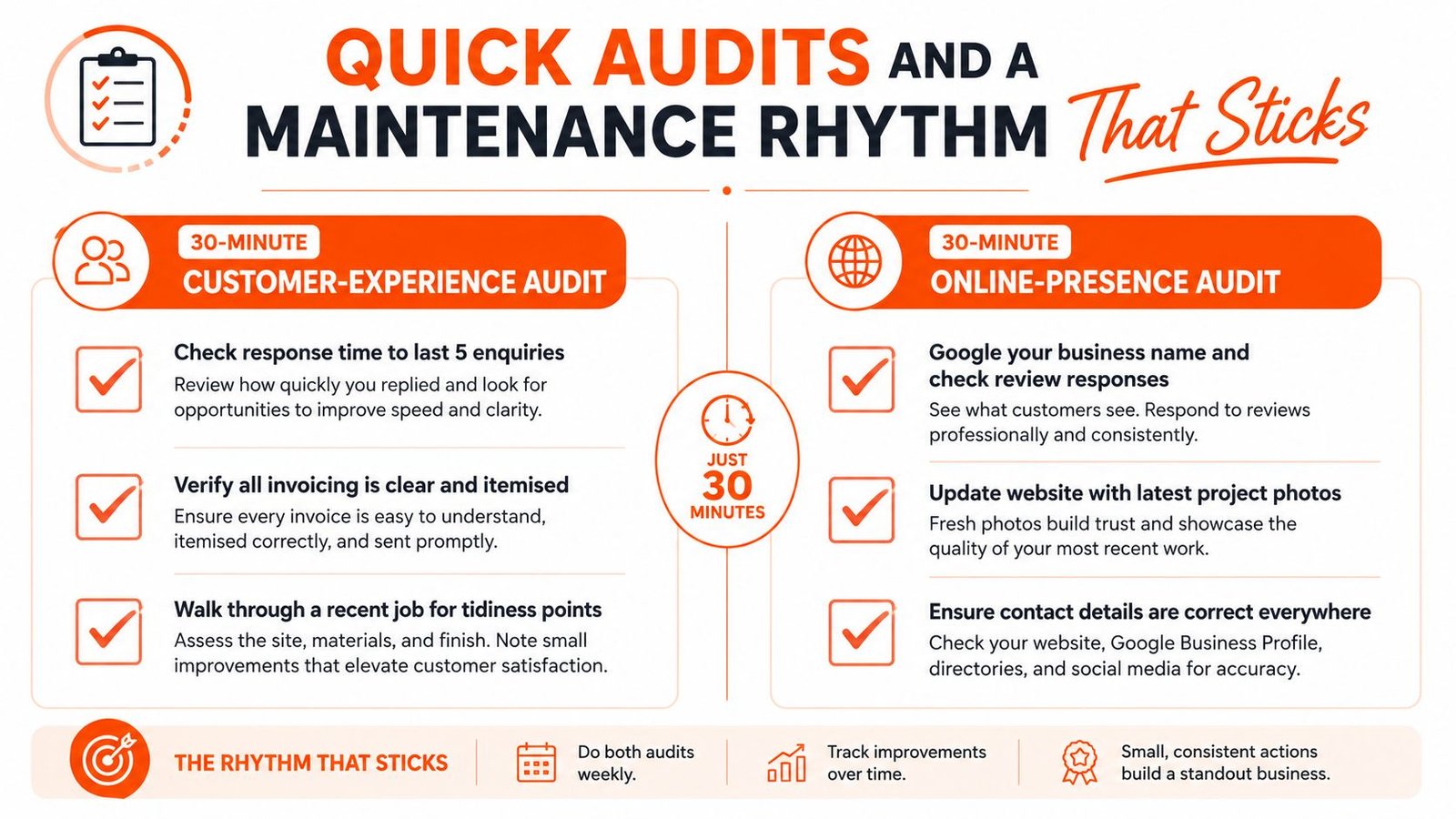
Audit the customer experience
Use the first 30 minutes to check:
- Recent enquiries: Review response speed and whether each customer received a clear next step.
- Invoices: Confirm that charges are understandable and itemised.
- Job presentation: Revisit a recent project, physically or through photos, and look for protection, tidiness, and handover gaps.
- Variations: Check whether extra work was explained and approved before it was carried out.
Use a second 30-minute audit for your online presence:
- Search results: Google the business name and check whether contact details and review responses are current.
- Project proof: Add genuine, recent photos and remove anything that misrepresents your services.
- Service wording: Confirm that your trade, locations, qualifications, and availability are accurate.
- AI-assisted content: Review every scheduled or drafted post for factual errors, exaggerated claims, and language that doesn't sound like your business.
Keep the rhythm light
Review communication, safety, presentation, documentation, and online activity each week. Check licences, insurance records, templates, and recurring customer complaints monthly. Review the whole process quarterly, then change one weak habit instead of creating a rulebook nobody follows.
The working checklist is simple: promise clearly, work safely, protect the property, document the result, and stay credible online. Start with the next quote you send today, then use the audit to see whether your process supports the standard you want customers to remember.
GrowTradie helps trade businesses stay visible with AI-generated, trade-specific social posts, professional designs, and automatic publishing, so online credibility doesn't disappear between jobs. Visit GrowTradie to set up a consistent presence that supports the professional standards customers look for before they book.