

You're probably good at the work and bad at getting a steady flow of calls. That's normal. Most electricians build their business on referrals, a few repeat customers, and the occasional rushed post on Facebook when the calendar looks thin.
That approach works until it doesn't. One busy month hides the problem. One quiet month exposes it. If your marketing depends on luck, your workload will too.
Marketing for electricians doesn't need to be complicated. It needs to be practical, local, and easy to repeat when you're busy. The right setup gets you found, gives people confidence fast, and makes it simple for them to call or message you.
Table of Contents
- Why Good Electricians Struggle with Marketing
- Become the Go-To Electrician in Your Area
- Turn Your Website into a 24/7 Lead Catcher
- A Simple Content Plan for Social Media and Ads
- Create a System for Reviews and Referrals
- Tracking Your Results and a Simple Timeline
Why Good Electricians Struggle with Marketing
Most electricians aren't short on skill. They're short on time, consistency, and a clear plan. You finish a job, send invoices, handle supplier calls, chase parts, answer messages, and then someone says you should “do more marketing” like you've got spare hours sitting around.
That's why marketing usually turns into random acts. A boosted post one week. A van photo the next. Maybe a website update six months later. Nothing links together, so nothing compounds.
The bigger issue is this. Good tradies often assume good work should sell itself. Good work matters, but people can't hire you if they don't see you, don't trust you, or can't contact you quickly. Being excellent on site doesn't automatically make you visible off site.
Practical rule: Stop treating marketing like a separate project. Treat it like part of the job pipeline, the same way you treat quoting, scheduling, and follow-up.
You also don't need to become a marketing nerd. You need a short list of actions you can repeat without overthinking them. That means:
- Showing up locally: Make sure people nearby can find you when they need electrical work.
- Making contact easy: Your phone number, service list, and quote request need to be obvious.
- Building proof: Reviews, job photos, and clear service pages do more selling than clever copy.
- Following up fast: Missed calls and slow replies kill good leads.
If you want a broader look at tools built for tradies, this guide to apps for electricians is useful because it focuses on practical business tools, not theory.
The rest of this article is the no-nonsense version. No jargon. No fluff. Just the actions that help marketing for electricians produce more calls and booked jobs.
Become the Go-To Electrician in Your Area
If you do one thing first, fix your Google Business Profile. It's your digital shopfront. For a lot of customers, it's the only thing they'll look at before deciding whether to call.

Searches for “electrician near me” rose 32% year over year, and businesses that dominate Google's Local 3-Pack get 126% more calls than competitors, according to electrical marketing statistics.
Fill out the profile like your next job depends on it
Half-complete profiles lose work. Customers compare fast. If your hours are wrong, your service area is vague, or your service list is thin, they'll move on.
Use this checklist:
- Business name: Use your real trading name. Don't stuff it with extra keywords.
- Phone number: Use the main number you answer.
- Service area: List the suburbs, towns, or regions you cover.
- Hours: Keep them accurate, especially if you offer emergency callouts.
- Services: Add every real service you want to be hired for, such as switchboard upgrades, fault finding, lighting installs, rewiring, smoke alarms, and EV charger installation if you offer it.
- Description: Write like a human. Say what you do, who you help, and where you work.
- Photos: Add real photos of your van, team, tools, completed jobs, and tidy work areas.
Make trust obvious in seconds
Customers don't study profiles. They scan. You need to answer their basic questions immediately. Are you local? Are you legitimate? Can you handle the job? Can they contact you right now?
A strong profile gives them confidence before you ever speak to them.
Reply to reviews, keep recent photos coming in, and update services when your work changes. An active profile looks like a real business, not an abandoned listing.
If you want a plain-English checklist, Wise Web has actionable steps for local SEO success that translate well into local visibility work without overcomplicating it.
Here's the blunt truth. Many electricians lose jobs before the phone rings because their profile looks neglected. A clean, complete, current profile makes you look easier to trust. In local service work, that's often enough to win the call.
Turn Your Website into a 24/7 Lead Catcher
Your website shouldn't be an online brochure. It should behave like a staff member who answers basic questions and pushes people toward calling you.

Too many electrician websites look decent but underperform. They bury the phone number, make visitors dig for service details, and talk too much about the business instead of the customer's problem. That kills momentum.
Your site has one job
A visitor lands on your site with a need. Maybe the power keeps tripping. Maybe they need a quote for a renovation. Maybe they want outside lighting installed before the weekend. Your site has one job. Get that visitor to contact you with as little friction as possible.
The best electrician websites usually include:
- A visible phone button: Especially on mobile. People should be able to tap and call.
- A short quote form: Name, suburb, phone, job type, brief message. That's enough.
- A clear service list: Don't make people guess what you do.
- Real job photos: Show finished work, not generic stock images.
- Customer reviews: Place them near your call-to-action, not hidden on a separate page.
- Service area details: Make it obvious where you work.
- Licensing and trust signals: Add the practical proof that reassures people.
A lot of website advice chases traffic and forgets conversion. This piece on improving organic traffic revenue is worth reading because it keeps the focus on turning visitors into actual business, which is the only metric that matters.
What to fix first
Start at the top of your homepage. If a visitor can't tell within a few seconds what you do, where you work, and how to contact you, rewrite it.
Use a simple structure:
- Headline: Say the service and area clearly.
- Subheadline: Mention the types of jobs you handle.
- Primary action: Call now or request a quote.
- Proof: Reviews, photos, and credentials.
This video gives a practical look at what makes a business site convert better:
Your contact page should also do less talking and more converting. Add a map or service area text, repeat the phone number, and keep the form short. Long forms lose leads.
If you're reviewing your local online presence as a contractor, this resource on local marketing visibility for contractors gives a useful practical lens for what customers need to see before they enquire.
A good website doesn't need to be fancy. It needs to be clear, fast, and easy to act on. If your current site looks polished but doesn't drive calls, it isn't doing its job.
A Simple Content Plan for Social Media and Ads
A homeowner sees your post while scrolling after work. They're not looking for “content.” They're deciding, rapidly and without fanfare, whether you look reliable enough to trust when something goes wrong.
That's why social media for electricians should build familiarity, not chase attention. You don't need to go viral. You need to look active, competent, and local.
Post what homeowners actually care about
The best posts are simple. A tidy switchboard upgrade. A quick safety tip. A before-and-after lighting job. A short explanation of what you fixed and why it mattered. That sort of content works because it feels real.
And social ads can absolutely pull work. 48% of electrical contractors get at least one new client every month from Facebook or Instagram advertising, as noted in the earlier source-backed research. That's enough reason to stop dismissing those platforms as a waste of time.
Use a simple weekly rhythm. Repeat it until it becomes automatic.
| Post Type | Example Content Idea | Why It Works |
|---|---|---|
| Before and after | Old light fittings replaced with modern LED downlights | Shows visible improvement and quality of finish |
| Safety tip | What to do when a circuit keeps tripping | Proves expertise and gives immediate value |
| Job spotlight | “Today's job was a switchboard upgrade in North Lakes” | Reinforces local presence and real activity |
| Meet the team | Photo of you or your crew with a short intro | Makes the business feel personal and trustworthy |
| FAQ post | “Do I need an electrician for a new oven install?” | Answers common buyer questions and pre-qualifies leads |
| Review graphic | Screenshot of a happy customer review | Uses social proof without extra effort |
| Seasonal reminder | Outdoor lighting checks before winter or storm season | Connects your services to timely homeowner needs |
Helpful beats clever. A simple post that answers a common customer question will usually do more for your business than a “creative” post with no practical value.
If you want a done-for-you approach to staying visible without writing posts yourself, this page on social media marketing for contractors shows the kind of consistent content workflow busy tradies usually need.
Run ads that match buying intent
Don't throw money at random ads. Match the ad to the job type.
For high-intent leads, use Google's local ad formats to show up when someone is actively looking for an electrician. These people already need the service. Your job is to be visible and easy to contact.
For Facebook and Instagram, keep the targeting local and the offer simple. Good examples include:
- Homeowners in your service area: Promote a core service like switchboard upgrades or fault finding.
- Specific seasonal jobs: Outdoor lighting, smoke alarm checks, or EV charger installation if that's part of your offer.
- Retargeting site visitors: Remind people who visited your site but didn't contact you.
The ad itself doesn't need marketing fluff. Use a photo of real work, name the service, mention the area, and tell people what to do next. Call now. Request a quote. Message for availability.
Most electricians overcomplicate this part. Post proof of good work. Run local ads around services people already need. Keep going long enough for repetition to do its job.
Create a System for Reviews and Referrals
Most electricians ask for reviews when they remember. That's the problem. If it isn't a system, it won't happen consistently.
Reviews and referrals come from the same place. Good work, followed by a simple prompt at the right time. Don't wait a week. Don't write a long email. Ask while the customer still feels relieved that the job is done.
Ask at the right moment
The best time to ask is shortly after a successful job, when the customer is happy and the result is fresh. Send a short text or email with a direct review link.
Use something like this:
Hi [Name], thanks again for having us out today. If you're happy with the work, would you mind leaving a quick Google review? It really helps local customers feel confident choosing us. [Insert review link]
That's it. Short, polite, and easy to act on.
Fast response matters before the job too. Calling a new lead back within 1 minute can increase conversion chances by 391% compared with waiting 10 minutes, according to this 2025 market report for electrician lead handling. If you're slow to reply, you're handing warm leads to competitors.
Build referrals into the job flow
Referrals happen more often when you make them easy and natural. At the end of a job, if the customer is clearly pleased, say so directly. “If you know anyone nearby who needs an electrician, feel free to pass on my number.”
You can strengthen that with a simple follow-up process:
- After completion: Send the thank-you message and review link.
- A few days later: If they replied positively, ask for a referral in plain language.
- Keep your contacts handy: Make sure your invoice, email signature, and business profile all show the same contact details.
- Stay memorable: A clean van, professional communication, and punctuality do more referral work than people realize.
If you want a more structured approach, HearBack outlines a system to boost local business referrals that's useful because it focuses on repeatable habits, not awkward sales tactics.
The businesses that get talked about most aren't always the cheapest. They're the ones people remember as easy to deal with.
Good reviews help strangers trust you. Good referrals help neighbours trust you faster. Both start with a reliable process, not wishful thinking.
Tracking Your Results and a Simple Timeline
Most tradies don't have a lead problem. They have a tracking problem. If you don't know what caused the call, you can't tell what's worth repeating.
That's common. 68% of trade businesses struggle to attribute leads to specific marketing channels, according to this 2025 report on electrician marketing challenges. The usual reason is simple. They're too busy to build a tracking habit.
Track booked jobs, not vanity metrics
Start with the easiest method. Ask every caller and every form lead, “How did you hear about us?” Then log the answer in one place. A spreadsheet works. So does a notes field in your CRM or job management software.
Track a few categories only:
- Google Business Profile
- Website
- Facebook or Instagram
- Referral
- Repeat customer
- Other
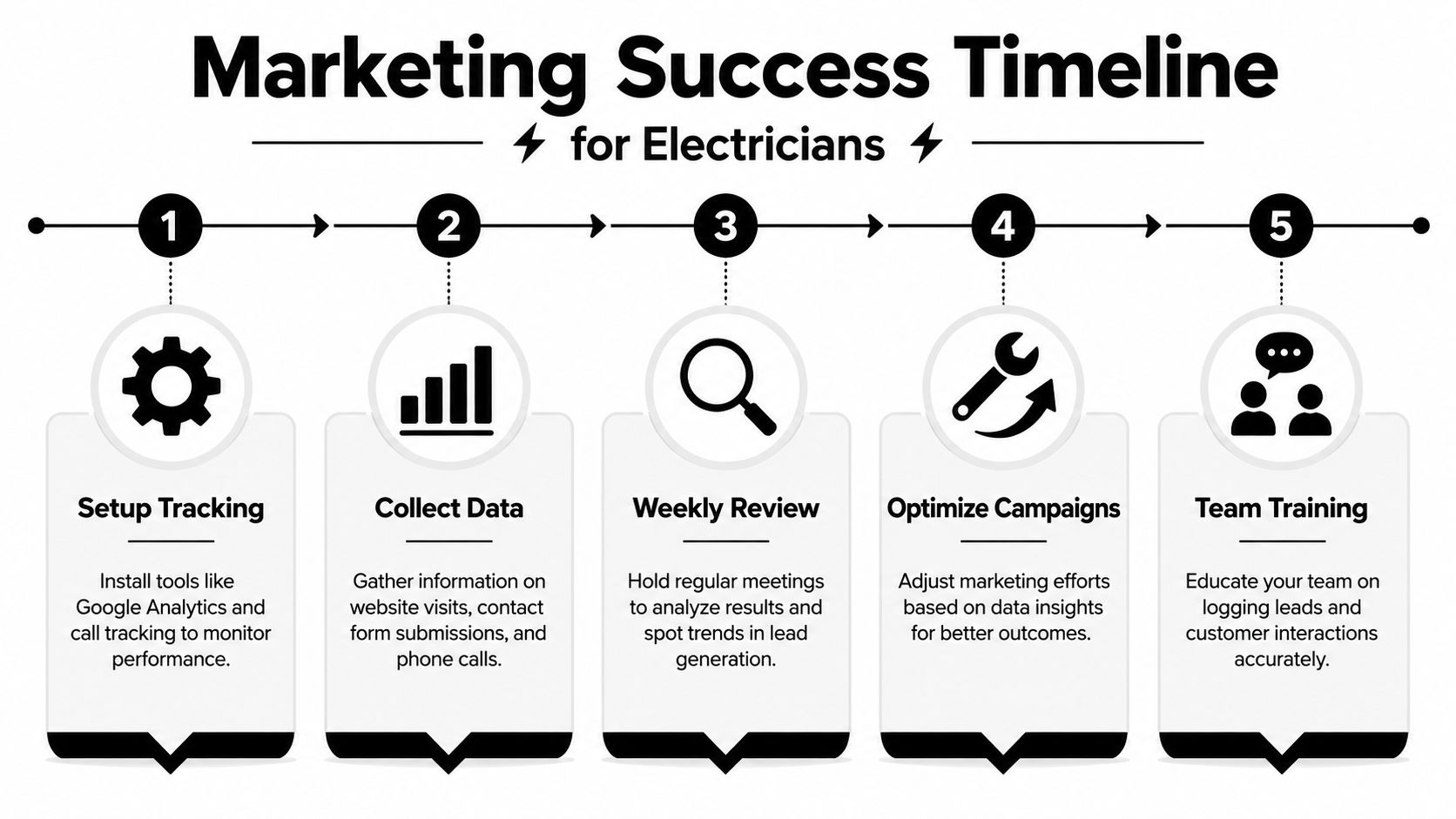
Don't obsess over likes, reach, or impressions. Those numbers don't pay for labour, fuel, or wages. Track enquiries, quotes, booked jobs, and which source produced them.
If a channel doesn't lead to booked work, it's a hobby. If it reliably leads to booked work, do more of it.
A simple rollout plan
Most electricians fail because they try to fix everything at once. Don't. Build this like a toolkit. One useful tool at a time.
A simple timeline looks like this:
- Month one: Fix your Google Business Profile. Complete every field, add real photos, and make sure your contact details are right.
- Month two: Tighten your website. Put your phone number at the top, shorten the contact form, and add reviews plus job photos.
- Month three: Start posting weekly. Keep it simple and local.
- Month four: Add paid promotion to your strongest service areas and best-performing service types.
- Ongoing: Ask every lead where they found you and review the answers weekly.
This approach works because it's manageable. You don't need a perfect marketing machine. You need a consistent one that helps more local customers find you, trust you, and contact you.
If you want help staying visible without having to write posts between jobs, GrowTradie is built for that exact problem. It creates and posts trade-specific content for your business automatically, so your socials stay active, your brand looks professional, and more local customers keep seeing your business while you focus on the work.