
You’re probably in the spot most painters hit sooner or later. A client asks for a price, you walk the job, you do some quick math in your head, and then you second-guess the number all the way home. Too high and you lose it. Too low and you win a job that eats your week and your profit.
That’s why learning how to price a painting job properly matters more than learning a clever sales line or a rough square foot shortcut. Good pricing isn’t instinct. It’s a system. The painters who stay profitable build that system around real job costs, real business costs, and real market feedback after the quote goes out.
Table of Contents
- Beyond the Square Foot Guess
- Calculating Your Foundational Costs
- How to Estimate Labor Without Guessing
- Adding Overheads and Building in Profit
- From Numbers to a Winning Quote
- Avoiding Common Pricing Traps
Beyond the Square Foot Guess
Most underpriced painting jobs start with the same mistake. Someone grabs a rough per-square-foot number, multiplies it by the floor plan, adds a little for paint, and sends the quote. It feels fast. It also misses the parts of the job that usually hurt you most, like prep, protection, access issues, extra coats, trim detail, and the time spent fixing what the client forgot to mention.
Professional estimators use a much simpler framework, but it’s far more reliable. Material Costs + Labor Costs + Overhead Costs = Total Project Cost, then you apply markup to reach the final estimate. That’s the method described by the Painting Contractors Association on estimating and bidding paint jobs, which also notes that markup commonly falls in the 20-30% range and that square-foot-only pricing often leads to underbidding.
That formula matters because it forces you to price the whole job, not just the visible parts.
Why square foot pricing keeps getting painters in trouble
Square footage can help as a reference point. It should not run the quote by itself.
A simple bedroom and a stairwell with high walls can measure similarly on paper, but they do not take the same effort. One might be straightforward rolling and cutting. The other might involve ladders, awkward angles, masking, repairs, and slower movement all day. If you charge them the same way, one of those jobs will punish you.
Practical rule: If your price comes from a shortcut before you’ve listed the actual work, you’re not estimating. You’re guessing.
The same problem shows up when painters multiply paint cost by a blanket number and call that a quote. That method ignores what usually drives the job.
The mindset shift that changes your margins
A profitable painting business doesn’t price to “stay busy.” It prices to cover delivery, protect margin, and leave room for the business to operate properly after the job is done.
That means every quote needs three layers:
- Direct materials for what you’ll consume on that project
- Labor for the time it takes your crew to complete every stage
- Overheads for the cost of running the business behind the scenes
Once you start pricing this way, the job gets clearer. You can see where profit is made, where it leaks, and which jobs look good on paper but don’t work in real life.
Calculating Your Foundational Costs
Materials are the easiest part to fake and the easiest part to get wrong. Painters often focus on the big-ticket item, the paint itself, and forget the long tail of smaller supplies that pile up across the week. If you want a quote to hold up, start with a complete takeoff.

Measure the work before you price it
Don’t measure a room loosely and hope the rest sorts itself out. Walk the space with a tape, laser measure, notebook, and camera. Record each paintable surface separately.
That usually means:
- Walls measured by length and height
- Ceilings measured by area
- Trim measured by linear footage or piece count
- Doors and frames counted individually
- Windows, baseboards, and built-ins noted as separate labor and material items
- Repairs and priming areas marked clearly
Subtracting openings can help in some spaces, but don’t get too clever with it. If a room has a lot of windows, cut-in edges, trim returns, and masking, the labor often stays high even when the paintable wall area drops. In practice, many painters lose more money from over-subtracting than from carrying a little extra material.
Build a complete materials list
Once the measurements are done, convert them into a list of what you’ll buy and use. Include the coating system, not just the finish coat.
A clean material list usually includes:
- Primer where needed for raw patches, stains, color changes, or adhesion problems
- Finish paint by surface type and sheen
- Caulk and filler for gaps, nail holes, dents, and trim movement
- Masking supplies like tape, paper, plastic, and drop sheets
- Application tools such as roller covers, sleeves, brushes, trays, and spray tips if relevant
- Surface prep supplies including sandpaper, abrasive pads, and patching materials
New painters usually undercount. They remember the wall paint. They forget the sundries. Then they do two supply runs, burn time, and absorb the cost.
Small materials don’t stay small when you miss them on every quote.
Price for the actual finish standard
A repaint with one color over a similar tone is one thing. A deep color change, stained trim conversion, patched walls, or smoke-damaged ceiling is another. The material list has to match the finish standard you promised.
If the job needs stronger coverage, more masking, or a full prime coat, write it into the quote and price it accordingly. If you leave that vague, the client hears one thing and your margin hears another.
A good habit is to write your material estimate in two passes:
| Check | What to review |
|---|---|
| First pass | Coatings, primers, fillers, caulk, masking, application tools |
| Second pass | Everything that gets forgotten, including touch-up supplies, replacement sleeves, extra plastic, and specialty consumables |
That second pass saves jobs.
How to Estimate Labor Without Guessing
Most painting quotes don’t fail because of paint cost. They fail on labor. That’s where small estimating mistakes turn into long days, rushed finishes, and jobs that looked profitable until the crew started.
Labor is also where experience matters most. According to the production rate guidance discussed in this painting estimate video, labor is the biggest variable in a painting estimate, and for a single room it can range from $150 for walls only up to $700 for a full room including ceilings and trim. The key is using production rates and checking them against actual job times, rather than borrowing random numbers and hoping they fit your crew.
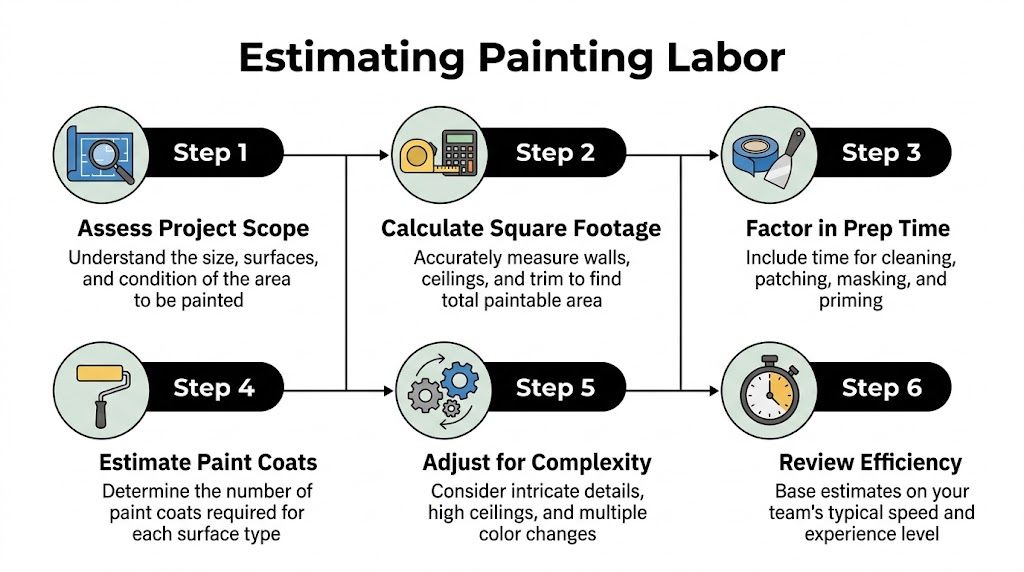
Break labor into stages
If you estimate labor as one lump sum, you’ll miss something. Break the job into stages and assign time to each one.
A practical labor breakdown looks like this:
-
Site setup and protection
Moving furniture, laying drops, masking floors, covering fixtures, setting ladders and tools. -
Surface preparation
Filling, sanding, scraping, caulking, spot priming, and dealing with defects that slow the whole job down if ignored. -
Application
Cutting in, rolling, spraying, back-rolling, trim work, doors, and detail passes. -
Dry-time dependent return work
Second coats, trim resets, hardware refit, and staged access where one area can’t be completed in one pass. -
Final detailing
Touch-ups, punch list corrections, client walk-through items. -
Pack-down
Removing masking, loading out, waste handling, and leaving the place presentable.
Many painters remember the application stage and underprice everything around it. The work before and after the roller touches the wall is where a lot of margin disappears.
A useful admin habit is tracking these stages the same way organized operators track jobs in field software. Even if you work small, a system mindset helps. Tools built for tradies in other trades, like job management apps used by electricians, are a reminder that estimating gets more accurate when the work is broken into repeatable parts.
Here’s a quick visual for the process:
Use your own production rates
Production rate means the speed your crew completes a specific task. Not a painter on social media. Not a number from a forum. Your crew.
That’s the difference between a quote that works and one that sounds good.
Start by building rates around tasks you do often:
- Rolling open wall areas
- Cutting in around ceilings and trim
- Painting baseboards and architraves
- Doors and frames
- Ceilings
- Prep-heavy work like patching and sanding
If one painter is fast on walls but slow on detailed trim, that matters. If two people work well together in occupied homes but lose time in empty repaints because one waits on the other, that matters too. Labor is not just hours. It’s workflow.
Check your estimate against real jobs
Your first set of production rates won’t be perfect. That’s normal. The fix is simple. Compare estimated hours against actual hours after every completed job.
Use a short review like this:
| Stage | Estimated time | Actual time | Why it changed |
|---|---|---|---|
| Prep | |||
| Application | |||
| Detailing | |||
| Pack-down |
After a few jobs, patterns show up. You’ll see whether your crew underestimates patching, loses time on color changes, or drags on trim-heavy rooms. That’s how labor stops being a gut-feel number and becomes something you can trust.
Adding Overheads and Building in Profit
A lot of painters think they’re making money because the job covered wages and materials. Then the insurance bill lands, the van needs repairs, tools need replacing, and the month suddenly looks thin. That happens when quotes cover the work but not the business.

Job cost is not business cost
Overheads are the costs you carry whether one brush moves that day or not. Think vehicle expenses, insurance, phones, software, quoting time, office admin, consumable tools, equipment replacement, and advertising.
If you don’t add overhead into the estimate, you’re personally absorbing those costs. That’s why some painters stay busy but never feel ahead.
The pricing guide from Housecall Pro on painting job pricing puts this in plain terms. Sustainable contractors target 20-40% net profit margins, and the effective hourly rate charged to clients often needs to be $50-$60 to cover a painter’s average $22.33 wage once insurance, equipment, transport, and other business costs are included.
That number surprises a lot of newer operators. It shouldn’t. Wage and charge-out rate are not the same thing.
Build your break-even first
Before profit, know your break-even.
A practical method is:
- Add labor cost for the estimated hours on the job
- Add materials
- Add overhead allocation based on how much business cost should be carried by that job
The same Housecall Pro pricing resource discusses a useful structure used by contractors: labor calculated from hourly wage, burden, and hours, then overhead allocated from monthly overhead divided by billable hours. That’s the right way to think about it even if your spreadsheet is simple.
Your quote should answer one question first. If you completed this job exactly as planned, what price would cover everything without losing money?
That is your break-even.
A break-even price is not a selling price. It is the floor below which the job starts taking from the business.
Profit is not what is left over
Profit needs to be built in on purpose. If you leave profit to chance, every surprise on site takes it away first.
The trade-off here is simple. A lower margin may help you win work faster, but it also leaves less room for callbacks, warranty issues, slower jobs, or a week where quoting time outpaces site time. A healthier margin gives the business breathing room.
Use this sequence:
- Calculate direct costs
- Add overhead
- Set your target profit
- Price the quote from that target, not from fear
Some contractors chase every job and end up training the market to expect a discount version of their service. Others price for the finish standard they deliver. The second group usually works with fewer nasty surprises because the quote already made room for reality.
If you want a business that can upgrade tools, keep reliable vehicles on the road, pay staff properly, and survive a bad month, profit isn’t optional. It belongs in the estimate before the client ever sees the number.
From Numbers to a Winning Quote
A good estimate can still lose if the quote looks vague, defensive, or hard to follow. Clients don’t need your whole spreadsheet. They need a clear scope, a clear price, and enough detail to understand what they’re paying for.
The quote should read like a work plan, not a text message with a dollar figure at the bottom.
What a client needs to see
Write the quote so there’s no confusion later. Include the areas being painted, what surfaces are included, what prep is included, what products are being used, how many coats are allowed for, and what is excluded.
Keep it tight, but specific.
A clean quote usually includes:
- Client and site details
- Scope of work with rooms or exterior elevations listed clearly
- Surface prep notes
- Coating system such as primer where needed and finish coats by surface
- Exclusions like major plaster repair, rotten timber replacement, or moving oversized furniture
- Total price
- Validity and start timing
- Payment terms
Clients compare clarity as much as price. A cheap quote that looks incomplete often raises doubts. A well-structured quote supports the number.
If you want your business presentation to look more polished online as well as on paper, tools that help tradies stay visible can support that trust factor. Something like content systems for local trade businesses won’t price the job for you, but it can help the business look more established when prospects check you out before approving the quote.
Sample Quote Breakdown
| Item | Description | Cost |
|---|---|---|
| Surface preparation | Fill minor defects, sand affected areas, mask and protect surrounding surfaces | |
| Materials | Primer, finish paint, caulk, fillers, tape, plastic, roller covers, brushes | |
| Labor | Application time for listed surfaces including setup and final touch-ups | |
| Overheads | Allocation for vehicle, insurance, admin, equipment, and operating costs | |
| Profit | Built-in margin for sustainable delivery and business growth | |
| Total | Final quoted price for approved scope |
That layout keeps the quote professional without overwhelming the client with internal math.
Use market rates as a check, not a method
Once you’ve built your quote properly, compare it against the broader market as a sanity check.
According to FieldPulse’s 2026 painting pricing guide, interior residential painting in the U.S. is typically priced at $1.25 to $5 per square foot, and the national average cost to paint a single room is about $1,900, with a range from $950 to $2,905. The same guide notes that labor usually makes up 75-85% of the total.
That kind of data helps you spot an estimate that is obviously out of line. It should not replace your own numbers.
If your quote is lower than your real costs because a broad average looked simpler, you’ve just turned a reference point into a pricing mistake. Use market rates to sense-check the result, not to build the result.
Avoiding Common Pricing Traps
The painful pricing mistakes are rarely dramatic. Most are small misses repeated over and over. A forgotten prime coat here. Uncharged repair time there. An hour lost collecting materials. Another hour moving furniture the client said would be gone before you arrived.

The mistakes that quietly kill margin
Watch for these first:
-
Prep written too loosely
If the quote says “prepare as needed,” clients often hear “fix everything.” -
Minor repairs treated as freebies
A lot of little defects still take real time. -
Travel and setup ignored
The brush isn’t the only thing you’re charging for. -
Complicated access not priced
High walls, stairs, tight rooms, and occupied homes slow production. -
Extra coats assumed away
Dark-to-light changes and problem surfaces don’t care what the original quote hoped for.
The job doesn’t have to be a disaster to lose money. It only has to take longer than you allowed.
Use your close rate to adjust prices
This is the part most painters never track, and it’s one of the most useful pricing tools you have.
If you quote regularly, your close rate tells you how the market is reacting to your prices. The overlooked guidance summarized in Angi’s discussion of what to charge for painting work is blunt: if your close rate is over 80%, you are severely underpriced. A close rate of 50-60% means you are slightly underpriced and likely have room to increase.
That matters because it turns pricing into a feedback loop.
Try this system:
- Track every quote by job type
- Record win or loss
- Review the pattern monthly
- Raise prices in categories you win too easily
- Keep notes on objections so you can separate price issues from trust issues
A painter winning nearly everything usually feels busy and assumes pricing is “about right.” In reality, the market may be telling him he’s too cheap. On the other hand, a lower close rate doesn’t automatically mean the number is wrong. Sometimes the quote is fine and the presentation is weak, the scope isn’t clear, or the wrong leads are coming in.
The point is to stop treating pricing as static. Build the quote from costs first. Then let actual win-rate data help you tune it.
GrowTradie helps trade businesses stay consistently visible without having to write and post content themselves. If you want more local prospects checking out your business, seeing a professional brand, and reaching out for quotes, have a look at GrowTradie.