
Your phone isn't ringing as often as it should. You know your work is solid. Your customers are happy once you get on site. The problem is simpler than most plumbers want to admit. Good operators still lose jobs if they're hard to find, hard to trust, or hard to contact.
That's what plumbing company marketing comes down to. Not logos, not fluffy posts, not generic “brand awareness.” It's getting found when someone has a problem, proving you're the safe choice, and making it easy to call you now.
Most plumbers don't need more tactics. They need a system they can keep running while they're quoting, ordering parts, driving between jobs, and managing the diary. That's the playbook below.
Table of Contents
- Be the First Plumber They Find
- Your Digital Hub a Website That Books Jobs
- Build Unbeatable Trust with Reviews and Referrals
- Get Emergency Calls with Smart Paid Advertising
- Stay Visible Without Wasting Time on Social Media
- Measure What Matters to Grow Your Business
Be the First Plumber They Find
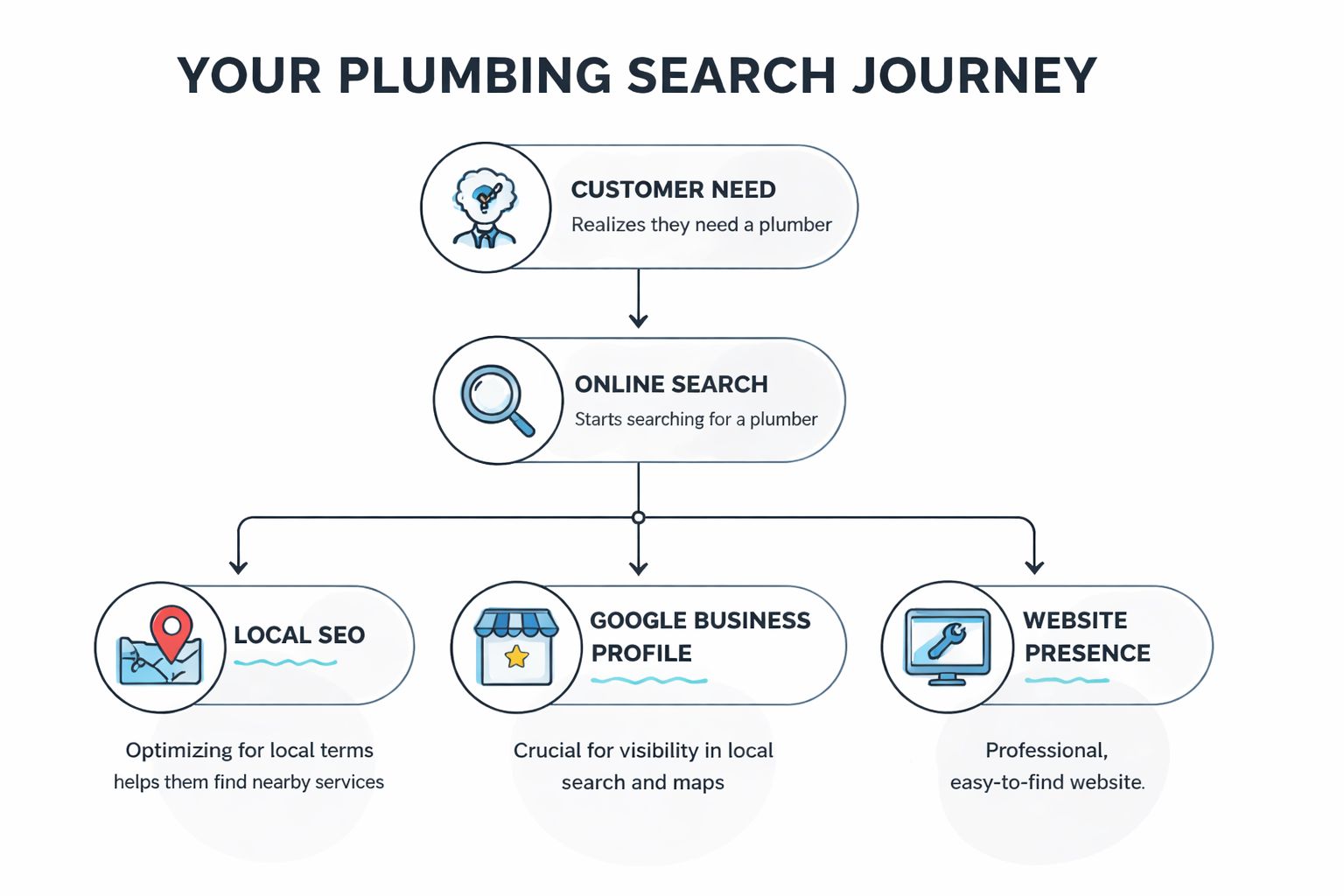
When someone has a burst pipe, blocked drain, or no hot water, they don't research for an hour. They search, scan, and call. That makes your Google Business Profile one of the highest-priority jobs in plumbing company marketing.
Getting this right is critical, as 46% of all Google searches are for local businesses, and 42% of those queries result in clicks on the Google Map Pack according to this plumbing marketing statistics roundup. If your profile is half-filled, outdated, or missing key details, you're making it easy for a competitor to win the call.
Claim and complete your profile properly
A lot of plumbers stop at “claimed.” That's not enough. Fill every field you can fill accurately.
Start with the basics. Business name, phone number, service area, hours, and website link all need to match what customers will see elsewhere. If your after-hours availability changes, update it. If you service three towns heavily and two only occasionally, set that up accurately.
Then build out the commercial detail customers use to judge you fast:
- Services listed clearly: Don't rely on “plumber” alone. Add your real service lines such as emergency plumbing, hot water systems, leak detection, toilet repairs, gas fitting if applicable, and commercial work.
- Photos that reduce doubt: Upload branded van photos, team photos, job photos, and clean shots of completed work. Skip stock-looking images.
- Business description: Write like a real operator. Say what areas you service, what types of jobs you handle, and what makes dealing with your company straightforward.
- Call-first details: Make sure the main number is the one someone should call right now, not the office line nobody answers after hours.
Practical rule: If a stressed customer can't confirm what you do, where you go, and how to contact you within a few seconds, your profile isn't finished.
For contractors who want a deeper breakdown of local visibility basics, this guide to local search setup for contractors is a useful companion.
Treat your profile like a live sales asset
A Google Business Profile isn't a listing you set once and forget. It behaves more like a storefront sign, dispatcher, and credibility check rolled into one.
That means you need a maintenance rhythm. Review it weekly. Check for wrong hours, unanswered reviews, missing photos, and outdated service details. Add fresh job photos regularly. Post updates when you have something real to say, like new service areas, seasonal service demand, or availability changes.
A simple weekly checklist works:
- Check calls and messages: Make sure enquiries are reaching the right person.
- Review business hours: Especially around holidays, weekends, and emergency coverage changes.
- Upload recent work: Fresh photos signal an active business.
- Read recent reviews: Respond while the job is still fresh in the customer's mind.
Customers don't care about platform jargon. They care that your profile looks current, legitimate, and easy to deal with. That's the standard.
Your Digital Hub a Website That Books Jobs
Once someone clicks through, your website has one job. Turn interest into contact. That's it.
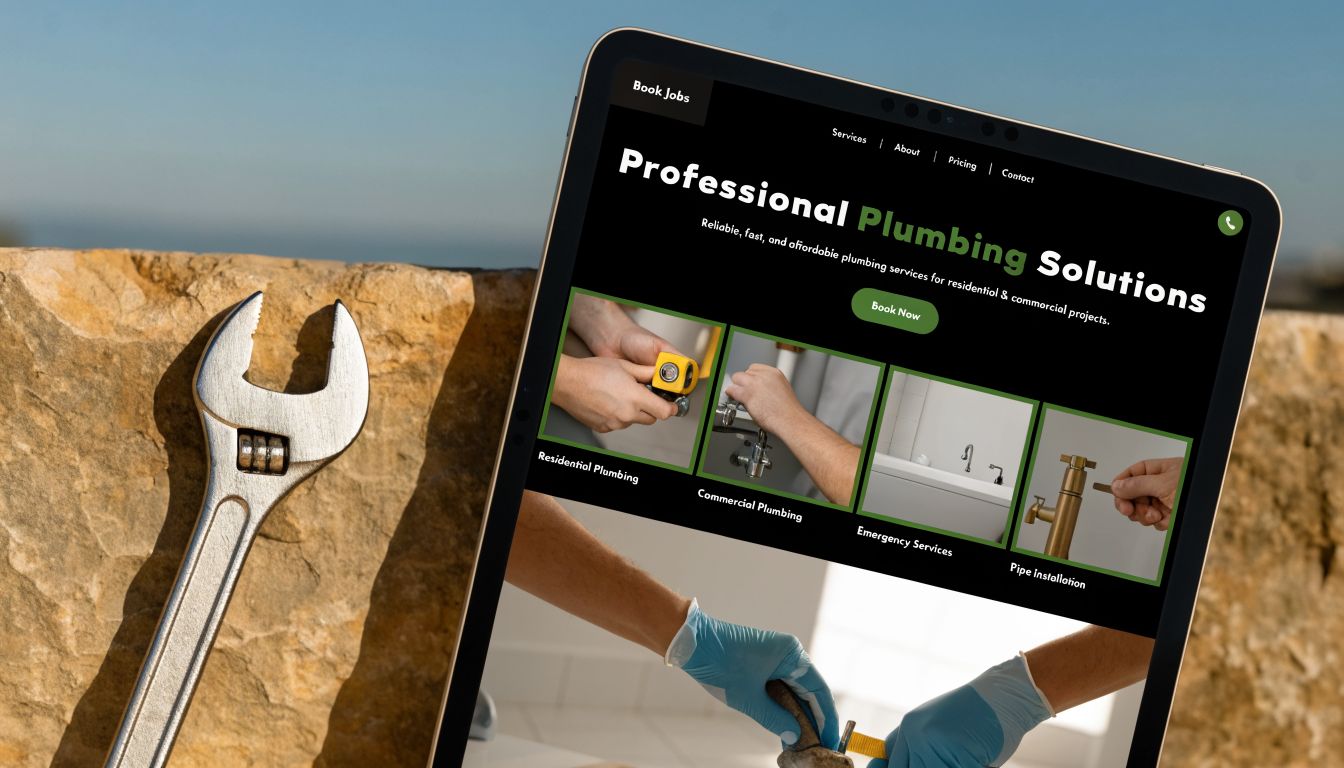
Too many plumbing sites try to look impressive and forget to be useful. Fancy animation, giant sliders, long welcome messages, and buried phone numbers all get in the way. A plumbing website should work like a good office manager. Answer the main questions fast, build confidence, and direct the visitor to call or enquire.
What every plumbing site must do on mobile
Most urgent customers are checking you on a phone, not sitting at a desk comparing ten companies. If your site makes them pinch, zoom, hunt for the number, or wait for oversized graphics to load, you lose.
The homepage should answer four things immediately:
| Question | What the site should show |
|---|---|
| Who are you | Business name, service area, and a clear headline |
| What do you do | Core plumbing services in plain language |
| Can I trust you | Reviews, licence details, accreditations, team photos |
| How do I contact you | Tap-to-call button and short enquiry form |
That structure beats “creative” layouts nearly every time because it matches how customers decide.
The three page elements that lift response
The best plumbing sites usually share the same bones.
First, contact options need to be impossible to miss. Put the phone number in the header, again near the top of the page, and again after service sections. Add a short form that asks only for what you need to respond fast. Name, phone, suburb, and job type is usually enough.
Second, trust needs proof. Use real team photos, van signage, licence numbers, insurance details, brand logos for products you install, and recent review snippets. Generic copy about “quality service” does nothing by itself.
Third, service pages need to match buying intent. Separate pages for emergency plumbing, hot water, blocked drains, leak repairs, and commercial plumbing help people confirm they're in the right place. Don't cram everything into one vague page.
A good plumbing website doesn't try to impress everyone. It reassures the right customer fast enough that they don't keep shopping.
One more point that gets missed. Every page should give the visitor an obvious next step. Call now. Request a quote. Book a visit. If the site reads like a brochure and not a booking tool, it's underperforming.
Build Unbeatable Trust with Reviews and Referrals
A plumber fixes the issue, sends the invoice, jumps to the next job, and means to ask for a review later. Later rarely happens. That gap costs work, because trust is what turns a good job into the next call, the next Google click, and the next referral.
In plumbing company marketing, reviews and referrals are not a side task. They are part of the job closeout process. People are letting you into their home or business, often under stress. They want proof from other customers that you turn up, solve the problem, and leave the place right.

Referral marketing works especially well in local service businesses because trust carries across households and job sites. Qualtrics explains that referred customers often arrive with stronger intent and a higher level of confidence than cold leads, which is exactly why plumbers should treat referrals as a system, not a bonus when they happen naturally (Qualtrics on referral marketing).
Ask at the point of relief
Timing matters more than wording.
The best moment to ask is right after the customer feels the result. The water is back on. The drain is cleared. The emergency is over. That is when they are most likely to follow through.
A simple process works better than a clever one:
- Ask on the day of the job: The tech mentions it in person once the work is complete.
- Send the link straight away: A text message gets a better response than hoping they remember later.
- Keep the ask short: “If you're happy with the job, could you leave us a quick Google review? It helps other local customers know we're reliable.”
- Tie it to admin: Add the review request to invoicing or job completion so it happens every time.
Time usually kills consistency. Owners get busy. Office staff forget. Techs remember on some jobs and skip it on others. Automation fixes that. If your CRM or software sends the review text as soon as the invoice is marked complete, the process keeps running even on your busiest days. That is the practical advantage time-poor plumbers need.
Respond like a business people can trust
A review profile with no replies looks unattended. A profile full of defensive replies looks worse.
For good reviews, thank the customer and mention the service in plain English. That helps future customers see the kind of work you do. For negative reviews, respond quickly, keep it calm, and offer a direct way to sort it out. The goal is not to win an argument in public. The goal is to show the next prospect that your business handles problems properly.
Use a simple response standard:
- Thank them by name if possible
- Mention the job type briefly
- Acknowledge any issue without arguing
- Give a direct next step to resolve it offline
Reviews also feed referrals. A customer who leaves a positive review is often the same person who recommends you to a neighbour, landlord, builder, or strata manager a month later.
If you want a practical system for turning finished jobs into more enquiries without adding admin, this guide to lead generation for plumbers shows how to set it up.
Get Emergency Calls with Smart Paid Advertising
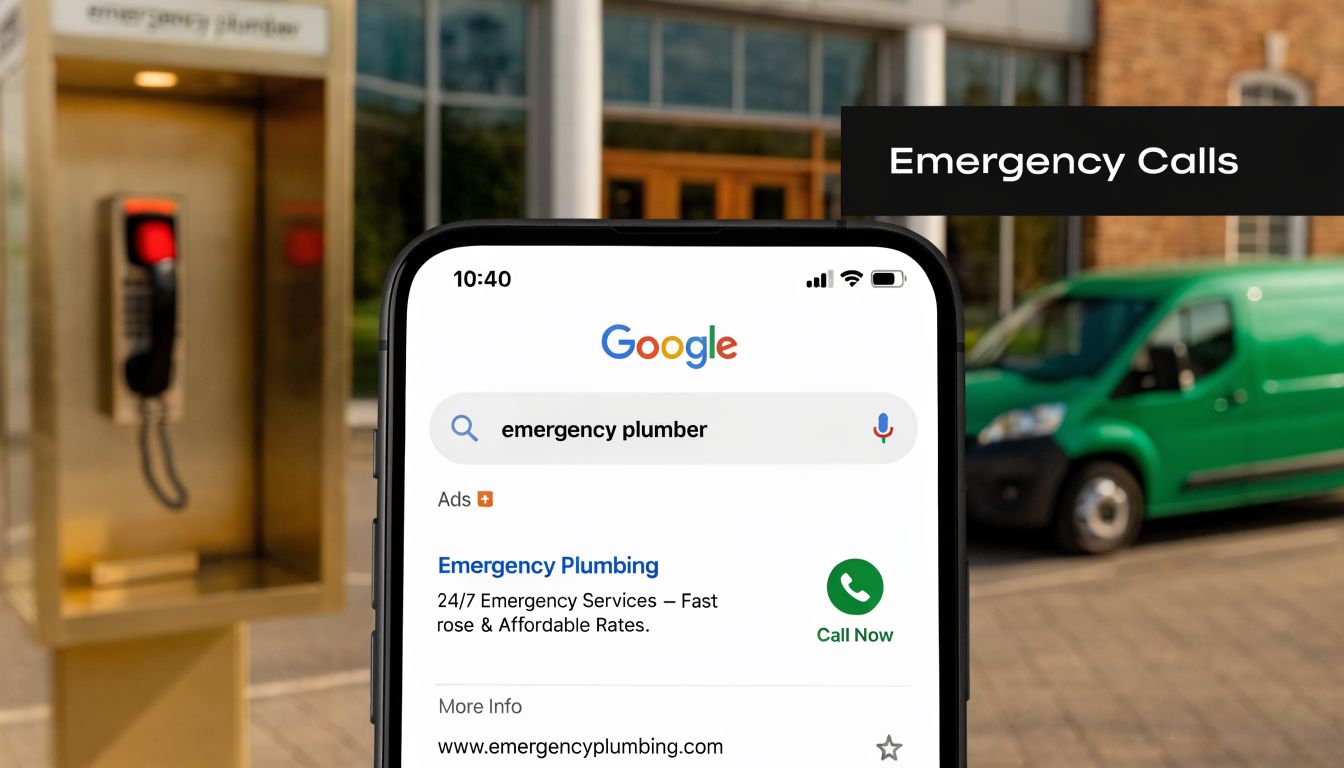
Paid ads are useful when you need demand now, not months from now. They work best for urgent, high-intent searches. Someone with a flooded bathroom is not browsing for entertainment. They need help and they need it quickly.
That's why paid search can be one of the sharpest tools in plumbing company marketing when it's tightly controlled.
Buy urgency not attention
The wrong way to run ads is broad, vague, and ego-driven. “Get our name out there” usually burns money. The right approach targets the searches most likely to become booked work.
Focus your campaign on service-led intent. Emergency plumber, burst pipe repair, blocked toilet plumber, no hot water plumber. Pair those with tight location targeting so your ads aren't showing outside the area you can service profitably.
A small campaign can outperform a bigger sloppy one if the match is right.
Here's the filter I use when judging whether a paid campaign deserves budget:
| Good signal | Bad signal |
|---|---|
| Searcher needs help now | Searcher is researching generally |
| Service area is tightly defined | Ads show across a wide, low-value radius |
| Ad copy matches the job type | Generic ads try to cover everything |
| Landing page has a direct call path | Traffic lands on a broad homepage |
Where plumbers waste money
The biggest leak in ad spend usually isn't the bid itself. It's irrelevant clicks.
By maintaining a list of negative keywords such as “DIY plumbing,” companies can reduce wasted ad spend by as much as 25-40% based on this paid plumbing marketing analysis. That means blocking searches from people looking for jobs, parts, training, free advice, or do-it-yourself fixes.
Useful negatives for many plumbing campaigns include job seekers, apprenticeships, courses, supplies, and DIY terms. The exact list depends on your market, but the discipline matters in every market.
If you don't tell the platform who you don't want, it will gladly spend your money finding them.
Ad copy matters too. Don't promise every plumbing service under the sun in one ad. Write ads around the problem type and make the next action obvious. Call now. Fast response. Local service area. Licensed team. Clear language beats clever language.
A more detailed breakdown of this channel is in this guide to PPC marketing for plumbers.
What to track before you scale
Before you increase budget, make sure the traffic is turning into booked jobs, not just clicks and calls.
Watch the basics closely:
- Lead quality: Are calls coming from real customers in your service area?
- Job type: Are you getting profitable work or low-value distractions?
- Booking outcome: Did the office convert the call into a job?
- Source match: Which keywords and ads produced the best enquiries?
This video gives a useful practical overview of how plumbers can think about paid search without overcomplicating it.
The trade-off with paid ads is simple. They can create fast demand, but they punish loose management. Tight targeting and disciplined exclusions make the difference.
Stay Visible Without Wasting Time on Social Media
Most plumbers don't ignore social media because they're lazy. They ignore it because the workday gets in the way. The phone rings, a job blows out, a supplier calls, and posting falls to the bottom of the list again.
That's why most trade accounts look abandoned. A few job photos. A holiday message from last year. Maybe one blurry van shot. Then silence.
Why most plumbing social accounts stall
The problem usually isn't ideas. It's consistency.
Social works best for plumbers as a visibility and trust channel. It helps people check that you're active, local, and legitimate. It supports the decision after someone has heard your name, seen your profile, or visited your site. What it usually doesn't reward is random posting whenever someone in the office remembers.
AI platform adoption has surged by 40% among home service businesses, and plumbers using scheduled, customized posts are seeing 25% more local enquiries than those relying on sporadic manual efforts according to this plumbing marketing article.
What consistent posting should actually do
You don't need to become a full-time content creator. You need a repeatable system that keeps your business visible without stealing hours from paid work.
The content itself can stay simple:
- Recent work updates: Finished installs, repair callouts, or before-and-after job summaries
- Local proof: Posts tied to the suburbs and areas you service
- Team presence: Techs, vans, workshop activity, and job-day snapshots
- Customer reassurance: Clear messages about response times, professionalism, and service types
A quiet profile makes people wonder whether the business is still active. A steady profile reassures them before they call.
Automation demonstrates its worth. If a platform can generate customized posts, schedule them, and keep your pages active in the background, it removes the biggest operational blocker. Time.
For a busy plumbing business, that's the ultimate win. Not chasing likes. Keeping your name in front of local customers and making sure that when they check you out, they see a business that looks alive, reliable, and current.
Measure What Matters to Grow Your Business
A plumber can stay flat out for a month and still have no clear idea which marketing is producing profitable work. The phone rings. Jobs get booked. Money comes in. Then a quieter patch hits, ad costs creep up, and nobody knows what to cut or what to back.
That is the problem measurement solves.
Without it, plumbing company marketing turns into a string of guesses. You keep paying for whatever looks busy, even if those leads do not book, come from the wrong areas, or only bring in low-value callouts.
Track the full path from lead to invoice
Start with source tracking. Use a different tracking number for each main channel if you can. If that feels like too much setup, ask every new lead how they found you and record it properly in your CRM, booking system, or even a shared spreadsheet. What matters is consistency.
The fields are simple, but they need to be there every time:
| Field | Why it matters |
|---|---|
| Lead source | Shows what created the enquiry |
| Service type | Helps you spot which channels bring better jobs |
| Suburb or area | Reveals where demand is strongest |
| Booked or not booked | Separates enquiries from actual work |
| Job value | Shows whether the source is commercially useful |
Clean habits beat fancy reporting.
I have seen plumbing businesses spend weeks fiddling with dashboards while the office team still forgets to log where the lead came from. That creates neat charts and bad decisions. A basic system that gets filled in properly is far more useful than a polished system nobody maintains.
The best marketing decision is often cutting the channel that cannot be tied to booked work.
A simple plumbing marketing scorecard
Use one scorecard and review it every month. Check it weekly if you are actively adjusting Google Ads or Local Services Ads. Anything less frequent than that leaves too much dead spend running.
Industry guides from providers like ServiceTitan's guide to plumbing advertising costs and ROI can give you a rough frame for what paid lead generation may cost, but benchmarks only help if you compare them against your own booked jobs, average invoice value, and close rate.
Track these five numbers:
- Leads by source: Google Business Profile, paid ads, referrals, social, website forms, and repeat customers.
- Booked jobs by source: Enquiries matter less than jobs that land on the schedule.
- Average job value: Some channels fill the day with small reactive work. Others bring higher-value installs or maintenance clients.
- Customer acquisition cost: What did you spend to win that customer?
- Repeat value: Some customers call once. Others turn into ongoing work, property managers, or strong referral sources.
The significant trade-offs become apparent. A cheaper lead source can look good until you see that half the jobs are low margin and rarely lead to repeat work. A more expensive source can still be the better bet if those customers book faster, spend more, and come back.
Time is usually the reason this tracking slips. The office is busy. The owner is on the tools. Nobody wants more admin at 6:30 pm. That is why a practical system matters more than a perfect one, and why automation matters. If your follow-up, posting, reminders, and lead capture run in the background through a tool like GrowTradie, your team has a much better shot at staying consistent with the numbers that matter.
Track the path from enquiry to invoice. Then spend more on what produces booked, profitable work, and cut the rest fast.