

You already know how to do electrical work. That's usually not the hard part.
The hard part starts when you realize going out on your own means answering the phone while you're on a ladder, pricing work without guessing, keeping paperwork straight, and getting paid fast enough to cover fuel, materials, and insurance. A lot of good electricians stall here. Not because they lack skill, but because the business side feels like a different trade entirely.
That hesitation is understandable. It's also worth pushing through. The U.S. electricians industry is projected to reach $347.5 billion in 2026 and includes about 262,000 businesses, which points to a large, fragmented market where small local operators can still compete on responsiveness, workmanship, and visibility according to IBISWorld's electricians industry outlook. Starting an electrician business isn't about becoming a corporate operator overnight. It's about building a tight, compliant, profitable local service business that runs cleanly from day one.
Table of Contents
- From the Tools to the Office Chair
- Laying the Foundation Legal and Financial Setup
- Gearing Up Your Tools Vehicle and Insurance
- Pricing Quoting and Getting Paid
- Winning Your First Jobs and Building Momentum
- Your First 6 Months A Startup Checklist
From the Tools to the Office Chair
Most electricians who think about going solo imagine the upside first. Better jobs. Better customers. Control over your schedule. Control over the standard of work. That part is real.
What catches people off guard is that the business doesn't fail because they can't wire a panel or track a fault. It fails because they underquote, ignore admin, buy too much too early, or wait for work to somehow appear. Starting an electrician business means shifting part of your week from the tools to the office chair, whether you like that part or not.
You're no longer just the technician. You're the estimator, scheduler, collector, purchaser, and the person responsible when a permit, invoice, or insurance document is missing.
That doesn't mean you need a fancy operation. It means you need a simple one that works. A clean business name helps, and if you're still stuck on that piece, this list of electrician business names is a practical place to start. Then you build around the basics that keep a first-year business alive: legal setup, cash control, reliable quoting, and a repeatable way to bring in work.
Laying the Foundation Legal and Financial Setup
A new electrical business can get into trouble before the first invoice goes out. It happens when the owner starts taking work under a name that is not registered properly, mixes personal and business money, or assumes their trade license automatically covers the company side.
The businesses that stay out of those holes usually start the same way. They get the registrations done, confirm the license path, open a separate bank account, and sort insurance before the first real job is booked. Unitel Voice's step by step guide to starting an electrician business lays out that order well. It is plain, but it works.
What changes when you become the owner
As an employee, your main risk is doing the job right and safely. As the owner, the risk widens fast. You are now the person responsible for tax records, contracts, permits, customer deposits, and whether the business is even allowed to trade.
That is why the early setup decisions matter more than the logo, the van wrap, or the website.
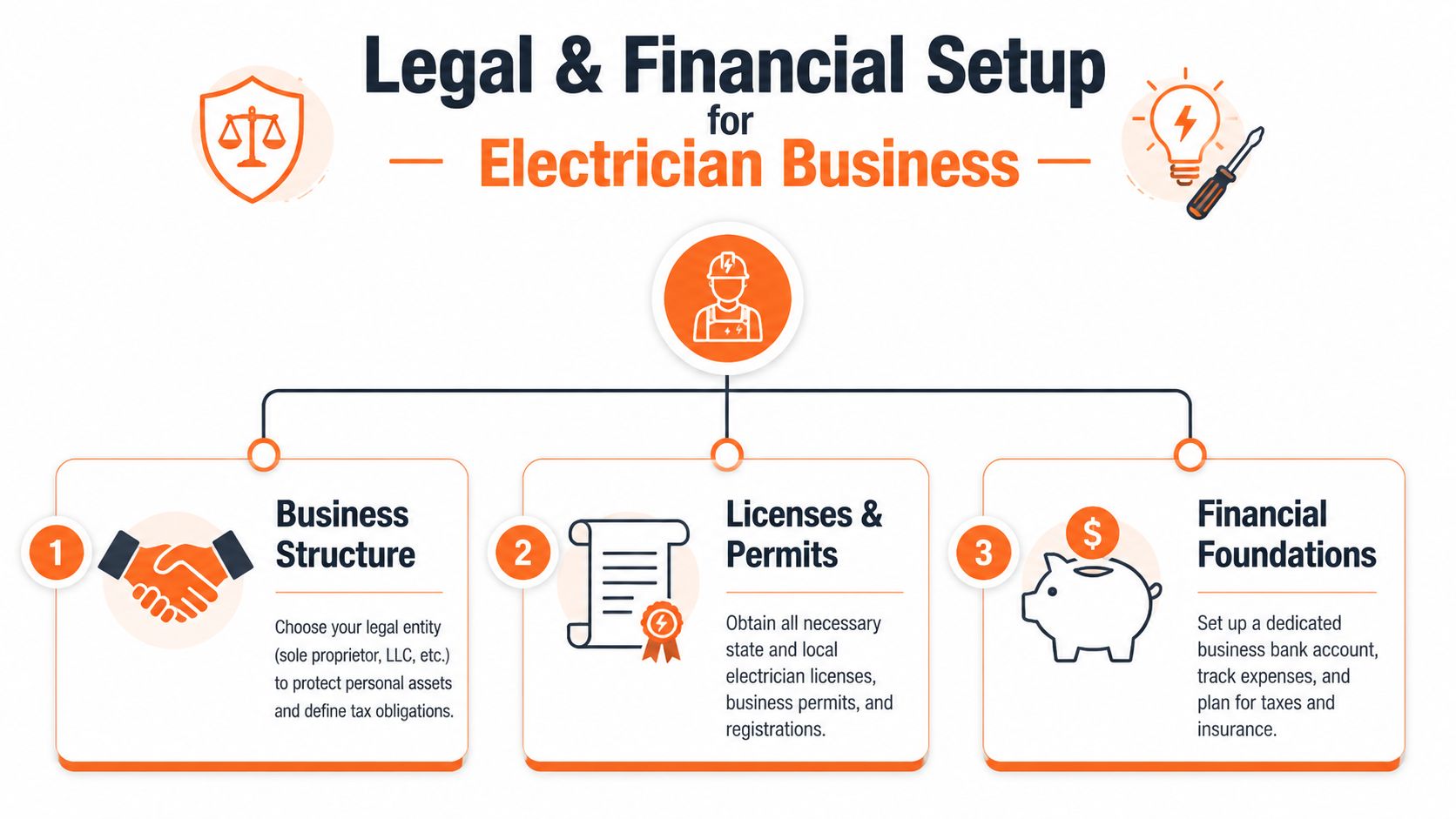
For many new electrical business owners, the first three decisions are these:
- Business structure: Choose a structure that fits your risk, tax position, and whether you plan to stay solo or hire. Keep it simple, but set it up cleanly from day one.
- Licensing path: Confirm which individual license, contractor license, registration, or supervising electrician requirement applies in your area before you advertise or quote.
- Financial separation: Open a dedicated business bank account and run every job cost, fuel bill, supplier payment, and customer payment through it.
Business Foundation Pillars
| Pillar | Key Decisions |
|---|---|
| Business Structure | Whether to operate as a sole proprietor, LLC, partnership, or another entity based on liability, taxes, and how you plan to grow |
| Licenses and Permits | Which electrician license, contractor registration, local permits, and tax registrations are required before taking work |
| Financial Foundations | Separate banking, expense tracking, tax planning, insurance setup, and a basic system for quotes and invoices |
Early overhead is rarely just tools and a van. Licensing fees, registrations, bookkeeping, insurance, and software all start showing up at once. If you do not account for them, you end up underfunded before the business has any rhythm.
A simple admin stack helps. Use one system for invoicing, one for bookkeeping, and one field workflow tool at most. If you are comparing options, these apps for electricians are a practical place to start.
Practical rule: If a purchase does not help you operate legally, collect money, or complete booked work safely, leave it out of month one.
The licensing question new owners often get wrong
A lot of bad advice mixes up two separate issues. One is whether you are qualified to perform electrical work. The other is whether you can own and run the company.
Those are related, but they are not always identical.
In many areas, the business needs a contractor license or a nominated qualified supervisor tied to it. The owner does not always have to be the person holding the highest trade credential. Some businesses are owned by someone focused on sales, admin, and growth, with a licensed electrician or responsible managing employee covering the technical side. Neighborly's overview of starting an electrical business explains that distinction.
This matters if you are in one of two camps. The first is the electrician who can do the work but has never dealt with the company side. The second is the founder who wants to build the business without personally being the lead electrician. Both models can work. Both can also go wrong if the licensing responsibility is vague.
Get the answer from your local licensing authority before you trade under a business name, apply for permits, or send quotes. Do not rely on forum advice or what another contractor told you over the counter at the wholesaler. One wrong assumption here can stall jobs, void cover, or leave you personally exposed.
Gearing Up Your Tools Vehicle and Insurance
New owners often overspend here because tools feel productive. Buying gear is easy. Preserving cash takes more discipline.

The smart move is to build your setup around the jobs you're booking. Industry guidance recommends targeting a 10% to 20% profit margin after expenses and staging tool purchases instead of buying expensive specialist equipment too early, as explained in Kickserv's guide for starting your electrician business. That's the difference between a lean launch and a van full of gear that hasn't paid for itself.
Buy for the work you have
You need a solid everyday loadout from day one. You do not need every specialty tester, every press tool, or every niche kit before the phone starts ringing.
A practical first setup usually looks like this:
- Daily hand tools: Quality screwdrivers, pliers, side cutters, strippers, crimpers, nut drivers, tape measures, knives, levels.
- Core test gear: A dependable multimeter, voltage tester, and the instruments you need for the work you are taking on.
- Access and safety gear: Ladders, PPE, lights, gloves, and site protection that let you work safely and leave a clean impression.
- Common consumables: Fasteners, connectors, tapes, clips, and other small items that stop you losing time on routine callouts.
Hold off on specialist purchases until the job is won or the work type becomes regular. If you only need a niche tool occasionally, hire it, borrow it from a trusted supplier relationship, or price the purchase into a confirmed job if that fits your market.
Your van is part stockroom part billboard part workshop
A flashy vehicle doesn't make you money. A reliable, organized one does.
Used versus new comes down to your cash position and tolerance for downtime. A used van can make perfect sense if it's mechanically sound and you keep enough reserve for repairs. A new van may reduce maintenance headaches, but it also raises your fixed pressure in the months when work volume is still settling in.
What matters more than the age of the van is how it's set up.
- Shelving and bins: If you can't find parts fast, you'll bleed time on every job.
- Secure storage: Loose tools get damaged, stolen, or left behind.
- Stock discipline: Carry the parts you use often, not half a wholesaler branch.
- Presentation: A clean van signals a clean operator. Customers notice.
If you want help keeping admin and field work from becoming chaotic, many electricians rely on job management tools for scheduling, quotes, and invoices. Some also use support tools for communication and visibility, including apps for electricians that fit a small trade business.
Insurance is part of the job not a paperwork extra
Insurance isn't something you sort out after you've landed work. It's part of being fit to trade.
At minimum, think in terms of three exposures. Damage or injury on site. Problems involving the work vehicle. The risk that an employee or subcontractor arrangement creates once you stop working alone. The exact policies depend on where you operate and how your business is structured, but the principle is simple. One uninsured incident can wipe out months of effort.
Here's a useful way to judge any cost in the setup stage. Ask whether it protects revenue, protects the business, or supports delivery. Insurance does all three.
A quick visual on vehicle and field setup is worth watching if you're still deciding what belongs in your first-year operation.
Pricing Quoting and Getting Paid
Friday afternoon. You finish a small switchboard job, send the invoice from the van, and realise there is barely any money left after materials, travel, and the two hours you lost picking up parts. The job felt busy. It just was not profitable.
That is how first-year electrical businesses get squeezed. The calendar looks full, but cash stays tight because the rate was built around wages, not around running a business. Your price has to cover labour, yes, but also quoting time, call time, travel, consumables, insurances, vehicle costs, software, mistakes, and the jobs that blow out.
A lot of sparkies undercharge early because they are trying to win the work and prove themselves. I get the instinct. It still puts you in a hole. Cheap work is hard to fix later because customers get used to the number, not the effort behind it.
Hourly versus fixed price
Use hourly rates where the risk is unknown. Fault finding, intermittent issues, and any job where the actual problem only shows up once you start opening things up belongs here. The customer can still have cost control if you set expectations properly. Give them a callout fee, an hourly rate after that, and a point where you will stop and get approval before going further.
Use fixed prices where the scope is clear and repeatable. Standard installs, fitting replacements, common upgrades, and well-defined small works are usually better quoted as a set price. Customers like knowing the number upfront, and you can often make better margin on work you know well.
The mistake is mixing the two.
If you fix-price a job with fuzzy scope, you carry all the risk. If you charge hourly for simple repeat work, the customer feels exposed and starts watching the clock instead of listening to your advice.
Build your price from the job backwards
Start with actual labour time. Then add the parts, the collection time, disposal, testing, certification, and a margin for the small things that always turn up. Add overhead properly. That includes the hours nobody sees, like quoting after dinner, chasing approvals, and sorting supplier issues.
Then ask one hard question. If this job goes slightly wrong, do I still make money?
If the answer is no, the quote is too cheap.
Early on, it helps to stay inside a narrower service mix because pricing gets easier once you know your production rate. If you are still working out which jobs to target, this guide to electrician lead generation strategies that suit a small trade business can help you focus on work that is easier to quote and deliver well.
What a professional quote needs to do
A quote is a sales tool, but it is also protection. It sets the rules before the job starts.
Good quotes are clear enough that a customer can understand them and tight enough that you can defend them later. Plain language wins here. Skip the fluff. Spell out what you are doing, what materials you have allowed for, what is excluded, and what happens if the scope changes after you begin.
A solid quote should cover:
- Scope of work: The actual tasks you will complete.
- Materials allowance: Whether supply is included and what standard or brand range you have priced.
- Exclusions: Making good, patching, permits, access equipment, after-hours work, or fault rectification outside the stated scope.
- Variations: How extra work will be approved and charged.
- Payment terms: Deposit, progress claim if needed, and final payment due date.
- Validity period: How long the price stands before material costs are reviewed.
Often, significant margin is lost. The customer says, "While you're here," and the new business owner folds extra work into the original price because it feels awkward to push back. Do that a few times a week and your quote becomes fiction.
Getting paid without chasing people for weeks
Payment terms need to match the size and risk of the job. Small same-day jobs can often be invoiced on completion and paid immediately. Larger work usually needs a deposit for materials and staged payments if the project runs over more than a few days. Waiting until the end of a long job to bill everything puts all the pressure on you.
Invoice fast. Same day is best.
Fast invoicing does two things. It keeps cash moving, and it tells the customer you run a proper operation. Slow invoicing usually leads to slow payment, missing paperwork, and awkward follow-up calls when the memory of the job has already faded.
One more trade-off matters here. Strict payment terms can cost you a few jobs. Weak payment terms can cost you the business. In the first year, cash flow matters more than looking easygoing.
Winning Your First Jobs and Building Momentum
A new electrical business doesn't need every job in town. It needs enough of the right jobs, done well, for the next job to come easier than the last one.
That changes how you should think about early lead flow. Don't chase every service type, every suburb, and every kind of customer on day one. Pick the work you can deliver confidently, price cleanly, and complete without drama. A narrow start is easier to sell than a vague promise to do everything.

Be easy to find and easy to trust
Most first customers aren't looking for a brand story. They want reassurance. Can this person do the work, communicate properly, turn up, and invoice like a professional?
That means your basics matter:
- Business listings: Make sure your business details are consistent wherever customers might find you.
- Phone handling: Answer when you can. If you can't, return calls quickly.
- Simple website or landing page: List your services, service area, contact details, and licensing information where appropriate.
- Job photos: Show finished work, tidy installs, and professional presentation.
- Clear service focus: “Residential upgrades and fault finding” is easier to trust than a vague list of everything under the sun.
One practical support option for keeping your online presence active is electrician lead generation tools. GrowTradie, for example, is built for trade businesses and handles social post creation and auto-posting so your profiles don't sit silent while you're on the tools.
Referrals come from process not luck
Word of mouth sounds organic, but the businesses that get it consistently usually do the same few things every time.
They communicate before arrival. They explain the problem clearly. They leave the site tidy. They send the invoice cleanly. They follow up. Then they ask for the review or referral while the customer still remembers how easy the whole job felt.
A customer rarely says, “He owned every specialist tool.” They say, “He showed up when he said he would, explained it properly, and sorted it.”
That's why small local operators can win work even against larger firms. Customers compare reliability and clarity long before they compare scale.
Simple posting beats disappearing for weeks
You don't need to become a content machine. You do need to stay visible enough that local customers and referral partners remember you exist.
Keep it practical. Post a completed switchboard upgrade. Share a photo of a tidy van setup. Show a before-and-after of a lighting job. Mention the suburb if that suits your market. Keep the tone plain and professional.
If you aren't the licensed electrician yourself, visibility still matters. You may be building the company around licensed staff, a responsible managing employee, or another compliant structure. As noted earlier, ownership and technical execution don't always have to sit with the same person, as long as the business is structured correctly and qualified licensed electricians are doing the work.
The worst early-stage approach is inconsistency. Businesses go quiet for weeks, then panic and try everything at once. Steady beats dramatic. One good job documented well can bring in the next call, the next review, and the next referral partner conversation.
Your First 6 Months A Startup Checklist
The first six months decide what kind of business you're building. Not in a dramatic way. In the boring, daily way that matters.
You're trying to prove three things to yourself. First, the business is compliant and insurable. Second, your pricing covers reality. Third, your work pipeline doesn't depend on luck. If one of those is weak, the cracks show early.

Month one is about control
Get the core setup locked down before you chase volume.
- Compliance first: Confirm registrations, licenses, permits, and insurance are current.
- Money visibility: Use dedicated banking, track every expense, and know what unpaid quotes and invoices are sitting out there.
- Operational basics: Have a quoting process, invoicing process, scheduling method, and customer record system that you will consistently use.
- Van and tool discipline: Keep only what helps you deliver booked work safely and efficiently.
Months two through six are about discipline
Many owners frequently drift. They get busy and stop managing. Don't do that.
Keep a short operating checklist:
- Review every quote before sending it. Make sure scope, exclusions, and payment terms are clear.
- Track job profitability. Not with guesswork. With notes after the job while it's still fresh.
- Protect the calendar. Leave room for quoting, admin, supplier runs, and customer calls.
- Ask for reviews consistently. The right time is right after a smooth job.
- Build safety habits early. Good habits are easier to keep than to rebuild later.
- Think before hiring. An apprentice or first hire should remove a bottleneck, not create new confusion.
A healthy first-year electrical business usually doesn't look glamorous. It looks organized. Customers know what to expect. Work is priced properly. Tools are where they should be. Paperwork is current. Cash isn't leaking out through sloppy buying or weak quoting.
That's what survival and growth usually look like when starting an electrician business. Not hype. Control.
If you want a simpler way to stay visible while you're busy running jobs, GrowTradie helps trade businesses create and publish social content without having to write posts themselves. It's a practical fit for electricians who want steady local visibility and a more consistent online presence without adding another admin job to the week.