

Some weeks you're flat out. The van's loaded, the phone won't stop, and you're quoting at night just to keep up. Then it goes quiet. Not because you're a worse electrician than last month, but because most tradies don't have a steady system for getting found and turning enquiries into booked jobs.
That's a significant problem with electrician lead generation. It isn't usually skill on the tools. It's inconsistency in visibility, trust, and follow-up. Good operators still lose work because they rely too much on word of mouth, leave their online presence half-finished, or miss calls while they're on site.
If you're busy enough already, that's good news. You don't need to become a marketer. You need a few simple actions done properly, then a repeatable routine that keeps the phone ringing without chewing up your evenings. The best lead systems aren't flashy. They make it easy for local customers to find you, trust you, contact you, and hear back quickly.
Table of Contents
- Introduction The End of the Feast-or-Famine Cycle
- Quick Wins to Get Your Phone Ringing This Week
- Setting Up Your Online Job Magnets
- Simple Content That Builds Trust and Attracts Work
- Turning Enquiries into Booked Jobs The Follow-Up Playbook
- Simple Tracking to Know What Is Actually Working
- Conclusion Consistency Beats Complexity
Introduction The End of the Feast-or-Famine Cycle
Most electricians know the feast-or-famine cycle too well. When work is flowing, marketing gets ignored because there isn't time. When work slows down, panic kicks in and everything gets tried at once. A few directory listings. A boosted post. Maybe some ads. Then nothing is tracked, so it's hard to tell what brought in work.
That cycle keeps good businesses stuck. You end up reacting to gaps instead of building a steady pipeline. The fix isn't doing more random promotion. It's putting a basic lead system in place that keeps working when you're on site, quoting, or dealing with admin.
Electrician lead generation has shifted hard toward digital discovery, especially local search, reviews, and directory visibility. A properly set up Google Business Profile helps electricians appear in local results and drive calls, and 28% of new contractor leads come from online directories according to WebFX's electrician lead generation guide. That means customers aren't just asking a neighbour anymore. They're checking Maps, reviews, and listings right when they need help.
Practical rule: If someone can't quickly see where you work, what you do, and how to call you, you're losing leads before the phone ever rings.
The upside is that this can be fixed with straightforward actions. Start with the free visibility pieces. Add one paid channel if you want faster lead flow. Then tighten the handoff so enquiries don't leak out through missed calls, slow replies, or forgotten quotes.
That's how you get off the rollercoaster. Not with jargon. With a practical system that makes it easier for the right customers to find you and easier for you to convert them.
Quick Wins to Get Your Phone Ringing This Week
The fastest wins usually aren't clever. They're the jobs you've made too hard for customers to book.
If someone searches for an electrician tonight, they're making a quick decision. They want to see a legit business, a working phone number, recent activity, and some proof that other people trusted you. They do not want to hunt around your profile, guess whether you service their suburb, or fill in a clunky form.
Fix the basics people check before they call
Start with your Google Business Profile. Treat it like your digital shopfront.
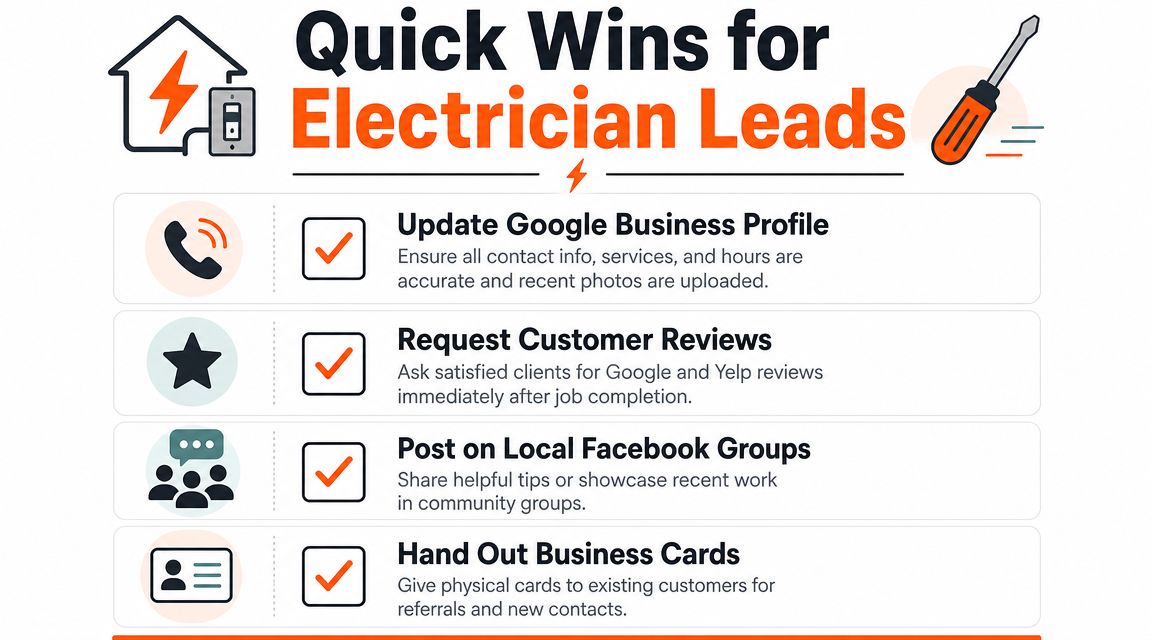
Run through this checklist today:
- Check your business name and phone number: Make sure they match everywhere your business appears.
- Tighten your service list: List real jobs you want more of, such as switchboard upgrades, fault finding, smoke alarms, EV chargers, lighting, or emergency call-outs.
- Add service areas clearly: Customers need to know you work in their suburb.
- Upload current photos: Van, team, switchboard work, lighting installs, neat finished jobs.
- Set real hours: If you don't answer after hours, don't pretend you do.
Then look at every major directory you're on. If your details are outdated on one platform and correct on another, customers notice. They may not ring at all.
Ask for reviews while the relief is fresh
Reviews are easiest to get right after you've solved a problem. The lights are back on. The oven circuit is fixed. The rental is compliant. That's when the customer feels the value.
Keep the ask simple:
“Glad we got that sorted for you. If you're happy with the job, a quick Google review really helps local customers find us.”
Send the review link by text before you drive away if possible. If you leave it for later, the moment passes.
A few recent reviews beat a profile that looks abandoned. The same goes for reply habits. Thank people, stay professional, and don't overthink it.
Use every offline touchpoint properly
A lot of electricians overlook the low-tech stuff that still works.
Your van should answer three questions in two seconds:
| What people need to know | What to put on the van |
|---|---|
| Who you are | Business name |
| What you do | Clear service label like Electrician or Emergency Electrical |
| How to contact you | Phone number and website |
On site signage matters too. If you're doing a longer job, a visible sign can trigger neighbour enquiries. Business cards still help when handed to a happy customer and said with one line: “If anyone asks for an electrician, feel free to pass this on.”
Past clients are another quick win. Send a short check-in text or email to previous customers, builders, real estate contacts, and property managers. Keep it direct:
- For past residential clients: “Just letting you know we're booking electrical work in the area this month. If you need anything checked or upgraded, reply here.”
- For builders and trades: “We've got room in the schedule for electrical work over the next couple of weeks. If you've got anything coming up, send it through.”
- For property managers: “Available for maintenance, faults, smoke alarms, and urgent electrical issues. Happy to help with overflow work.”
None of this is fancy. That's why it works. It removes friction and puts your name in front of people already close to booking.
Setting Up Your Online Job Magnets
Free visibility gets you in the game. Paid channels help when you want lead flow on demand.
The mistake is jumping into ads without knowing what each platform is built for. Electrician lead generation works best when the channel matches the job type. Urgent fault work is different from promoting switchboard upgrades or EV charger installs. Use the wrong platform and you pay for attention that doesn't turn into calls.
Pick the right paid channel for the job
This comparison keeps it simple.
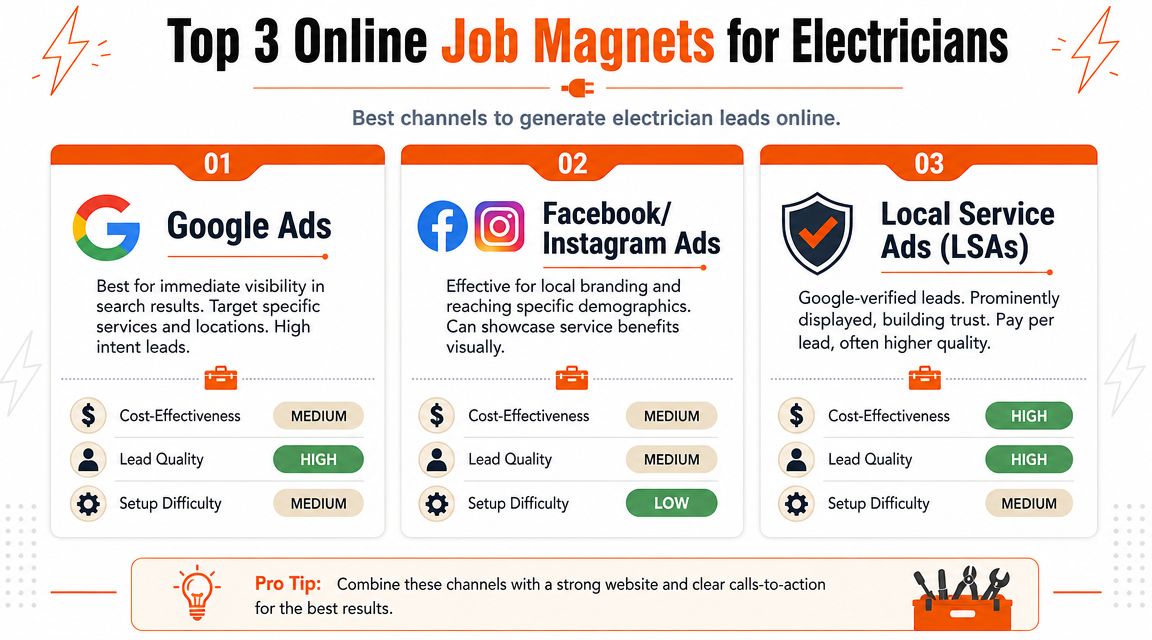
| Channel | Best for | Strength | Trade-off |
|---|---|---|---|
| Google Local Services Ads | Urgent local jobs | Strong trust, pay per lead model | Verification takes effort |
| Google Ads | Specific high-value services | Good control over suburb and service targeting | Can waste spend if too broad |
| Facebook and Instagram Ads | Local awareness and reminder marketing | Useful for staying visible in selected postcodes | Lower urgency than search-driven leads |
A lot of tradies ask which one is best. Wrong question. The right question is which one fits the work you want.
Later in the section, this video gives a broader look at online lead generation options for tradies.
What each channel is good at
Local Services Ads are the closest thing to a fast lane for local service leads. They sit prominently and are built for people ready to contact someone now. If you do emergency or high-intent residential work, this is often the first paid option worth testing.
Google Ads work well when you want to target a specific service rather than every job under the sun. Think “EV charger installation”, “ceiling fan installation”, or “switchboard upgrade electrician” in selected service areas. Narrow targeting beats broad targeting almost every time.
Facebook and Instagram ads are different. They're not usually where someone goes in a panic with no power. They're better for staying visible with homeowners in your area, reminding them you exist before the need becomes urgent. A seasonal safety check, landlord compliance reminder, or before-and-after project can work well here.
Paid ads don't fix a weak business profile, thin reviews, or slow response times. They just send more people into that weak system.
Keep your setup simple
Don't launch three channels at once. Pick one and build around your best jobs.
A workable approach looks like this:
- Choose one service first: Emergency call-outs, EV chargers, smoke alarms, switchboards, or lighting upgrades.
- Choose one area: Your strongest suburbs or the postcodes closest to your crew.
- Send leads to one clear contact point: A direct phone call is often best for urgent work.
- Make sure someone answers fast: Ads fail when the phone rings out.
If you want a practical breakdown of improving local visibility for trade businesses, this guide on local search visibility for contractors is useful.
And here's the video mentioned above:
Keep your expectations realistic. Paid channels are job magnets, not magic. They work when the service, area, ad message, and response process all line up.
Simple Content That Builds Trust and Attracts Work
A lot of electricians avoid posting because they think every post needs to be polished, clever, or filmed like a commercial. It doesn't.
The kind of content that wins work is usually simple proof that you're active, local, and competent. Customers don't need entertainment. They need reasons to trust you before they call. And consistent posting does make a difference. Businesses that publish content at least monthly are reported to generate 67% more leads than those that don't, according to Amra and Elma's electrical marketing statistics.
Post the kind of proof customers actually care about
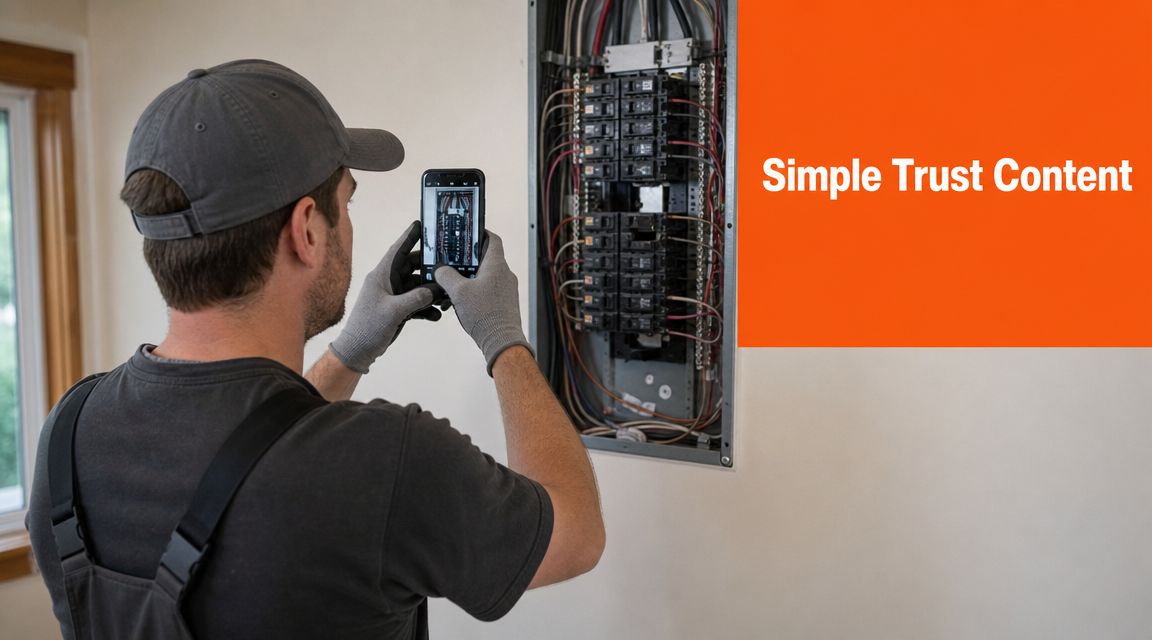
Four content pillars are enough for most tradies:
- Show your work: Clean switchboard upgrades, outdoor lighting installs, EV charger jobs, fault finding, smoke alarm replacements.
- Share your knowledge: Short safety tips, signs a fitting needs replacing, what to do before calling an electrician.
- Back your local area: Mention the suburb, the type of property, or another local business involved in the job.
- Show the person behind the business: Van photos, team on site, tools packed for the day, a quick update between jobs.
This works because it answers silent customer questions. Are you active? Are you real? Do you do the sort of work I need? Do other people trust you enough to let you into their home or business?
Customers don't need daily posting. They need enough recent activity to feel confident you're established and still operating.
A simple weekly posting rhythm
You do not need to post every day. Two or three times a week is plenty if the posts are relevant and current.
Try this rhythm:
| Day | Post type | Example |
|---|---|---|
| Monday | Recent job | “Completed a switchboard upgrade in Belmont today” |
| Wednesday | Helpful advice | “Three signs your outdoor lighting needs attention” |
| Friday | Local trust post | “Working across Geelong this week. Thanks to our clients for keeping us busy” |
If writing captions slows you down, use a repeatable format. Job done. Problem solved. Area. Call to action.
For tradies who want help keeping content consistent without writing it all themselves, this guide on content marketing for contractors is worth reading.
Easy post ideas you can reuse
Use short formats you can create in minutes:
- Before and after: Old fitting, new fitting, short note on what changed.
- On-site photo: “Fault found and repaired today in [suburb].”
- Quick tip: “If your circuit keeps tripping, stop resetting it over and over. Get it checked.”
- Customer reassurance post: “Licensed, tidy, and focused on safe work that lasts.”
- Local connection post: “Great working with another local trade on this renovation.”
You don't need to explain every technical detail. In fact, overexplaining can lose people. Keep it simple, visual, and local. The point isn't to impress other electricians. It's to give future customers enough confidence to call you first.
Turning Enquiries into Booked Jobs The Follow-Up Playbook
A lot of money gets wasted after the lead arrives.
The biggest issue for many service businesses isn't a lack of leads. It's lead leakage, where paid-for or hard-won enquiries never turn into booked work because the reply was slow, the call was missed, or the quote was never followed up. That's the core problem highlighted in ServiceTitan's guide to electrical leads. If a customer contacts several electricians after a local search, the one who responds first has a clear advantage.
Speed wins more jobs than clever copy
Many electricians often lose easy work. They're flat out on site, the phone rings, voicemail kicks in, and the customer moves to the next number.
You don't need a complicated system. You need a basic response process that runs the same way every time.
Set up these essentials:
- Clickable phone number on your website: Mobile users shouldn't need to copy and paste.
- Short contact form: Name, phone, suburb, and job type is enough.
- Voicemail that sounds live and useful: Tell callers what to do next.
- A same-day callback habit: Even if you can't quote yet, acknowledge the enquiry.
If you use email follow-up to keep warm leads moving, this practical resource on electrician email marketing can help.
Use a basic response flow
A simple follow-up workflow beats good intentions.
- Missed call comes in
Call back as soon as you can. - No answer
Send a short text straight away. - Website form arrives
Reply fast with a call if the job looks urgent. - Quote sent
Follow up if there's no reply. - No decision yet
Check back once more, professionally.
A weak follow-up process usually looks like this: quote sent, silence, then nothing. A strong one keeps the conversation alive without sounding desperate.
Scripts that sound normal
Use wording that fits how real tradies talk.
I saw your enquiry come through. I'm on a job at the moment but can help. Send me your suburb and a quick note on the issue, and I'll call you back shortly.
For missed calls by text:
- Short and direct: “Hi, it's [Name] from [Business]. Sorry I missed your call. What electrical issue do you need help with?”
- If you're booked today: “I'm tied up on site right now but happy to help. Send through the job details and your suburb and I'll get back to you.”
- After sending a quote: “Just checking you've received the quote. Let me know if you'd like to go ahead or if you want me to talk you through it.”
For voicemail:
- Professional but simple: “You've reached [Business Name]. We're likely on site right now. Leave your name, number, suburb, and what you need help with, and we'll get back to you as soon as possible.”
None of this is advanced. It just stops good enquiries from going cold. And for most trade businesses, that's where the easiest growth sits. Not always in more lead volume, but in losing fewer of the leads already coming in.
Simple Tracking to Know What Is Actually Working
Most electricians don't need a dashboard full of graphs. They need to know which lead sources turn into real jobs.
If you're spending money or time on electrician lead generation, you should be able to answer one question without guessing: where did this job come from?
Track four things and ignore the rest
Use this infographic as the benchmark for what matters.
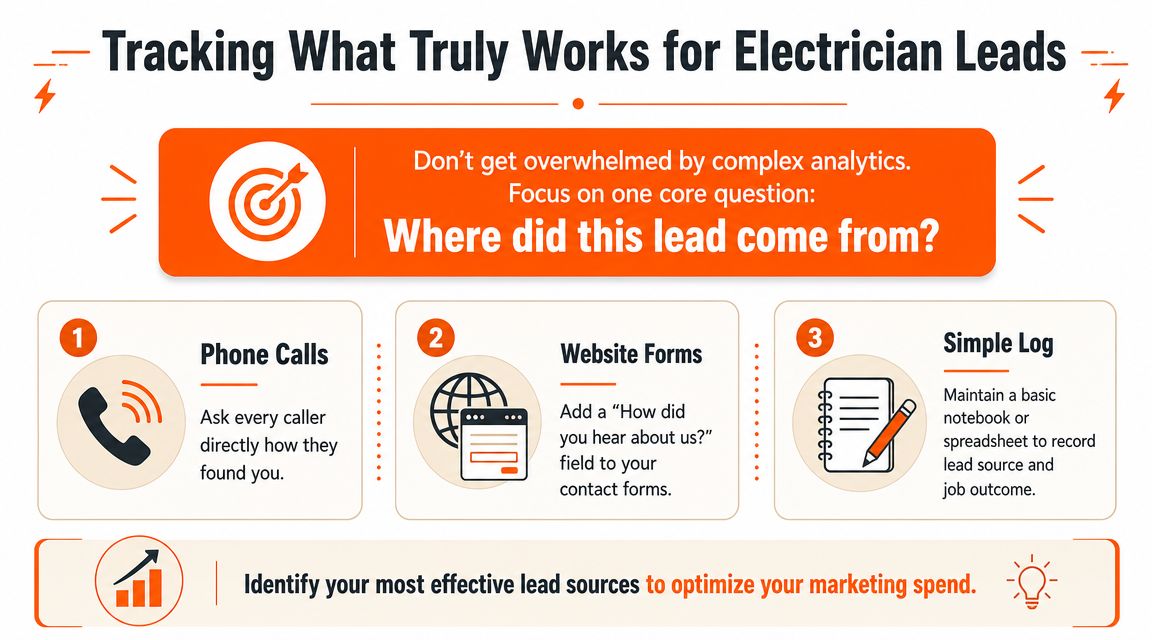
You only need four columns in a notebook or spreadsheet:
| Date | Customer | Source | Job value |
|---|---|---|---|
| 12 May | Smith | Google Business Profile | Switchboard upgrade |
| 14 May | Rental manager | Referral | Smoke alarms |
| 16 May | Jones | Facebook post | Lighting install |
If you want one extra field, add Outcome. Won, quoted, or lost.
Ask every new customer, “How did you hear about us?” Ask it on the phone. Put it on your form. Write the answer down exactly as they say it.
A notebook beats guessing
A lot of businesses stay stuck because they remember noise, not results. One ad campaign feels busy, so they assume it worked. A directory sends lots of tyre-kicker enquiries, so they think it's valuable. But if the jobs are poor or the close rate is weak, that channel isn't helping.
One industry report estimates the average cost per lead for electrical marketing is around $79, which is useful as a benchmark when you're judging whether a paid source is worth it, as noted in the earlier section's source. On your side, the practical question is simpler: what did I spend, how many enquiries came in, and how many turned into profitable jobs?
Track source first. Then track whether it produced work worth doing. Volume alone can mislead you.
Once you log a few months of enquiries, patterns show up fast:
- One channel brings better job types: Put more effort there.
- One source sends weak enquiries: Cut it or tighten it.
- Referrals still convert best: Keep nurturing them, but don't rely on them alone.
- A paid source works only when you answer quickly: Fix the response process before increasing budget.
This is how you stop making decisions by feel. Simple tracking turns marketing from a guess into a business tool.
Conclusion Consistency Beats Complexity
The businesses that win more local work usually aren't doing everything. They're doing the basics well, then repeating them.
They keep their profiles current. They collect reviews. They stay visible with simple content. They use paid channels carefully instead of spraying money everywhere. Above all, they respond fast and follow up properly so good enquiries don't disappear.
That's the shape of electrician lead generation when it works. Not a pile of tactics. A reliable system.
You don't need to master every platform or learn technical jargon. You need a small set of actions you can keep doing when work is busy and when it's quiet. That's what smooths out the feast-or-famine cycle and gives you more control over your schedule, cash flow, and growth.
If you want an easier way to stay visible online without writing posts yourself, GrowTradie helps trade businesses generate and auto-post branded content built for local services. It's a practical option for busy electricians who want steady visibility and more enquiries without turning marketing into a second job.