

Your phone isn't ringing enough. Or it's ringing, but with the wrong jobs, the wrong areas, and too many price shoppers. Meanwhile, inboxes fill up with agencies promising page-one rankings, “more traffic,” and miracle growth if you just sign a long contract today.
That's how HVAC owners waste money.
A good HVAC SEO company should help you win more booked jobs in the service areas you want. A bad one will drown you in reports, hide behind jargon, and blame “the algorithm” when nothing changes. You don't need another vendor. You need a partner that can prove how their work turns into calls, forms, and revenue.
Table of Contents
- Define Your Business Goals Before You Hire
- How to Vet and Choose the Right Partner
- What a High-Performing Partner Actually Delivers
- Understanding Contracts Pricing and Timelines
- How to Measure Real Results and Spot Red Flags
- Your Partner in Growth Not Just Marketing
Define Your Business Goals Before You Hire
If you don't define success first, an agency will define it for you. That usually means reports full of rankings, impressions, and vague “visibility” wins while your dispatch board still has empty gaps.
A serious HVAC SEO company should be measured against business goals, not abstract web activity. Decide what you need more of before you take a single sales call. More repair work this week is different from more install leads next quarter. More calls inside your best ZIP codes is different from broad awareness across an entire metro.

Pick targets that your office can track
Start with numbers your CSR or office manager already understands:
- Booked repair calls: Count actual jobs booked, not just inbound leads.
- Installation opportunities: Separate higher-ticket replacement and install enquiries from basic service calls.
- Service area quality: Track whether leads come from towns and suburbs you want more of.
- Response capacity: Don't push lead volume if your team can't answer fast or can't service the workload well.
The market is big enough to reward clarity. Recent industry data shows 68% of HVAC firms now prioritize local online search rankings as their primary marketing focus, and 84% of consumers search online before contacting an HVAC company, according to SequoiaGeo HVAC statistics. If most buyers start online, then your goals can't be fuzzy. They need to line up with how people find and choose contractors.
Define the kind of growth you want
Not every contractor wants the same thing. A newer operator might want to own one suburb first. A mature company might want more install work and fewer low-margin callouts. If you're still tightening up the basics of the business, it's worth reviewing guides on how to start an HVAC company so your growth targets match your staffing, pricing, and service mix.
Practical rule: If you can't explain success in one sentence to your office manager, you're not ready to hire a partner.
Write down these five answers before any sales meeting:
- Which services matter most right now
- Which locations you want more work from
- What a good lead looks like
- What your team can handle each week
- What would make you fire the agency in six months
That last one matters. It forces honesty. If the answer is “we spent money and couldn't tie it to booked work,” good. That's a real standard. Use it.
How to Vet and Choose the Right Partner
Most agencies sound smart on the first call. That proves nothing. What matters is whether they can explain their plan in plain English, show how they think, and stay focused on booked jobs instead of vanity metrics.
You also need to judge character, not just capability. Consumers choose HVAC contractors based on trust, and reliability is the top priority for 38% of consumers, even above price, as noted in the earlier research. If your partner acts slippery during the sales process, expect the same behavior after you sign.
Start with your own shortlist rules
Before you book discovery calls, set filters. Don't let every slick website onto your list.
Use these screening rules:
- Trade relevance: They should understand service-area businesses, dispatch realities, seasonality, and the difference between repair and replacement intent.
- Clear communication: If they can't explain their process without jargon, they'll be painful to manage.
- Proof of thinking: They should talk through structure, content, profile optimization, reporting, and mobile performance without sounding scripted.
- No cheap-bait offers: Lowball retainers often mean templated work, outsourced account management, or almost no real execution.
A firm that serves other local trades can still be a good fit if they understand lead quality and local buying behavior. For example, reviewing how agencies position themselves in adjacent trades can sharpen your eye. This breakdown of a plumbing digital marketing agency is useful because the same bad habits show up across home services.
Ask questions that expose fluff
Don't ask, “How do you help HVAC companies grow?” Every agency has a polished answer for that. Ask questions that force specifics.
| Question Category | Sample Question to Ask |
|---|---|
| Strategy | How would you prioritize my service pages, locations, and Google Business Profile in the first 90 days? |
| Lead quality | How will you separate emergency repair intent from estimate shoppers and low-value traffic? |
| Reporting | What will your monthly report show me besides rankings? |
| Accountability | If booked jobs don't improve, what changes do you make and how fast? |
| Website performance | What problems on a mobile site usually suppress calls and form fills? |
| Content | How do you handle city pages so they aren't duplicate junk? |
| Ownership | Who owns the website copy, profiles, landing pages, and analytics access if we part ways? |
| Communication | Who do I talk to each month, and are they actually doing the work? |
Good answers are specific. Bad answers are broad, polished, and evasive.
A good partner says things like: they'll build unique service pages by city, tighten navigation so users find the right service fast, improve mobile usability, and tie reporting to calls and forms. A weak partner says they use a “proprietary framework” and then pivots back to rankings.
If they can't tell you what they'd change first on your current site, they probably haven't looked at it closely.
What to listen for on the call
Listen less for confidence and more for discipline.
A solid agency usually does three things in the first conversation:
- They ask about margins and service mix: They want to know which jobs are worth chasing.
- They ask about geography: They understand that a lead in the wrong town can waste dispatch time.
- They ask about your office process: They know leads don't turn into revenue unless someone answers and books them.
A shaky agency usually does the opposite:
- They promise speed: Fast results with no diagnosis usually means shortcut work.
- They talk only about rank positions: Useful, but incomplete.
- They avoid ownership questions: That's where bad contracts hide.
Pick the team that talks like an operator, not a pitch deck.
What a High-Performing Partner Actually Delivers
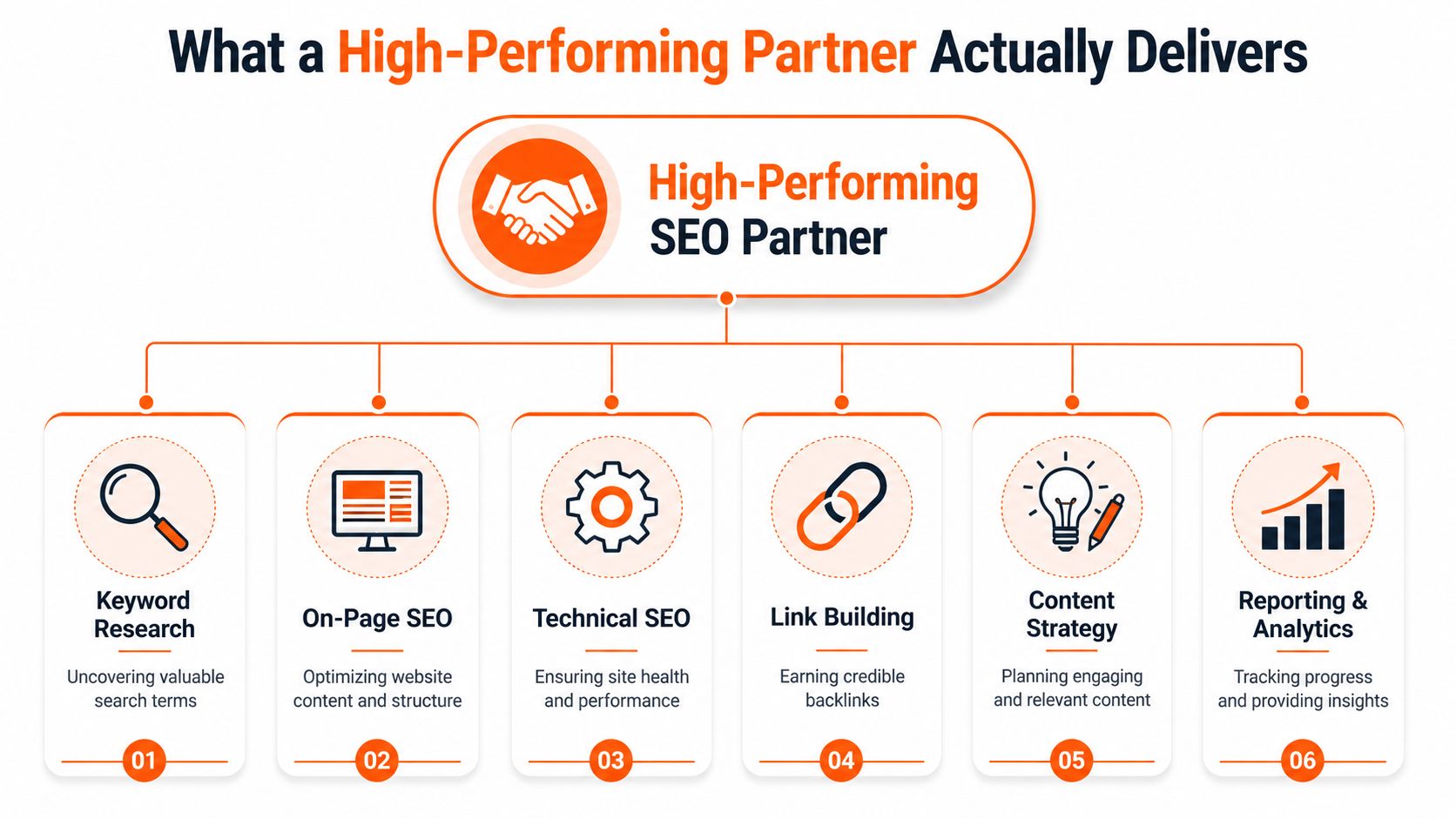
A good HVAC SEO company doesn't sell magic. It delivers a stack of visible, inspectable work that makes your business easier to find and easier to trust.
It's comparable to a system inspection. You don't judge quality by how impressive the invoice looks. You judge it by what was installed, fixed, tested, and documented.
The deliverables that matter
A proven approach includes unique, long-form service pages for each city you serve and a fully optimized Google Business Profile with correct NAP details, photos, and hours, according to Rohring Results on key elements of effective HVAC search visibility. That's the kind of work that helps a contractor show up where local buyers are deciding whom to call.
Here's what that means in plain English:
- City-specific service pages: One page for every real service area, written uniquely, not cloned with swapped suburb names.
- Service-specific pages: Separate pages for AC repair, furnace installation, heat pump work, maintenance, and other core jobs.
- Google Business Profile work: Correct name, address, phone, hours, categories, photos, and regular upkeep.
- Internal site structure: Clear navigation so a homeowner can reach the right service in seconds.
- Content that answers buyer questions: Material that helps people trust you before they call.
- Reporting tied to outcomes: Calls, forms, and enquiries by service and area.
If you want a simple benchmark for what this should resemble across the wider digital presence, this overview of digital marketing for HVAC gives a useful big-picture frame.
What good execution looks like
Plenty of agencies “offer” these items. Few execute them well.
Good execution looks like this:
- Pages are written for humans first: A homeowner can tell what you do, where you work, and how to contact you.
- Locations are real: No fake city pages for places you don't serve well.
- Profile details match everywhere: Your NAP information is consistent.
- Photos and trust signals are current: Outdated branding and empty profiles make you look neglected.
The best partner makes your company look dependable before the customer ever calls.
What should you see month to month? Not just movement in rankings. You should see page launches, profile improvements, content additions, site fixes, and reporting that connects activity to enquiries. If the agency can't point to concrete work product, you're buying talk.
Understanding Contracts Pricing and Timelines
Many HVAC owners fall into a common trap. The sales call sounds reasonable. The monthly fee seems manageable. Then the contract locks you in, the scope stays vague, and progress gets explained away for months.
Set your expectations before you sign.
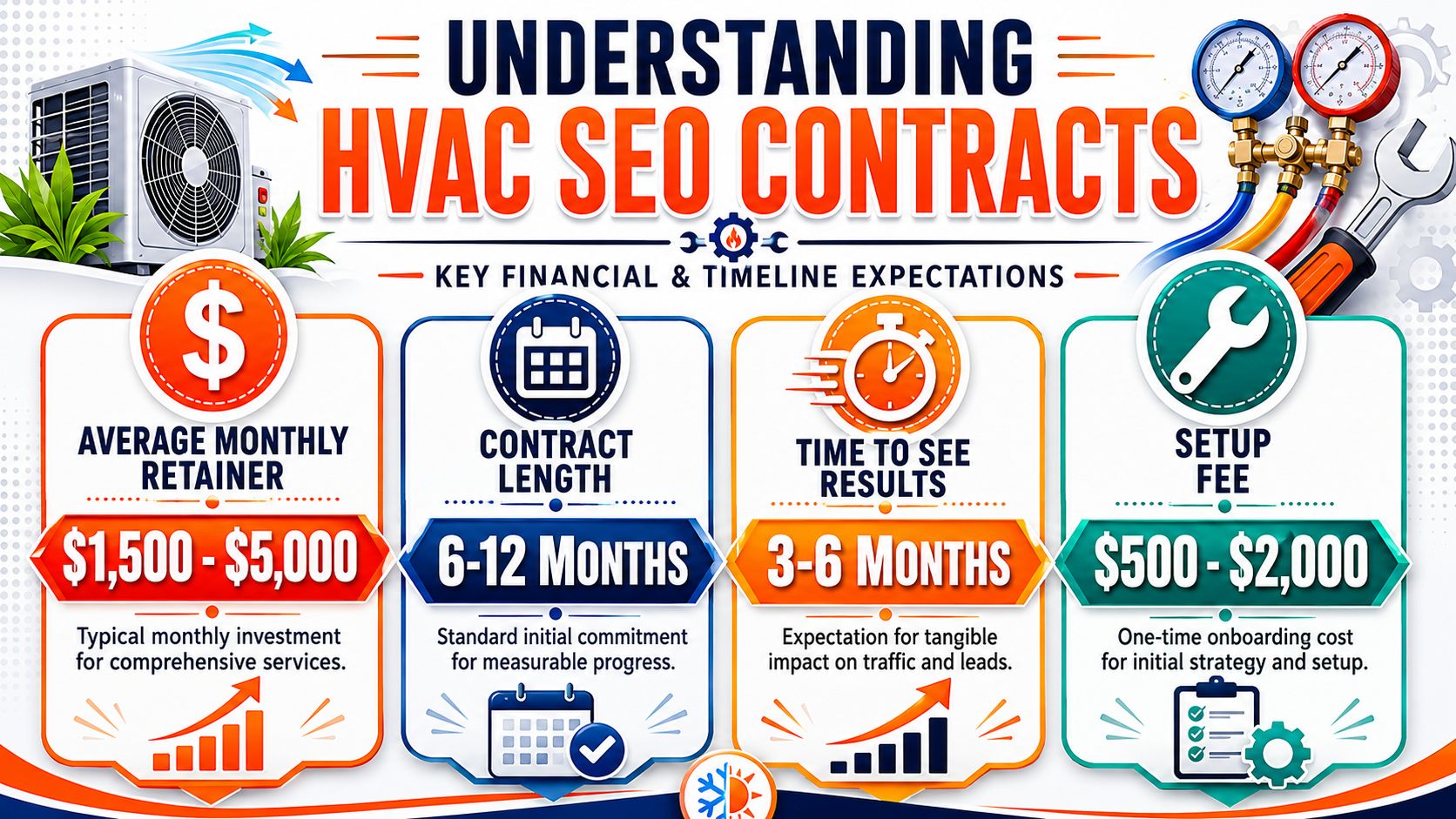
For 2026, the average monthly budget for an HVAC business to effectively grow its online presence is between $1,000 and $5,000, and that investment can generate around 20 qualified leads per month once established, based on Built Right Digital HVAC cost benchmarks. That gives you a realistic starting point for budgeting. It also tells you something important. Serious work isn't bargain-bin cheap.
What the budget usually covers
Inside that monthly investment, you should expect a mix of strategy and execution. Depending on the market and the site's condition, that often includes:
- Foundational local work: Profile optimization, local keyword targeting, and service-area relevance.
- Site improvements: Better page structure, clearer calls to action, and content expansion.
- Technical fixes: Faster page speed, mobile usability improvements, and cleanup of obvious issues.
- Ongoing reporting and reviews: Not just a PDF, but actual discussion of what changed and what happens next.
Some technical improvements may also require upfront work. The verified cost data says website speed improvements can require an upfront investment of $500 to $2,000 in some cases, and seasonal demand or competitor pressure can push budgets higher during peak periods, as covered in the same source above.
Here's the embedded video many owners find useful before they sign anything:
What a fair contract should say
The exact length and legal wording will vary, but the intent should be clean. You should never have to guess what you're paying for or what happens if the relationship ends.
Look for these terms:
- Clear scope: What pages, profiles, fixes, content, and reporting are included.
- Asset ownership: You own your website content, accounts, and data access.
- Defined communication cadence: Monthly review, named contact, and clear escalation path.
- Exit clarity: Reasonable notice period. No hostage tactics over your own assets.
A fair timeline is also important. Good partners won't promise overnight transformation. They should explain the sequence. Fix the site, tighten local signals, improve pages, then measure the lead flow over time. If someone guarantees immediate domination in a competitive market, treat that as a sales tactic, not a plan.
How to Measure Real Results and Spot Red Flags
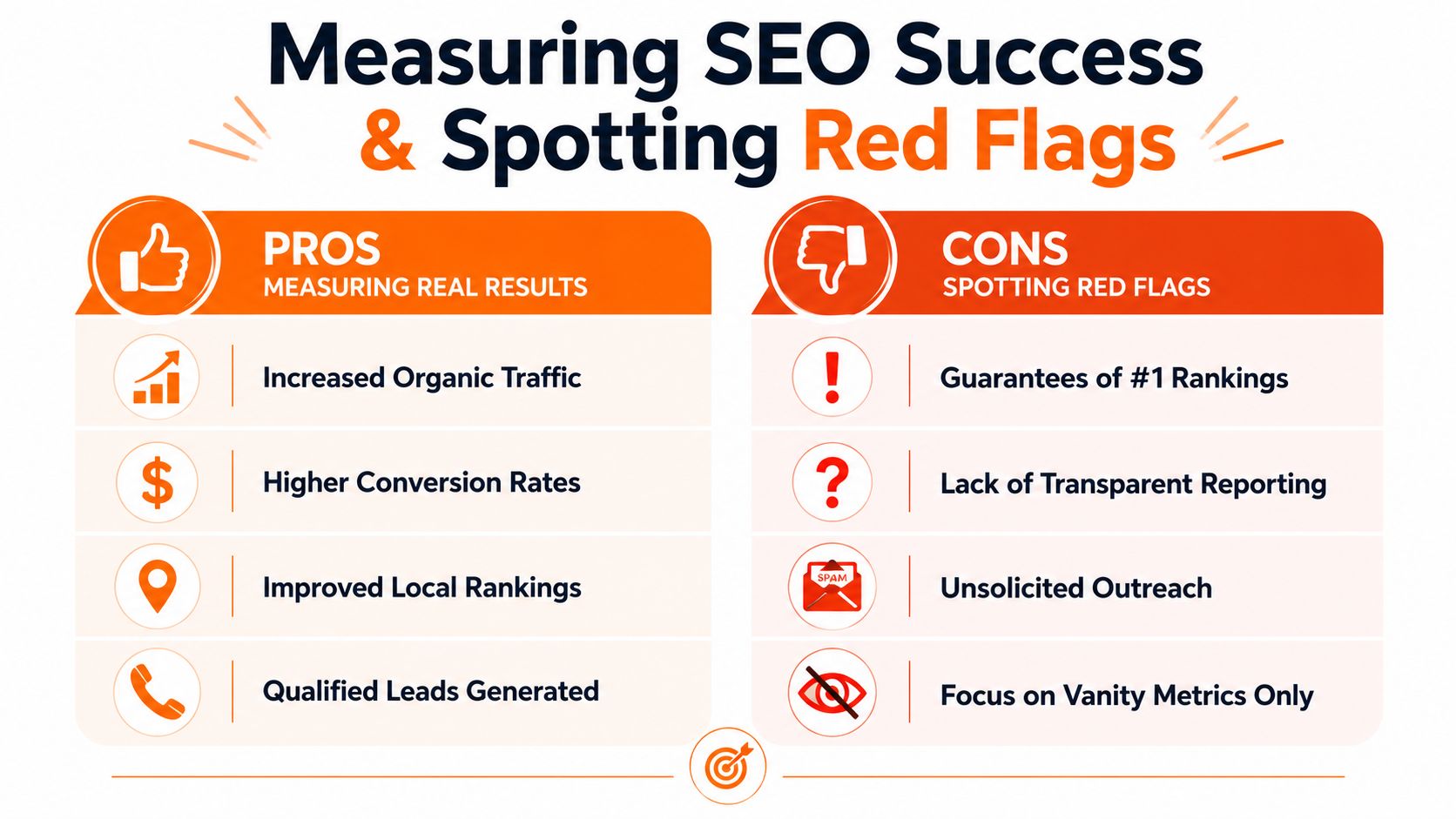
You don't need a 40-page report. You need a clear answer to one question. Is this partner helping generate more qualified enquiries that turn into booked work?
That means judging performance through business outcomes first and web data second.
Track business outcomes, not pretty dashboards
A good monthly review should let you compare what matters against what doesn't.
| Look for this | Not that |
|---|---|
| Calls from target service areas | Broad traffic with no location quality |
| Contact forms tied to real services | Reports obsessed with impressions |
| Booked jobs by service type | Keyword screenshots with no context |
| Missed call patterns and response issues | “Brand awareness” explanations |
| Mobile performance and usability fixes | Fancy charts that avoid lead discussion |
Owners often miss the full picture. A partner can send qualified people to your site, but if your office is slow to respond, revenue still leaks out. Workforce data shows only 30% of HVAC companies respond to leads within one hour, yet 70% of consumers who search locally visit a business that follows up within that window, according to WorldMetrics HVAC marketing statistics. So hold the agency accountable for lead quality, but hold your team accountable for speed.
A campaign can work and still underperform because the office didn't answer fast enough.
Red flags that should make you nervous
Some red flags are obvious. Others hide inside polished communication.
The biggest technical warning sign is mobile neglect. 60% of HVAC-related searches happen on mobile devices, and a site that's hard to use on a phone can lose up to 50% of potential leads, according to Nopio's HVAC web performance guide. If your agency isn't talking about mobile layout, page speed, button placement, and usability, they're ignoring where a large share of your buyers are.
Other danger signs show up in behavior:
- Guaranteed top rankings: No ethical firm controls search platforms that tightly.
- No transparent reporting: If they avoid call counts, forms, and page-level work, assume the work is thin.
- Generic city pages: Cheap duplicate content signals lazy execution.
- Silence between invoices: If you only hear from them when it's renewal time, that's a problem.
- Business name stuffing in listings: That's a shortcut that can get a profile penalized.
Warning sign: If an agency can't explain results in plain language to your dispatcher, they probably can't explain them to you either.
A real partner welcomes scrutiny. A scam hides behind complexity.
Your Partner in Growth Not Just Marketing
Choosing an HVAC SEO company isn't a branding exercise. It's an operating decision. You're buying a system that should support steady enquiries, stronger trust, and more booked jobs in the areas you want to own.
The right partner behaves like part of your team. They ask about margins, staffing, service mix, call handling, and territory. They tell you what needs fixing. They don't dodge hard questions. They don't hide weak performance behind pretty charts.
The wrong partner sells hope, not execution. They push long contracts, vague deliverables, and vanity metrics. They talk a lot about exposure and not enough about booked work.
Be hard to impress. Ask blunt questions. Demand clarity on scope, ownership, reporting, and mobile performance. Judge them by whether the phone rings with the right jobs, not by whether a dashboard looks busy.
That's how you avoid scams. That's how you find a real growth partner.
If you're too busy on the tools to stay consistently visible online, GrowTradie gives trade businesses a practical way to keep their presence active with professional content and auto-posting built for local enquiries, not empty engagement.