

Some weeks your crew is flat out. The phone keeps ringing, referrals come in, and you're quoting work faster than you can schedule it. Then the weather shifts, referrals slow down, and it gets uncomfortably quiet.
That gap is where most HVAC businesses feel stuck. You know people in your area need repairs, replacements, and maintenance, but when they search on Google, other companies show up first. If you're tired of hoping word of mouth fills the calendar, you need a system that helps local customers find you at the exact moment they're ready to call.
Table of Contents
- From Unpredictable Work to a Steady Stream of Local Jobs
- Mastering Your Free Listing on Google Maps
- Building a Website That Converts Visitors into Customers
- Using Customer Reviews to Build Trust and Attract Leads
- Becoming the Go-To HVAC Expert in Your Community
- A Simple Checklist to Keep Your Online Presence Strong
From Unpredictable Work to a Steady Stream of Local Jobs
A lot of HVAC owners start with the same playbook. Do good work. Answer the phone. Wrap the vans. Ask for referrals. That gets a business moving, but it rarely creates a reliable flow of local jobs on its own.
The problem isn't that referrals are bad. The problem is that referrals are uneven. They come in bursts, and they don't give you much control over which services people ask for, which suburbs stay busy, or how you keep the schedule full when demand softens.
I've seen the same pattern over and over. One contractor dominates in person but looks invisible online. Another company with a weaker reputation shows up first on Google Maps, has more recent reviews, and wins the call before the better operator even gets a chance. That's frustrating because the better business often isn't losing on service. It's losing on visibility.
Most local customers don't know who's best before they search. They choose from the businesses Google puts in front of them.
That's why local seo marketing for hvac contractors matters in practical terms. Not as a buzzword. As a way to stop relying on luck. You want your business to appear when someone nearby searches for furnace repair, AC replacement, heat pump service, or emergency help.
The good news is that this isn't about complicated marketing theory. It's a repeatable system.
- First, own your Google Maps presence: That's the fastest way to get seen by nearby customers.
- Next, back it up with a useful website: Your site has to match the places and services you offer.
- Then, build trust in public: Reviews, photos, and clear responses do more selling than slogans.
- Finally, stay active: A neglected profile and stale website fade fast.
If you want a broader trade-focused overview, this guide to getting found locally as a contractor is a useful companion to the process here.
Mastering Your Free Listing on Google Maps
A homeowner searches "AC repair near me" at 7:30 p.m. Three companies show up in Google Maps. One profile has fresh reviews, real job photos, clear hours, and a local number that gets answered. Another has outdated hours, no recent activity, and an old phone number. The first company gets the call.
That is why your Google Business Profile deserves attention. For many HVAC contractors, it is the first thing a local customer sees, and often the only thing they check before deciding who to ring.
Get the basics perfect first
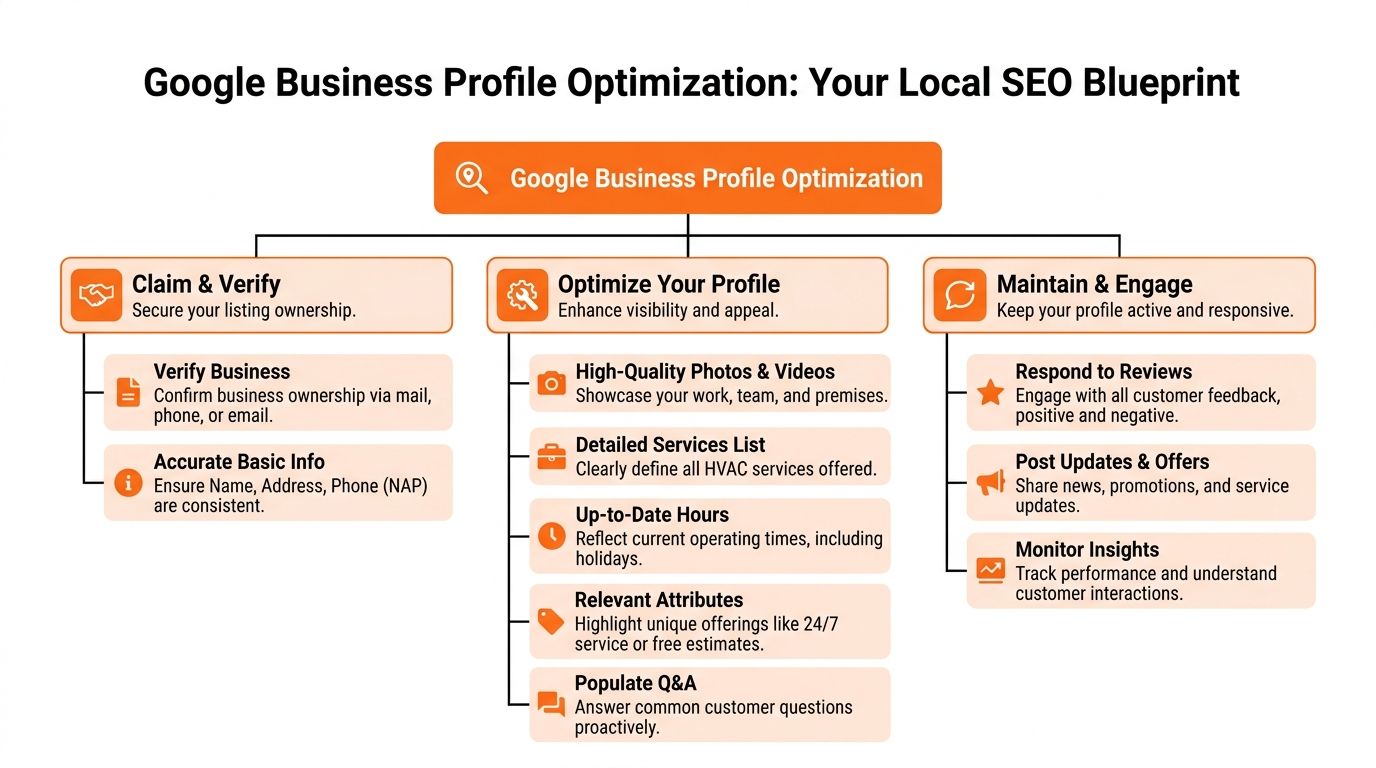
Claim the profile. Verify it. Keep ownership with someone accountable inside the business, because this listing controls calls, direction requests, messages, and your visibility in Maps.
Then tighten up the details that affect both trust and lead quality.
| Item | What to do | What goes wrong if you ignore it |
|---|---|---|
| Business name | Match your real trading name and website branding | Mismatched naming confuses customers |
| Phone number | Use the main local number you actually answer | Leads go to old or unmonitored lines |
| Hours | Set normal hours and update holiday changes | People call expecting service when you're closed |
| Categories | Choose the most accurate primary and secondary categories | Google associates you with the wrong services |
| Service areas | List real service areas only | You attract poor-fit leads far outside your route |
Google's own guidance says your business information should be accurate and kept consistent across the web, and your website should reflect the same details customers see in your profile. In practice, that means using the same business name, address, and phone number on Google, your website, and major directory listings. You can review that standard in Google's guidelines for representing your business on Google.
HVAC owners often lose ground without realizing it due to disparate business details. The business has one phone number on Google, another on Yelp, an old suite number on Facebook, and a website footer nobody updated after the move. Customers hesitate. Google gets mixed signals. Calls slip to the company whose information looks cleaner.
Fill the parts many contractors leave half-done
A strong listing usually wins on completeness, not tricks.
Use real photos from actual jobs. Add your vans, technicians, installs, maintenance visits, office frontage, and branded uniforms. Clean, honest proof beats polished stock images every time because homeowners want to know you are a real local company, not a lead gen shell.
Spell out your services clearly. If you handle AC repair, furnace installation, heat pumps, maintenance plans, ducted systems, and after-hours service, list them. A customer should not have to hunt for basic answers.
This walkthrough gives a good visual of what a complete setup looks like in practice.
A few profile elements carry more weight than owners expect:
- Photos that reduce hesitation: Show your team in uniform, branded vehicles, and real homes or commercial sites.
- Business description: State what you do, which suburbs or towns you cover, and what kind of jobs you want.
- Questions and answers: Add common questions yourself, such as financing, emergency availability, or whether you service specific brands.
- Attributes: Turn on relevant options like emergency service, payment types, or women-led ownership if they apply.
Practical rule: If a homeowner cannot tell what you do, where you work, and how to contact you in a few seconds, the profile still needs work.
If you want the bigger picture beyond Maps, this guide to digital marketing for HVAC businesses explains how your listing, reviews, and website work together to produce booked jobs.
Keep it active after setup
A finished profile still needs attention. Add new photos every month or two. Check holiday hours before long weekends. Answer every review. Post service updates, maintenance reminders, or seasonal offers when they are relevant.
Fresh activity helps in two ways. It gives Google a stronger signal that the business is active, and it gives homeowners confidence that someone is paying attention.
The HVAC companies that consistently show up in local search usually are not doing anything flashy. They keep the profile accurate, current, and believable. That is what turns a free Google Maps listing into a steady source of calls.
Building a Website That Converts Visitors into Customers
A homeowner lands on your site at 7:30 p.m. because the air conditioner has stopped working. They are hot, frustrated, and comparing you with two other contractors in nearby suburbs. If your phone number is hard to find, your service area is vague, or the page feels generic, that job often goes to someone else.
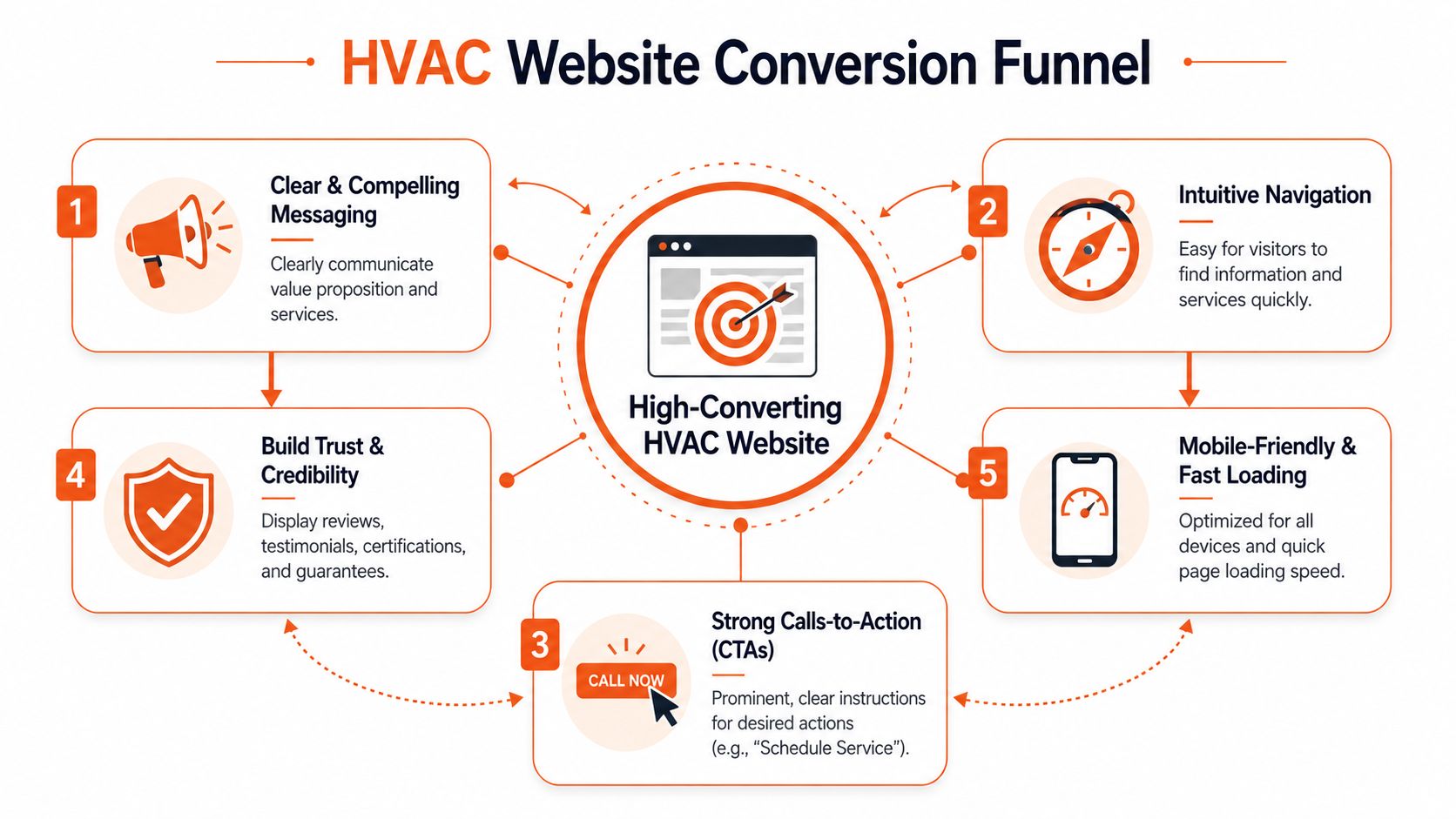
That is the core purpose of an HVAC website. It should help the right local customer feel confident enough to call, request service, or book an estimate.
Why generic pages lose jobs
One broad page for every service and every town feels efficient when you are building the site. It performs poorly once real customers start using it.
A person searching for “AC repair in North Shore” wants to land on a page about AC repair in North Shore. A person comparing furnace replacement options in another town wants details that match that job and that location. If both searches lead to the same catch-all page, the customer has to sort it out alone. Many will leave instead.
For contractors covering multiple towns, separate service pages and separate location pages usually work better than one all-purpose page. The goal is not to hit a made-up word count. The goal is to give each page enough original detail to answer local questions, show that you operate there, and make the next step clear. The guide on local marketing for HVAC contractors supports building unique local pages, but it does not need a fixed word-count rule to make the point.
There is a trade-off here. More pages mean more writing, more photos, and more upkeep. But for HVAC companies that want better visibility across several suburbs or cities, that work usually produces more qualified calls than sending every visitor to the same general page.
What a strong service area page needs
A useful local page should sound like it was written for that town and that service, not copied twenty times with the suburb name swapped out.
Include the basics first. Put the service and location in the headline. Explain what you provide on that page, whether that is emergency repair, system replacement, seasonal maintenance, or indoor air quality work. Confirm the areas you cover nearby so the visitor does not have to guess.
Then add local proof. Mention the types of properties you commonly work on, the system issues you see in that area, and examples from real jobs if you have them. A short testimonial from a nearby customer, photos from local installs, or a note about common problems in older homes can do more than a paragraph of generic sales copy.
A page gets stronger when it answers practical questions fast:
- What service is this page about?
- Do you work in this suburb or town?
- What kinds of systems do you handle?
- How quickly can someone expect a response?
- What should the customer do next?
Here is the standard I use. If a homeowner can scan the page in under ten seconds and know you handle their problem in their area, the page is doing its job.
How to make the next step obvious
A lot of HVAC sites lose leads after earning the click. The visitor arrives, but the path to calling or enquiring is clumsy. The phone number is tiny. The quote form asks for too much. The page talks about the company before it explains the service.
Clean structure fixes a lot of that.
| Website element | What the customer needs |
|---|---|
| Header | Phone number and main service areas visible immediately |
| First screen | Clear service message and a direct action button |
| Mid-page trust section | Reviews, licenses, certifications, and local proof |
| Service details | What you do, who it's for, and how fast you respond |
| Footer | Repeat contact details and service area coverage |
Keep forms short. Name, phone, suburb, and a brief job description are usually enough for a first enquiry. Every extra field gives the customer another reason to leave.
Different pages should also match different buying situations. Emergency repair pages need speed, availability, and reassurance. Replacement pages need financing information, brand options, and trust signals. Maintenance pages need a clear explanation of what is included and why it saves hassle over time. Treating all visitors the same usually lowers conversions because their intent is different from the moment they search.
If you want a broader view of how websites, search visibility, and lead flow fit together, this guide to online marketing for contractors lays it out in plain language.
Done well, local seo marketing for hvac contractors brings in the right visitor and gives them a straightforward reason to contact you now.
Using Customer Reviews to Build Trust and Attract Leads
A homeowner finds your Google listing at 7:30 p.m. because the air conditioner quit after dinner. They see two nearby companies. One has recent reviews that mention fast service, fair pricing, and a technician who explained the problem clearly. The other has a stale profile and no replies to complaints. The phone usually rings for the first company.

Reviews shape two decisions at once. Google uses them as one signal of local relevance, and homeowners use them to decide who feels safe to call. For an HVAC owner, that makes reviews part of lead generation, not just reputation management.
Reviews help you win the comparison
Homeowners rarely judge your business on its own. They compare your rating, review volume, and how recent the feedback looks against the other companies in the map pack. A smaller shop with steady, detailed reviews can outperform a larger competitor that let its profile go quiet.
Recency matters more than many owners expect. Twenty strong reviews from last month usually do more for trust than a pile of old five-star ratings from three years ago. Detailed reviews help too. Comments that mention the actual job, such as capacitor replacement, furnace diagnosis, or same-day AC repair, are more convincing than generic praise.
Your responses matter as well. A short, professional reply shows that your company pays attention after the invoice is paid. That gives the next customer one more reason to call.
Build a review process your team can repeat every day
The best review system is simple enough to survive a busy summer week.
Use a process like this:
- Ask right after the job is resolved. Timing matters. The best moment is when the customer is relieved and the technician has explained what was fixed.
- Send a direct review link. Text usually works well because it is fast and easy to open.
- Keep the ask plain. Thank them for choosing your company and ask for honest feedback about the visit.
- Make it part of closeout. Techs and office staff should know exactly who asks, when they ask, and what link gets sent.
- Track it weekly. Watch for long gaps, because an inconsistent flow of reviews weakens trust.
I have seen HVAC companies overcomplicate this with scripts, incentives, and too many follow-ups. A clean process usually works better. Ask consistently. Make it easy. Keep it tied to completed jobs.
Reviews should be part of your service workflow, the same way you handle invoices, photos, and job notes.
Handle negative reviews in a way that protects future sales
Bad reviews are part of the job, especially in service businesses where schedules slip, parts are delayed, or customers are upset before your truck even arrives. The goal is not to win an argument in public. The goal is to show future customers that your company handles problems like an adult.
A good response does four things:
- Acknowledge the issue
- Stay calm and specific
- Offer a path to resolve it offline
- Avoid blame, sarcasm, or technical excuses
Short replies usually work best. Thank them for the feedback, say you take the concern seriously, and provide a direct contact for follow-up. If the complaint is unfair, keep the same tone. Prospective customers read those exchanges closely.
If you want more booked jobs from local search, treat reviews as part of customer service and sales. Get them steadily, respond to them promptly, and use them to show how your company works in real homes with real people.
Becoming the Go-To HVAC Expert in Your Community
A homeowner in your service area hears a loud bang from the furnace on a cold night. Before they call anyone, they search Google for the symptom, the likely fix, and whether the system is worth repairing. If your company shows up with a clear local answer, you are in the running before the phone rings.
That is how local authority gets built. You keep showing up with useful information and a visible presence in the community you serve.
Answer the questions homeowners already ask
The best content ideas usually come from your office staff and techs, not a marketing spreadsheet. Listen to the questions that come up during estimate calls, service visits, and replacement quotes. Those are the topics that help homeowners make decisions.
Google's SEO starter guidance says helpful content should be created for people first and should answer what visitors are trying to learn, not just target search engines, as explained in Google Search Central's guidance on creating helpful, reliable, people-first content.
For an HVAC company, that means publishing pages or articles such as:
- Local pricing questions: How much a heat pump install typically costs in your area
- Common repair concerns: Why an AC runs constantly during hot weather
- Replacement decisions: When a 15-year-old furnace is worth replacing instead of repairing
- Home-specific issues: Best HVAC options for older homes, additions, or rooms with uneven temperatures
Keep it plain. A homeowner does not want a technical lecture. They want enough clarity to decide whether to call, what to expect, and whether your team sounds trustworthy.
One good page can keep producing calls for months if it answers a real question better than the generic pages your competitors publish.
Build local authority offline and online
Local authority is not built by content alone. It grows faster when your company is visible in the same places your customers already trust.
That includes supplier relationships, local sponsorships, chamber listings, neighborhood events, and media requests during weather swings. Google specifically notes that prominence in local results can be influenced by information the search engine has about a business across the web, including links, articles, and directories, in Google Business Profile help on how local ranking works.
The trade-off is simple. Some local mentions help. Some are just noise.
| Opportunity | Worth doing when | Skip it when |
|---|---|---|
| Supplier relationships | They mention your company, send referrals, or feature completed work | It is only a logo placement no customer will ever see |
| Community sponsorships | The audience includes local homeowners in your service area | The event draws the wrong crowd or is outside your market |
| Local media input | You can give timely advice during heat waves, cold snaps, or energy cost spikes | The coverage is too broad to send any local demand |
| Allied trade partnerships | Plumbers, electricians, remodelers, or roofers serve the same type of customer | The referrals are inconsistent or price-shopping leads |
I have seen contractors waste money chasing exposure that never turns into booked work. A small sponsorship tied to a real neighborhood often outperforms a bigger spend on broad branding. Relevance matters more than reach.
Turn familiarity into booked jobs
The goal is not to look famous online. The goal is to be the company people recognize when they are ready to hire.
A useful article answers a question. A mention from a supplier or community group adds credibility. Seeing your trucks at local events makes the name feel familiar. Put together, those touches lower hesitation at the moment a homeowner needs service, repair, or replacement.
That is the practical side of local seo marketing for hvac contractors. It helps your business stay visible long enough, and credibly enough, to win more local calls and more booked jobs.
A Simple Checklist to Keep Your Online Presence Strong
A lot of HVAC owners have been through the same cycle. The Google listing gets set up, the website goes live, a few reviews come in, and then everyone gets busy running calls. Three months later, holiday hours are wrong, an old phone number is still sitting in a directory, and a competitor with a less impressive company starts showing up more often in local search.
That drop usually comes from neglect, not from some advanced SEO problem.
The weekly and monthly rhythm
Local visibility improves when the basic signals stay accurate and active over time. HVAC companies do not need a complicated reporting setup to manage that well. They need a simple routine the office can keep up with.
I usually treat this like shop discipline. Small checks done on schedule prevent bigger problems later.
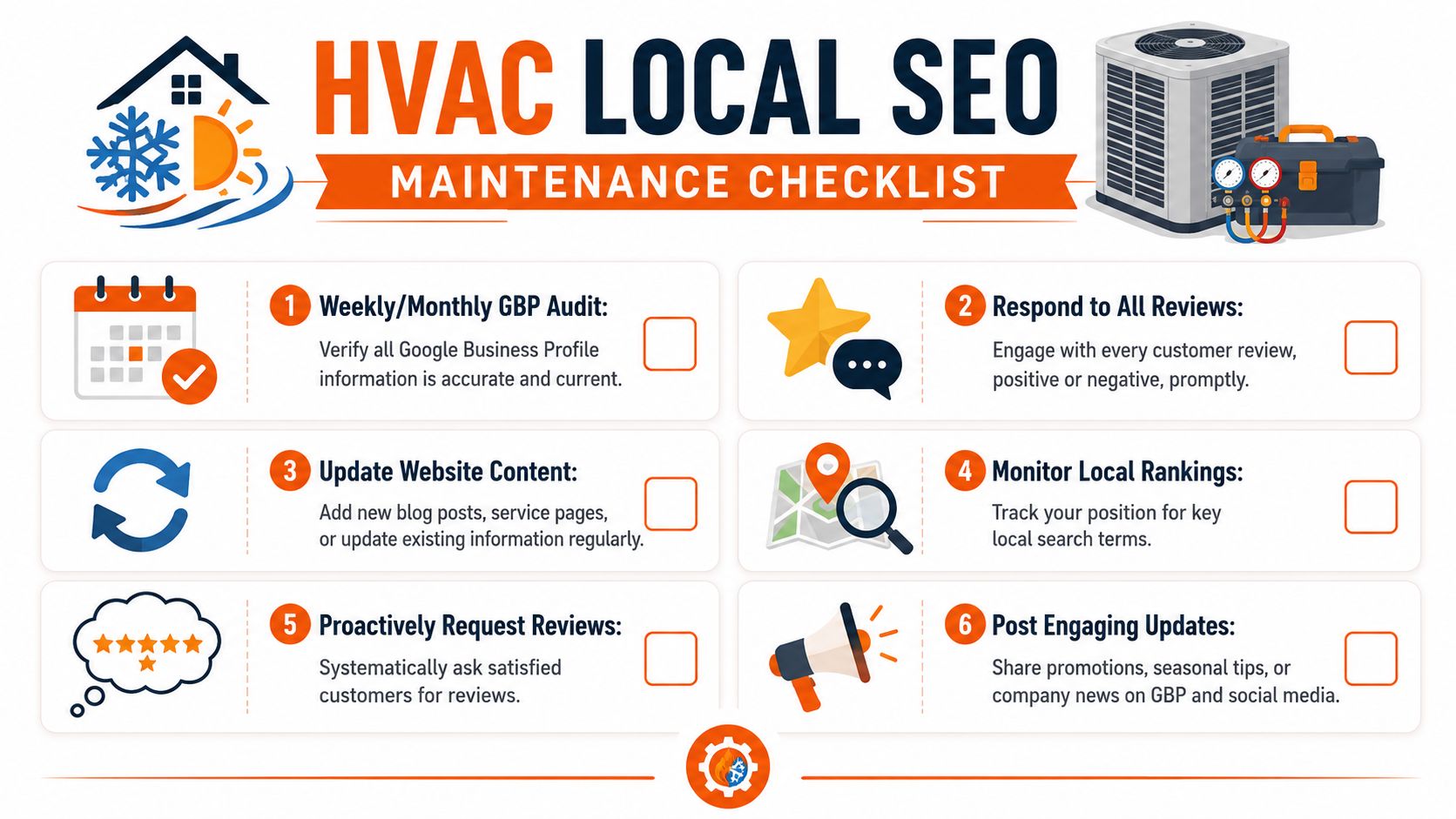
Use a straightforward rhythm:
Weekly
- Check your Google listing: Confirm hours, phone number, service status, and any unanswered questions.
- Reply to new reviews: Thank happy customers and address complaints before they sit there for weeks.
- Review lead notes: Look at what callers needed, which towns they came from, and whether they mentioned Google.
- Post one fresh update: Add a job photo, seasonal reminder, financing mention, or short service update.
Monthly
- Review your main website pages: Make sure service areas, offers, contact details, and forms are current.
- Ask for reviews consistently: The goal is a steady flow, not a burst once a quarter.
- Publish one useful piece of content: Answer a real question your team heard from homeowners that month.
- Check major listings for accuracy: Your name, address, phone number, and hours should match everywhere that matters.
This work is simple. It still gets skipped because nobody owns it.
If you assign these checks to one person, give them 30 minutes each week and a longer block once a month. That is usually enough to keep the foundation solid without turning your office manager into a full-time marketer.
How to tell if it is leading to booked jobs
The goal is booked work, not prettier dashboards.
Start with the signals your team can verify in the field and on the phone:
- Ask every new lead how they found you
- Track calls and direction requests from your Google listing
- Watch which towns and ZIP codes start producing more enquiries
- Listen for phrases like “I saw your reviews” or “you were the company I kept seeing”
- Check whether form fills and calls line up with the services you are trying to grow
Those patterns tell you more than raw traffic numbers by themselves. If your company starts hearing the same Google-related comments again and again, visibility is turning into trust. If trust is improving, booking rates usually follow.
Here's a simple checklist to keep on hand:
| Task | Frequency |
|---|---|
| Verify Google Business Profile details | Weekly |
| Respond to every review | Ongoing |
| Add new photos | Monthly |
| Update service area pages | Monthly |
| Publish one helpful local article or update | Monthly |
| Check major directory details for consistency | Monthly |
| Ask leads how they found you | Every enquiry |
The HVAC companies that stay visible year-round usually follow boring habits well. Accurate information, fresh proof of recent work, and steady review activity beat random marketing pushes almost every time.
GrowTradie helps trade businesses stay visible without having to become full-time marketers. If you want consistent, professional content that keeps your business active online and supports more local enquiries, GrowTradie gives you a practical way to do it without adding more admin to your week.