
You can do great work all week and still be the tradie nobody remembers when the phone rings. You've fixed the leak, patched the wall, installed the unit, cleaned up properly, then you're back in the ute heading to the next job while the quieter operator down the road keeps showing up in local feeds, local groups, and local maps. That's the gap community awareness fills. It's not about looking busy, it's about staying top of mind in your patch so the next homeowner, property manager, or landlord thinks of you first.
Table of Contents
- Why Most Tradies Stay Invisible Locally
- Setting Your Local Awareness Foundation
- What to Post to Build Community Awareness
- Choosing the Right Local Channels
- Growing Trust Through Partnerships and Testimonials
- Measuring Community Awareness Without the Overwhelm
- Automating and Scaling With GrowTradie
Why Most Tradies Stay Invisible Locally
Most tradies assume the work will speak for itself. In practice, the job gets finished, the client is happy, and then the trail goes cold unless you keep showing up where locals already look. A business can be skilled, reliable, and recommended by word of mouth, yet still lose enquiries to a competitor who posts more often and stays visible between site visits.
That's the hard truth. Being available is not the same as being remembered. If a new family moves into your suburb next month, they don't know your history, your reputation, or how many mates have recommended you. They know the names they've seen recently, and the tradie who stays in front of them wins the call more often than the tradie who relies on good intentions.
A useful way to think about it is simple. Your workmanship builds trust after the first job, but community awareness gets you into the shortlist before the first enquiry ever lands. That's why the most visible local operators don't treat visibility as a one-off push. They treat it as a steady habit.
Practical rule: if people only hear from you when you need work, they'll forget you when they need help.
That's especially true in growing suburbs, where new residents arrive with no prior connection to any local operator. If you want to stay ahead, you've got to keep your name in circulation, even when the ute's parked and the tools are back in the shed.
Setting Your Local Awareness Foundation
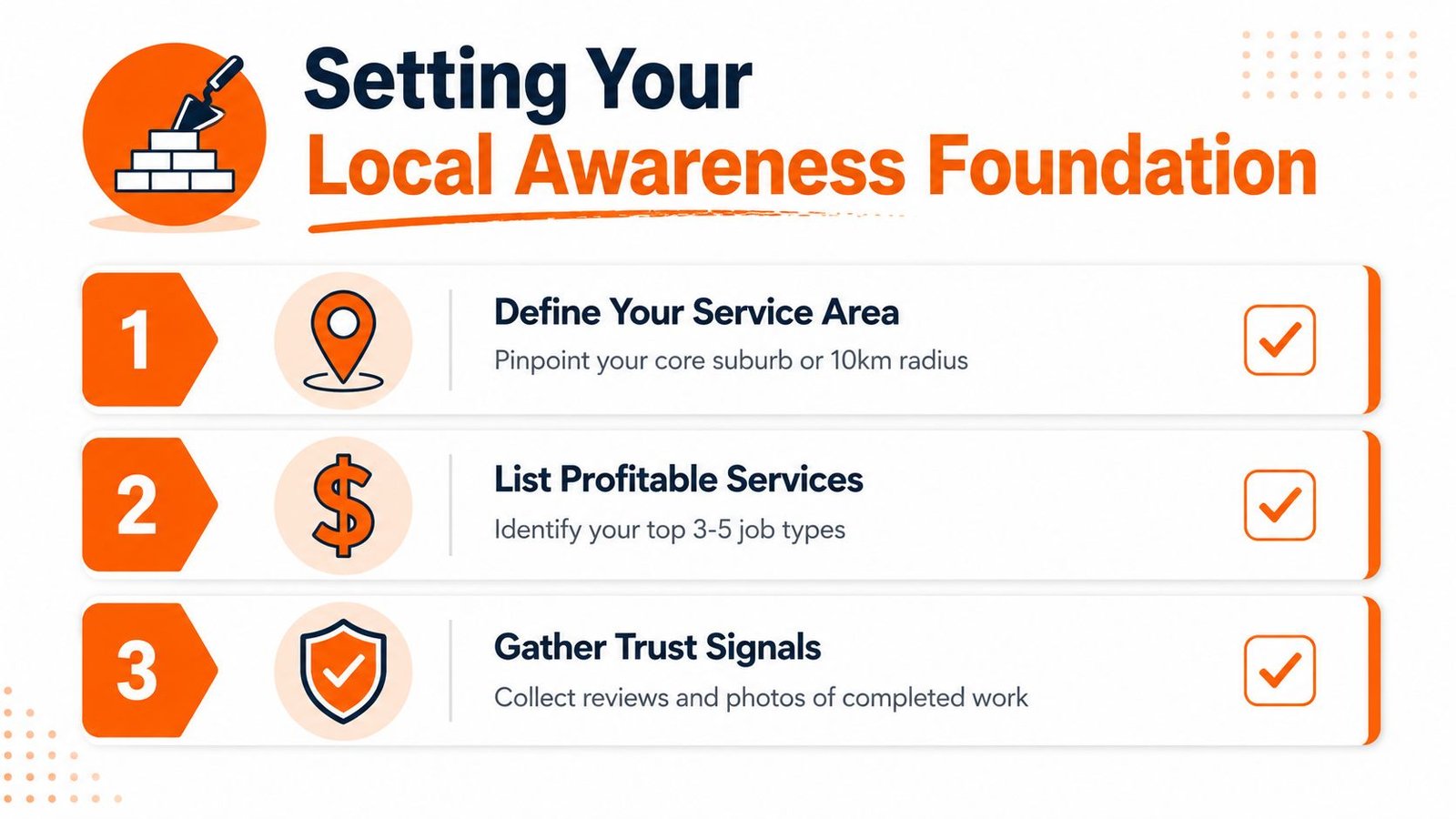
Start with geography, not guesswork. Pick the suburb, cluster of suburbs, or radius you want to own, then write it down. If you try to serve everywhere, your message gets muddy and your presence gets thin.
Lock the basics before you post
A strong local profile needs a few trust signals ready on day one. That means your licence number, insurance details, and a small stack of recent reviews that sound real, local, and specific. It also means a short one-line description that tells people who you help and where you work.
If someone can't tell what you do in five seconds, they'll scroll straight past you.
Keep the wording plain. “Licensed electrician serving the western suburbs” beats a vague slogan every time, because locals don't need poetry, they need confidence. If you're a plumber, sparky, carpenter, or HVAC tech, your profitable jobs are usually a small handful of repeatable services, not every job under the sun.
Get the photos that actually sell the work
Have these ready on your phone before you start posting:
- Completed jobs: clean shots that show the finished result and the context around it.
- Your van: branded, tidy, and easy to recognise on the street.
- Team photos: no stiff corporate poses, just real people locals can trust.
- Uniform and gear: small details that show you run a proper outfit.
Set up one Google Business Profile entry and make sure the service area, contact details, and categories are correct. That single profile often becomes the hub people check when they want to confirm you're real, local, and active. A tidy foundation makes every later post and enquiry land harder because the proof is already there.
What to Post to Build Community Awareness
The best posts for a trade business don't need clever writing. They need proof, clarity, and repetition. A finished job with a short story works because it shows the problem, the fix, and the outcome without you having to oversell anything. A before-and-after does the same thing faster, because the contrast does the heavy lifting.
Stick to a tight content mix
Use a small set of formats and rotate them. That keeps the feed alive without forcing you to invent new ideas every week. A solid mix looks like this:
- Completed job story: “Old unit failing under load, new one installed, tested, and ready.”
- Before-and-after photo: show the mess, the fix, and the result.
- Seasonal tip: practical advice tied to the weather or local conditions.
- Behind-the-scenes shot: van load-out, workshop prep, job planning, or materials sorted for the day.
- Customer thank-you: a short testimonial, especially if the client mentions speed, cleanliness, or communication.
That mix works because each post has a different job. Completed work proves competence. Before-and-afters prove transformation. Tips build trust before anyone asks for a quote. Testimonials reduce risk for the next person thinking of calling you.
If you want a sharper example of showing the work instead of just talking about it, the best approach is to treat each job as a demonstration of skill. This guide on skill demonstration fits that idea well, because local buyers respond to visible proof far more than polished claims.
Keep the rhythm realistic
Don't set a daily posting target you'll abandon by Wednesday. A tradie with a full diary needs a repeatable weekly rhythm, not a content marathon. Two or three solid posts a week, based on real jobs and real photos, is far better than a burst of noise followed by silence.
Good posting beats perfect posting. A simple photo with one clear line is still useful if it lands in front of the right locals.
Reuse strong formats with different jobs. One week it's a hot water replacement. Next week it's a switchboard upgrade. Then it's a quick tip about spotting a problem early. The point is to stay visible and useful, not to write like a magazine.
Choosing the Right Local Channels
Don't spray your message everywhere and hope something sticks. Pick the places where locals already look for answers, then match the message to the channel. A job-update photo belongs in one place, a quick helpful comment belongs in another, and a sponsor logo on a club banner does a different kind of work again.
Use each channel for its real job
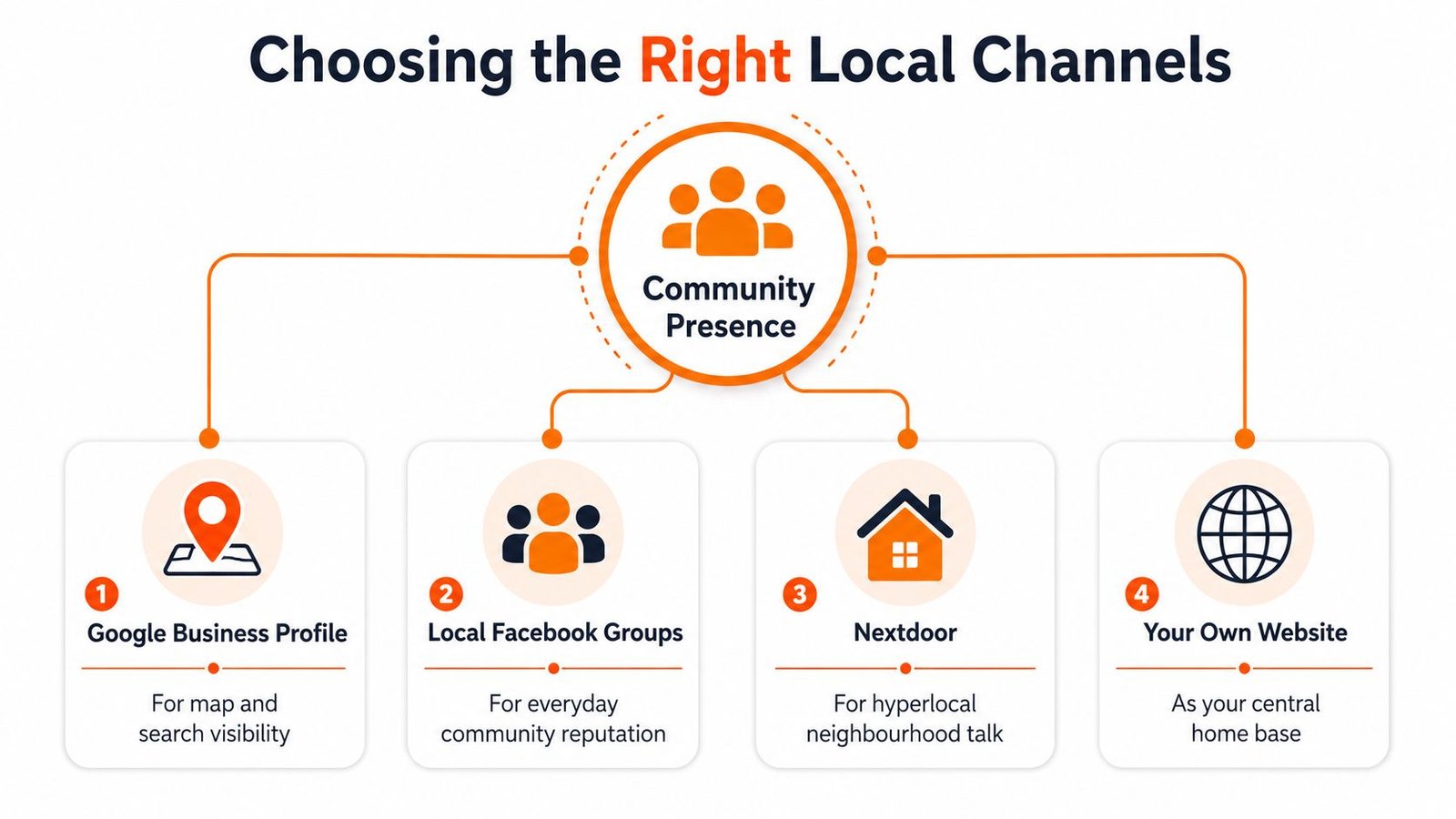
Google Business Profile is your map-and-search home base. Keep it active with job photos, recent updates, and correct business details. Locals checking whether you're nearby and legit will often look here first. For geographic focus, the right service area matters more than trying to look bigger than you are, and the practical thinking behind that lines up with geographic targeting.
Local Facebook groups are for reputation, not hard selling. Answer questions, give practical advice, and sound like a person who knows the patch. If someone asks about a noisy unit, a leaking tap, or a delayed job, a short helpful reply does more for your reputation than a string of promotional posts ever will.
Nextdoor works well for hyperlocal word-of-mouth. Keep it friendly and useful, not pushy. The same goes for local sponsorships and club partnerships. A logo alone won't move the needle much, but showing up, helping out, and being involved will.
Don't damage your name chasing attention
Avoid buy-swap-sell spam, copy-paste sales pitches, and “cheap job” language in community spaces. That stuff burns trust fast. People in local groups talk, and they remember who helped and who just tried to sell.
Use two or three channels properly instead of six channels badly. That's the smarter play for a busy trade business because consistency beats scatter every time.
Growing Trust Through Partnerships and Testimonials
A plumber I knew built more steady local work by partnering with a real estate agency than by trying to post more often. The agency needed someone responsive for urgent callouts, neat photos for property files, and a tradie who wouldn't make their staff look bad in front of landlords. He gave them that, then asked for a referral thank-you when the fit was right.
That's how partnerships work. You don't walk in asking for “collaboration.” You show up with a clear value offer. Fast response, professional presentation, and reliable communication are usually worth more to a partner than a glossy brochure.
Simple pitch: “I can look after your clients quickly, send you clean job photos, and make the process easy for your team.”
Build the referral loop the practical way
Real estate agencies, kitchen showrooms, builders, hardware suppliers, and property managers all sit close to local demand. They see who needs help before the public does. If they trust you, they'll send work your way without fanfare, and your name starts spreading through the exact circles you want.
Testimonials do the same job on the customer side. Ask soon after the job, while the result is still fresh and the client is happy. Keep the ask simple, so it feels natural:
- Short written note: one or two lines about the problem solved.
- Quick video review: a casual phone-recorded clip is often enough.
- Permission to reuse it: use the same praise on posts, profiles, and quote follow-ups.
Keep the wording in plain language. If a customer says you were on time, easy to deal with, and left the place tidy, that's gold. Those details matter because the next buyer wants to know what working with you feels like, not just what tool you used.
A good reputation management habit strengthens this part of the process, and contractor reputation management is where that thinking becomes a repeatable system. The goal is to keep every good job doing a second job for you, long after the invoice is paid.
Measuring Community Awareness Without the Overwhelm
Stop trying to track everything. You only need a few numbers that tell you whether locals are noticing you and whether that attention turns into enquiries. Separate awareness from action, or you'll mistake a busy feed for a busy business.
Keep the weekly check simple
Track these four things once a week:
- Profile views: are more locals checking you out?
- Calls and missed calls: did the phone activity rise?
- Form enquiries: are people contacting you directly?
- Diary mix: how many jobs are from new customers versus repeat customers?
The point isn't to build a dashboard circus. The point is to see whether your presence is growing in a way that leads to actual work. A post can get attention and still fail to produce a booking. A call can come in from an old client and tell you nothing about new local awareness. Keep those signals separate.
Use a baseline, then compare later
Record where things stand now before you change anything. Then keep posting consistently for a few months and check whether the business feels easier to find, easier to remember, and easier to contact. That's the true test.
Track the work, not the ego metrics.
A good measurement habit doesn't take long. Five minutes a week is enough if you're honest with the numbers and disciplined about the same few checks each time. If the visible signals are up but enquiries aren't, the message needs work. If calls are up but the diary is full of the wrong jobs, the targeting needs tightening.
Automating and Scaling With GrowTradie
The smartest way to keep community awareness alive is to stop relying on memory. Tradies don't need another thing to juggle between quoting, ordering, and turning up on site. They need a system that keeps the business visible while they stay focused on the tools and the jobs.
Put the routine on rails
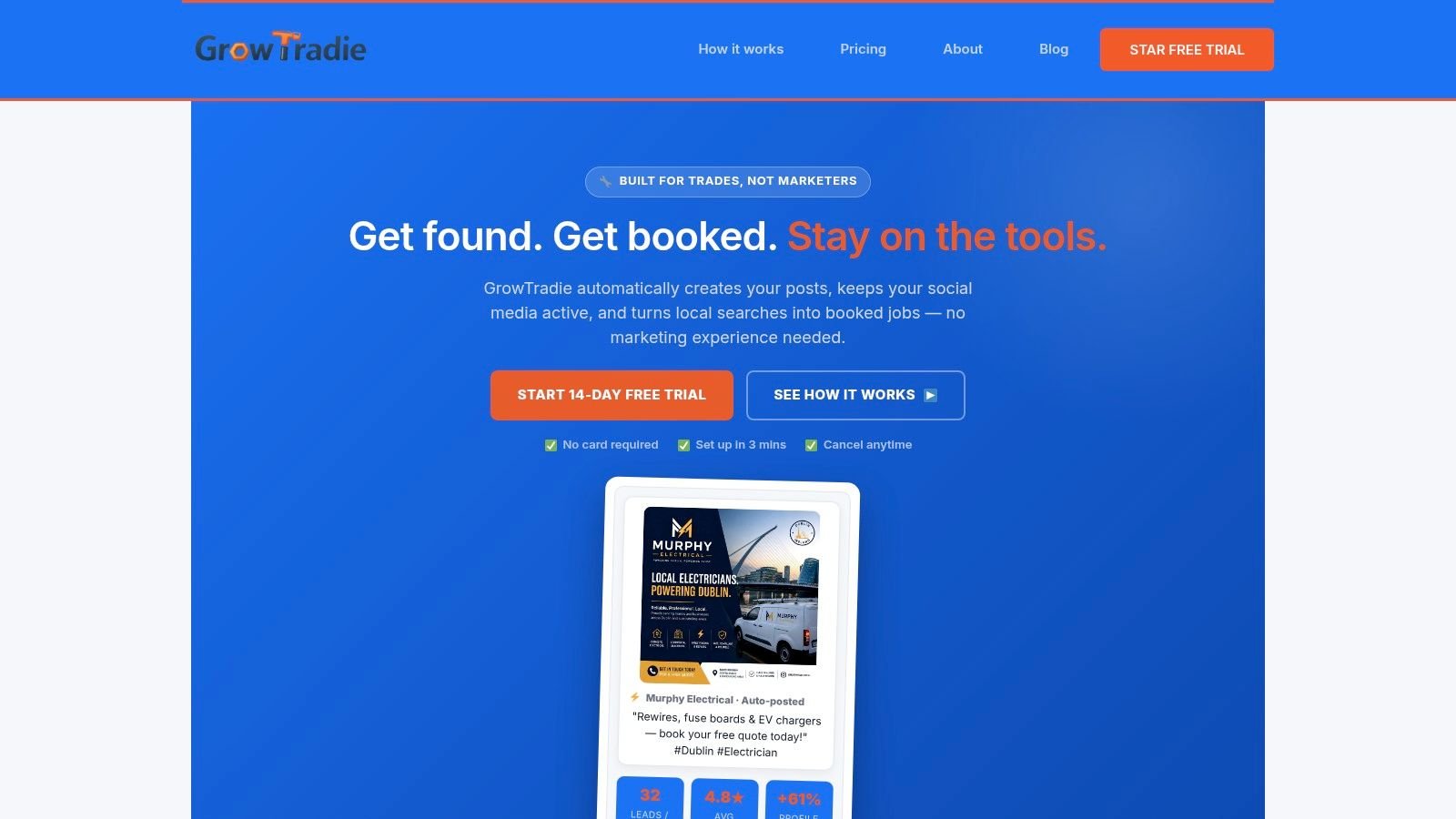
A platform like GrowTradie takes the basic inputs, your trade, your services, and your suburb, then turns them into trade-specific posts that are professionally designed and scheduled for you. That matters because most local operators don't have time to write, format, and post content every week. They need the visibility without the admin.
Consistency is key. When the posting cadence runs in the background, the business doesn't go quiet between jobs. That steadiness is what keeps names in front of locals who are ready to enquire later, not just now. It also removes the stop-start problem that kills a lot of decent local marketing efforts.
Focus on enquiries, not just activity
The next step is better feedback. Performance insights, once available, will help show which posts drive enquiries instead of just likes. That's the right direction, because likes don't pay the bills. Booked jobs do.
For a trade business, the automation model makes sense for three reasons. First, it protects your time. Second, it keeps your local presence steady. Third, it gives you a cleaner link between what you post and what the phone does next. If you're serious about staying visible all year without building a marketing team, this is the kind of system that makes sense.
If you want a steadier way to stay visible in your patch without adding more to your plate, take a look at GrowTradie. It's built for trade businesses that need consistent local presence, professional posts, and a simple way to turn attention into real enquiries. Set it up once, keep the business showing up, and let the system do the repeat work while you stay on the tools.