

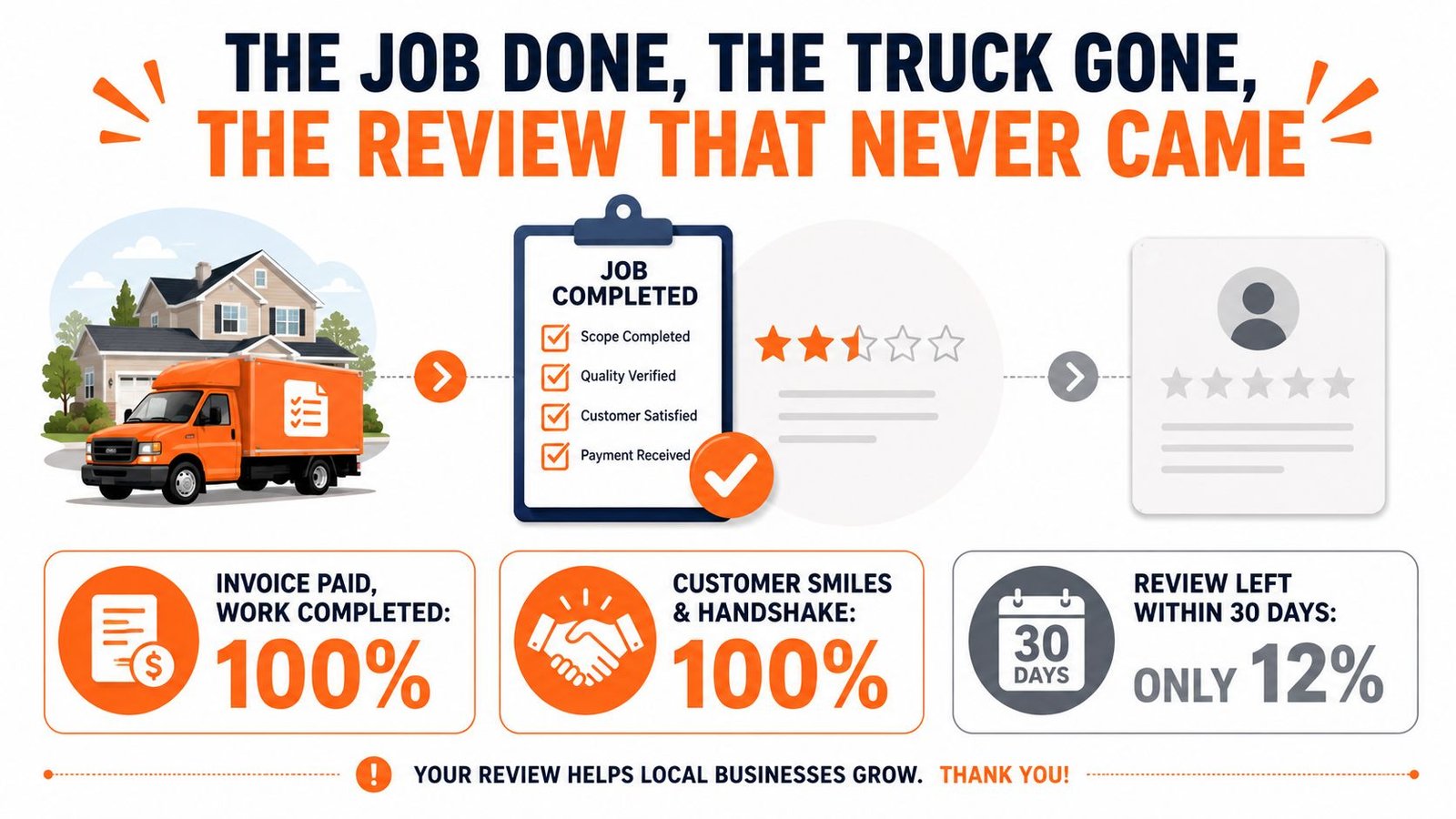
The invoice is paid, the customer is smiling, and the van is already loaded. You drive away thinking the job went well, then check your profile a few weeks later and find the same review count staring back at you. Nothing went wrong on site. The missing step happened after the work was finished.
For plumbers, electricians, carpenters, and HVAC technicians, how to get customer reviews isn't mainly a marketing question. It's an operations question. The review request needs to sit beside the invoice, job photos, warranty details, and final customer check, so it happens while the customer still remembers the relief of having the problem sorted.
Table of Contents
- The Job Done, The Truck Gone, The Review That Never Came
- The Right Moment to Ask and the Right Way to Do It
- Where Reviews Belong and Why One Platform Should Lead
- Follow-Up Cadence and Automation That Runs Itself
- Handling Negative Reviews Without Spiralling
- Staying on the Right Side of Google and the ACCC
- Your 30-Day Review System and the Numbers Worth Watching
The Job Done, The Truck Gone, The Review That Never Came
A homeowner calls because a hot-water system has failed, a switchboard needs attention, or a leaking pipe is damaging the cupboard below the sink. You arrive, explain the fault, do the work, test everything, clean up, and walk the customer through what you've completed. They thank you at the door and tell you they'll recommend you to a neighbour.
Then the day moves on. You have another call, a supplier to chase, an apprentice to brief, and an invoice to send. The customer gets back to work, school pickup, dinner, or whatever filled the hours before you arrived. They may be happy with the result, but happiness doesn't automatically become a public review.
That gap is where good feedback disappears.
A good job doesn't create a review by itself
Most customers won't open Google later, search for your business, find the right profile, sign in, and write a thoughtful review without a prompt. They need a clear request, a direct path, and a reason to act now rather than vaguely intending to do it later.
Word of mouth still matters, but it has a limitation. A referral only reaches the people your customer happens to speak with. A review sits in front of strangers who are comparing local providers when they need help, often without knowing anyone who can personally vouch for you.
The difference matters because online reviews are already part of the buying process. Pew Research's study of online reviews found that 82% of U.S. adults said they at least sometimes read online ratings or reviews before buying something new, while 40% said they always or almost always did so. The same research found that 51% of review readers thought reviews generally gave an accurate picture of product quality, but 48% said it was often difficult to tell whether reviews were truthful and unbiased.
That combination tells you what a review must do. It has to be visible, but it also has to feel real.
Reviews are proof for people who've never met you
At 9pm, a homeowner comparing three profiles doesn't know how you speak to customers, whether you arrive when promised, or how carefully you leave the site. They can't see the parts of your service that a past customer experienced firsthand. They see your business name, star rating, recent comments, perhaps a project photo, and the pattern formed by other people's experiences.
BrightLocal's Local Consumer Review Survey reported that 77% of consumers in 2021 said they always or regularly read online reviews when browsing for local businesses, compared with 60% in 2020. The survey also found that 49% trusted customer reviews as much as personal recommendations from friends and family.
The trust issue is just as important. 62% said they'd seen a fake review for a local business in the previous year, and 67% said fake reviews made them distrust reviews overall. A profile full of vague praise can therefore look less useful than a smaller set of specific, believable comments about the job, communication, cleanliness, or follow-up.
Practical rule: Ask for an honest account of the completed job, not a five-star rating. Specific feedback builds credibility because it gives strangers something they can recognise.
Treat the request as part of the handover
The cleanest workflow starts before the job. Capture the customer's mobile number at booking, confirm how you'll contact them, and make the review request one of the final steps in your job management process.
Your technician marks the work complete. The customer receives the invoice or completion message. The review request follows while the outcome is still fresh. That sequence turns a vague intention into a repeatable handover task.
A business that makes reviews part of the wrap-up process is building brand authority through completed work and visible customer experience, not just asking for attention. The broader principle is covered in this guide to brand authority for trade businesses.
Consistent collection also helps with recency. Independent survey data found that reviews less than 30 days old were trusted by 73% of respondents, compared with 64% for reviews 30 to 90 days old, 41% for reviews 90 to 365 days old, and 19% for reviews older than a year, as reported by BGR Review's consumer trust research. Those figures don't mean an older review has no value. They show why collecting feedback needs to continue after you've built a decent profile.
The Right Moment to Ask and the Right Way to Do It
Ask when the customer has just seen the finished result, not when your memory finally catches up with your admin. Review-request data reports a 42% conversion rate for SMS, compared with 9% for email, and shows that requests sent within 0 to 2 hours after completion converted at 42%. That rate fell to 31% at 2 to 6 hours, 18% at 6 to 24 hours, 11% at 24 to 48 hours, and 6% after more than 48 hours, according to Launch365's review-request benchmark.
The practical setup is simple. The person who closes the job, or the office coordinator if you have one, triggers a short SMS with one direct review link. Don't put links to Google, Facebook, three directories, and your website in the same message. A customer on a phone should know exactly what to tap.
The request should feel like a handover, not a favour.
Try this SMS:
Hi [Name], thanks for choosing [Business Name] today. If you've got a minute, we'd appreciate an honest review of the work here: [direct review link]. Thanks, [Technician Name]
If the customer is still on site, mention the request while you explain the completed work, then send the link after you've left. Don't stand over them while they write it. Google policy guidance says businesses shouldn't pressure customers to leave ratings while they're on the premises, and Google review policy guidance also prohibits incentives in exchange for reviews.
For email, keep the subject plain:
Subject: How did we do on your [job type]?
Hi [Name], thanks for having [Business Name] take care of your [job type]. We'd value your honest feedback about the experience. You can leave it here: [direct review link]. Regards, [Name]
The point isn't clever wording. It's timing, one link, and low effort.
Where Reviews Belong and Why One Platform Should Lead
A tradie who asks customers to review eight different sites usually ends up with thin profiles everywhere. Start with the platform local customers already use to check your business, then build a strong, active profile there before adding secondary directories.
For most service businesses, Google Business Profile should lead because it puts reviews beside your business details during local searches and when inspecting map listings. Facebook can support trust when customers already use your page, while trade-specific directories can help in categories where homeowners compare providers inside that directory.
Don't confuse presence with priority. Claiming a profile is sensible. Splitting every review request across multiple destinations is usually not.
| Platform | Best For | Volume Needed to Stand Out |
|---|---|---|
| Google Business Profile | Local discovery, map comparisons, and the first profile many customers inspect | A steady flow of recent, specific reviews |
| Customers who already follow or check your business page | Enough recent feedback to make the page look active | |
| Trade directories | Category-specific comparison and referral traffic | A complete profile with credible reviews relevant to the trade |
There isn't a universal number that counts as enough. Compare your profile with the businesses customers see beside you, then focus on closing the gap in recency, detail, photos, and responsiveness, not just the star average.
Build the primary profile first
Use one direct link in your SMS and email. Add the same link to your invoice footer, completion message, and a QR code on a leave-behind card if that suits your workflow. The customer shouldn't have to search for your business name or work out which listing is genuine.
Once the main profile receives reviews consistently, choose the next platform based on customer behaviour. A trade directory makes sense if it sends relevant enquiries. Facebook makes sense if customers use your page to validate the business. The right sequence depends on where your local buyers already look.
A focused approach also supports a broader online reputation building process, where accurate business details, customer feedback, and public responses reinforce one another instead of sitting in disconnected profiles.
Follow-Up Cadence and Automation That Runs Itself
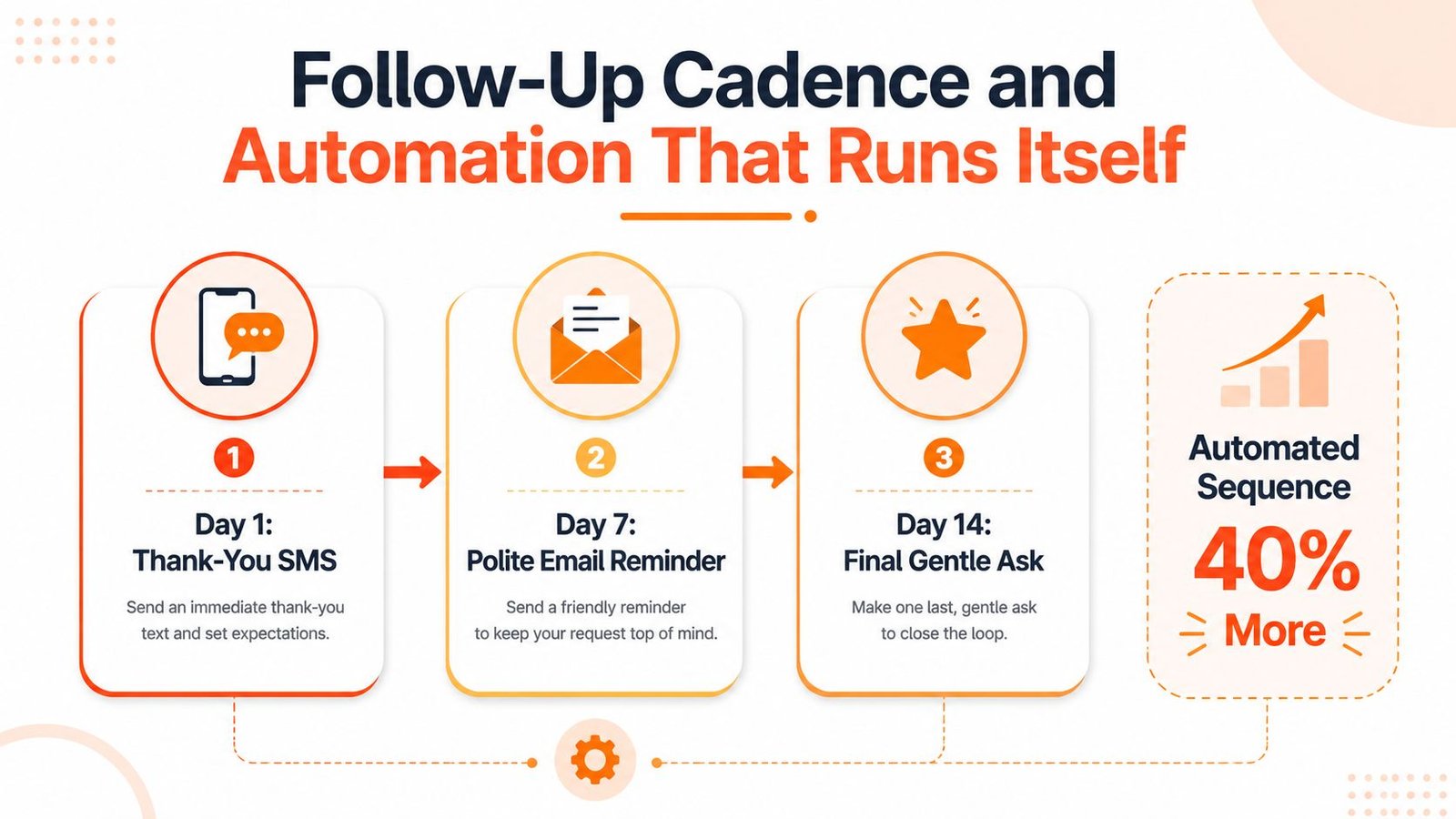
A first request won't reach every customer, even when the job went well. Review-request benchmarks report average response rates around 8.3%, with variation by platform, including 7.2% on Shopify, 12.9% on Wix, and 11.0% on BigCommerce, according to Fera's review-request benchmark. Another benchmark reported email response rates rising from 2.2% with one email to 4.1% with four emails, while typical industry practice still sits around 1% to 3%.
For a tradie, the answer isn't an endless campaign. It's a short sequence that stops automatically when the customer responds.
- Immediately after completion: Send the thank-you SMS with one review link.
- If no review arrives: Send a polite email reminder with the same destination.
- Two days later: Send a final, brief SMS or email, depending on what the customer has already received.
- After the final ask: Stop. Suppress that customer from future requests for the same job.
Your software should use the job-complete status as the trigger. Store the mobile number at booking, connect the review link to the template, and create a rule that cancels reminders when a review is detected or staff records that the customer has responded.
The system can live inside your field-service platform, CRM, email tool, or a dedicated reputation tool. The important connection is between job completion and the first request, not the brand of software.
For contractors who also need regular local posts handled, GrowTradie describes a service that creates trade-specific social posts and schedules them automatically. That supports ongoing visibility, while the review workflow should still be triggered by the completed job.
Handling Negative Reviews Without Spiralling
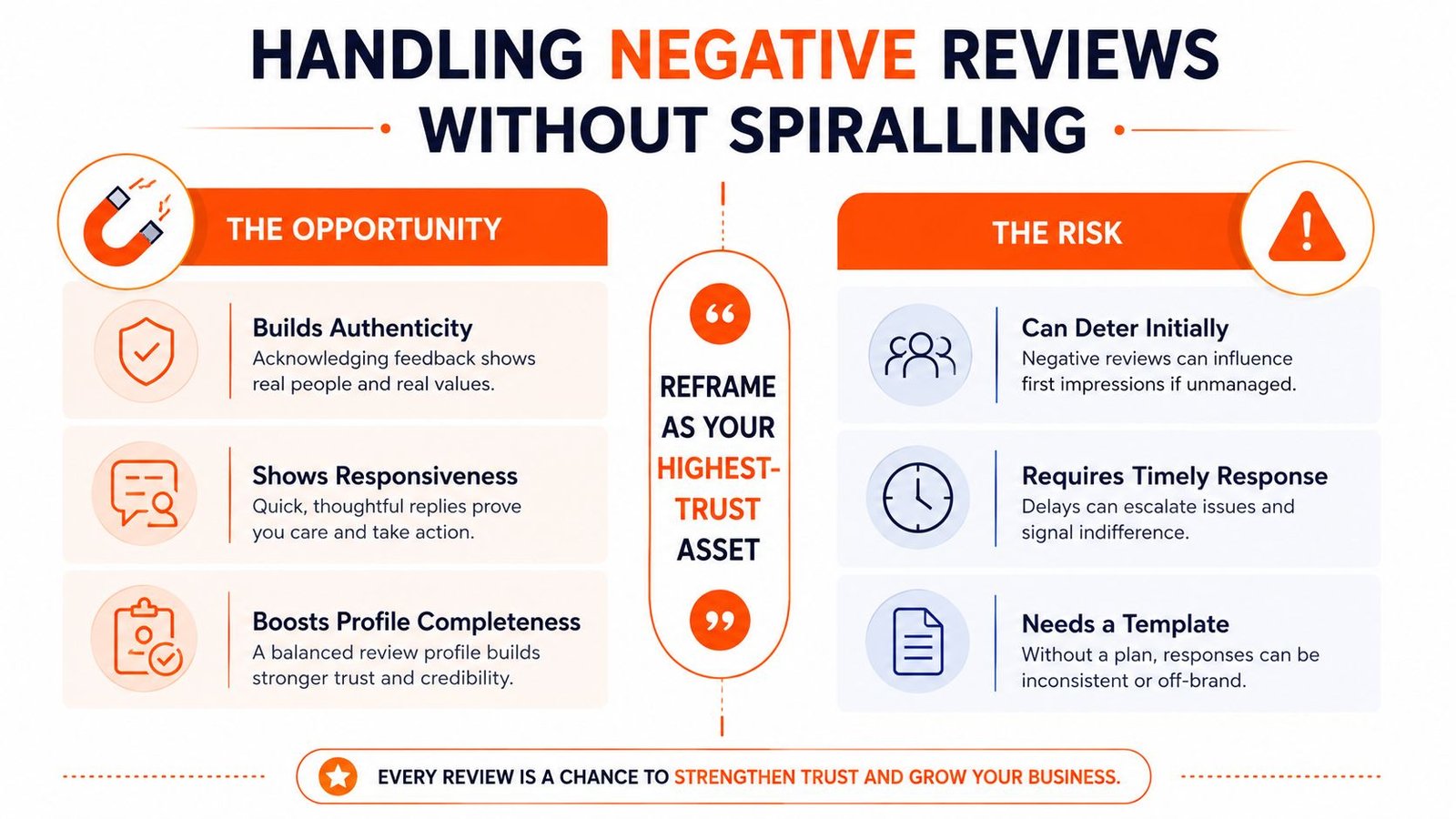
A negative review exposes your response in public. That can feel uncomfortable, but it also gives future customers evidence about what happens when a job doesn't go perfectly.
The first move is speed without panic. Respond as soon as you can establish the facts, with a practical target of resolving the issue within 72 hours, reflecting the trust premium reported for businesses that calmly respond to negative reviews and offer resolution within that window in BGR Review's survey data. Don't argue from the cab of the truck or write while you're angry.
Use a public reply to open a private resolution
A useful response has four parts:
- Acknowledge the concern: Show that you've read the actual complaint.
- State what you can confirm: Keep private details out of the public reply.
- Offer a next step: Give a phone number or ask the customer to contact the office.
- Follow through: Record the issue and assign someone to resolve it.
A suitable template is:
Hi [Name], thanks for raising this. We're sorry the experience didn't meet the standard we aim for. We'd like to review what happened and sort out the next step. Please call [number] or email [address] with your job details so [contact name] can speak with you directly.
If the complaint is accurate, say so and explain what you'll do next. If the record is wrong, don't accuse the reviewer of lying. State the relevant facts calmly, then invite a direct conversation.
A worked example
Customer review: “The electrician arrived late, left packaging behind, and wouldn't return my calls.”
A poor reply would blame traffic, question the customer's memory, and insist the work was technically correct. A stronger response would be:
Hi [Name], we're sorry we arrived later than agreed and left you chasing an update. We'll review the job notes and contact you today to discuss the packaging and your call. Please reach us on [number] so we can put this right.
That reply doesn't admit facts you haven't checked. It shows ownership of the communication problem and gives a clear route to resolution.
BrightLocal reports that 19% of consumers expect a same-day response, 32% expect a reply by the next day, and 81% expect a response within one week, as shown in its Local Consumer Review Survey. Set an internal alert for new reviews so the office can acknowledge them even when the field team is busy.
Staying on the Right Side of Google and the ACCC
The common assumption is that any review request is safe because you're only asking for feedback. The risk starts when the request manipulates who responds, what they say, or where they post.
Google's rules require reviews to reflect a real firsthand experience. They prohibit payment, discounts, or other incentives offered in exchange for reviews. Businesses also shouldn't pressure customers to leave ratings while they're on the premises, and people with conflicts of interest, including current or former employees, contractors, or close personal affiliates, shouldn't review the business, according to Google review policy guidance.
The practical line for tradies
| Risky behaviour | Safer practice |
|---|---|
| “Leave five stars and we'll take money off the invoice.” | “Please leave an honest review of your experience.” |
| Asking only customers who praise you in person | Ask customers consistently after completed jobs |
| Standing beside the customer while they submit the rating | Send the link and let them respond privately |
| Asking an employee, subcontractor, or relative to review you | Request feedback only from genuine customers |
| Drafting praise for the customer to copy | Let the customer choose their own words |
The Australian Consumer Law also matters. A testimonial or public representation must not mislead people about your service, the customer's experience, or the relationship between the reviewer and your business. You can make the process easy, but you can't manufacture independent-looking praise.
Use wording such as “honest review”, “feedback about your experience”, or “tell us what we could improve”. Avoid language that implies a positive rating is expected. A compliant system protects more than a profile. It keeps your customer records, staff habits, and public claims aligned with what happened on the job.
Your 30-Day Review System and the Numbers Worth Watching
A review system doesn't need a new employee. It needs an owner, a trigger, a message, and a short monthly check.
Week one and week two
Start by auditing your primary profile. Check the business name, phone number, service area, opening hours, photos, review link, and response history. Read the last group of reviews as a buyer would. Note whether customers mention arrival times, explanations, workmanship, tidy handover, or follow-up.
Next, choose one platform to lead and write the request templates. Load the SMS into your job-management software or CRM, then place the direct review link where the person closing the job can reach it without opening a separate marketing system.
Week three and week four
Wire the job-complete trigger into the follow-up sequence. Test it with an internal record before sending it to real customers. Make sure the first message fires promptly, reminders stop after a response, and someone receives an alert when a new review needs a reply.
Create a response process for both praise and complaints. A short thank-you is enough for a simple positive review, while a detailed complaint needs an assigned owner and a private resolution path.
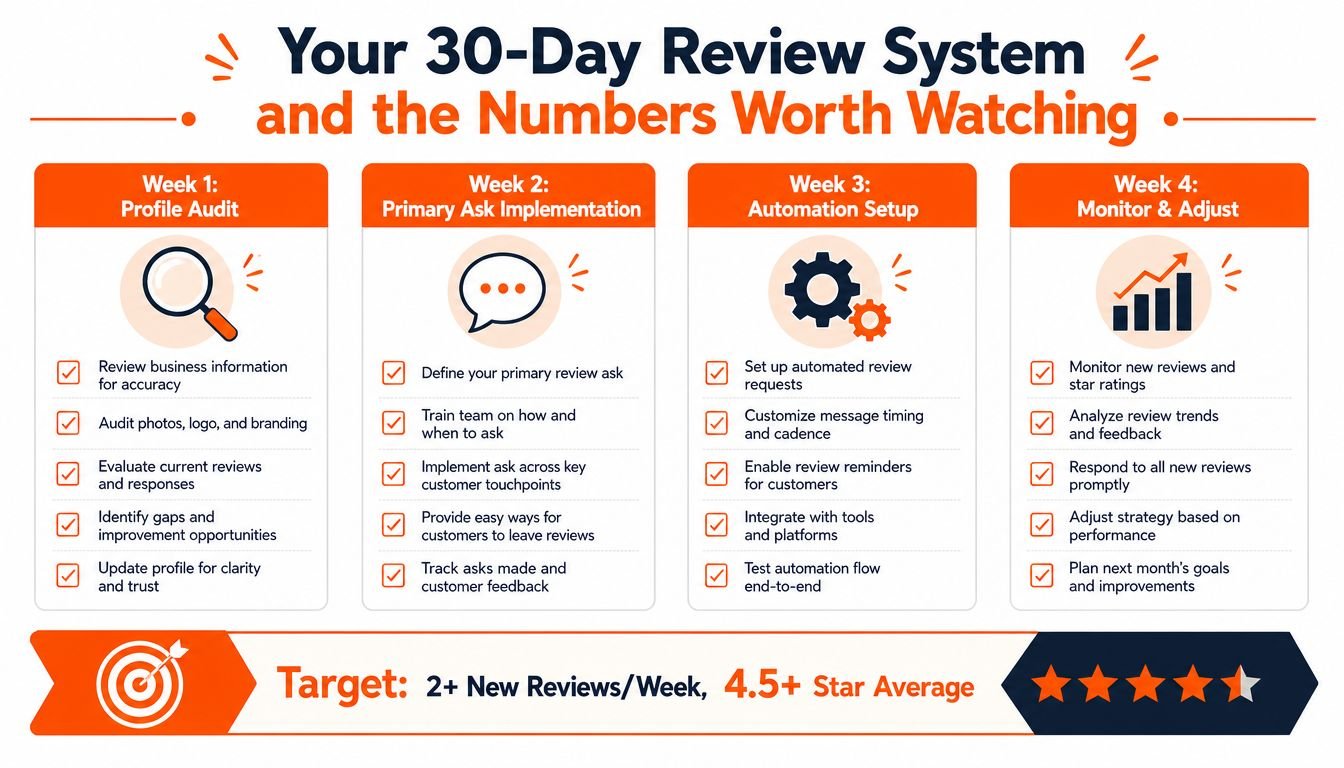
Track a small dashboard each month:
- New review count: Shows whether completed jobs are producing fresh feedback.
- Average rating: Gives context, but shouldn't replace reading the written comments.
- Response time: Compare your internal response with customer expectations.
- Review recency: Shows whether the profile reflects current service.
- Specificity: Look for useful detail about the work, communication, and finish.
Don't chase a perfect-looking profile at the expense of authenticity. Buyers are increasingly concerned about fake or AI-generated reviews, with 62% reporting concern in 2026, while 83% said reviews matter only when they're recent and relevant, according to Harvard Business Review's review research. The same principle applies to format. Recent research reported that 51% of consumers look for reviews containing photos and 94% trust verified purchase reviews more, as summarised in GoodFirms' survey release. For a tradie, that can mean inviting customers to describe the completed work or share a project photo when appropriate, without scripting the result.
The system is working when the request happens without relying on your memory. Set up the profile audit this week, load the first message, and assign one person to review the dashboard monthly.
GrowTradie helps trade businesses stay visible with AI-generated, locally focused social posts that are professionally designed, scheduled, and posted automatically between jobs. Visit GrowTradie to set up consistent content and keep building the trust that turns completed work and customer reviews into more local enquiries.