
89% of B2B marketers use organic social media to distribute content, 84% use paid channels, and 9 in 10 say their website is a primary distribution channel. For a tradie, what is content distribution? It's getting your posts, photos, and offers in front of the right locals on the right channels, so your phone rings and quote requests come in instead of your work sitting unseen.
That matters because most plumbers, sparkies, and carpenters aren't short on good work, they're short on time and visible proof. You can do a tidy job, leave a customer happy, and still go quiet online for weeks, which means the next local with a burst pipe or a faulty circuit finds someone else first. Content distribution fixes that gap by turning finished jobs into a repeatable system that keeps you in front of people who already need a trade.
Table of Contents
- The Quiet Week and Why Content Distribution Matters for Tradies
- What Content Distribution Means in Plain Language
- The Three Channel Types Tradies Need to Know
- The Five Distribution Channels That Bring Local Work
- A Simple Distribution Workflow Tradies Can Run Between Jobs
- A Week in the Life of a Tradie Running This System
- Measuring What Matters Beyond Likes and Impressions
- Your Starter Plan and How GrowTradie Keeps It Running
The Quiet Week and Why Content Distribution Matters for Tradies
Wednesday rolls around, the ute's clean, the gear's packed, and the phone's been flat since breakfast. You've finished the jobs you had lined up, but the next one hasn't landed yet, and that's the sort of week that makes a lot of tradies stare at the screen and wonder what they're missing.
The answer usually isn't better work. It's better distribution.
Customers don't wake up and ring the first tradie they see by accident. They scroll photos, check reviews, ask a mate, compare a few businesses, and look for signs that someone's active, local, and reliable. If your finished jobs, service tips, and offers only live on one channel, you're relying on chance. Content distribution puts those assets where locals look.
Practical rule: if a local can't bump into your work more than once, you're making them do all the remembering.
That's why content distribution is worth treating like part of the job, not a side hustle. In trade work, the product isn't just the service, it's trust. A tidy before and after, a short job site update, or a quick “here's what to do before we arrive” post can keep you visible without turning you into a full-time marketer. The point is simple, you're not chasing attention for its own sake, you're staying in the mix until the call comes.
The bigger market data backs up how embedded this has become. The content distribution market is already measured in the hundreds of billions of dollars, and it's projected to keep growing, with video carrying the biggest share of the market in 2025, according to Mordor Intelligence's market estimate cited in the brief. That matters because the industry has moved well beyond random posting, it's now a structured system built around channels, formats, and repeatable reach.
If you want a tradie-friendly starting point for thinking about channel planning, this small business content strategy guide is a useful companion.
What Content Distribution Means in Plain Language
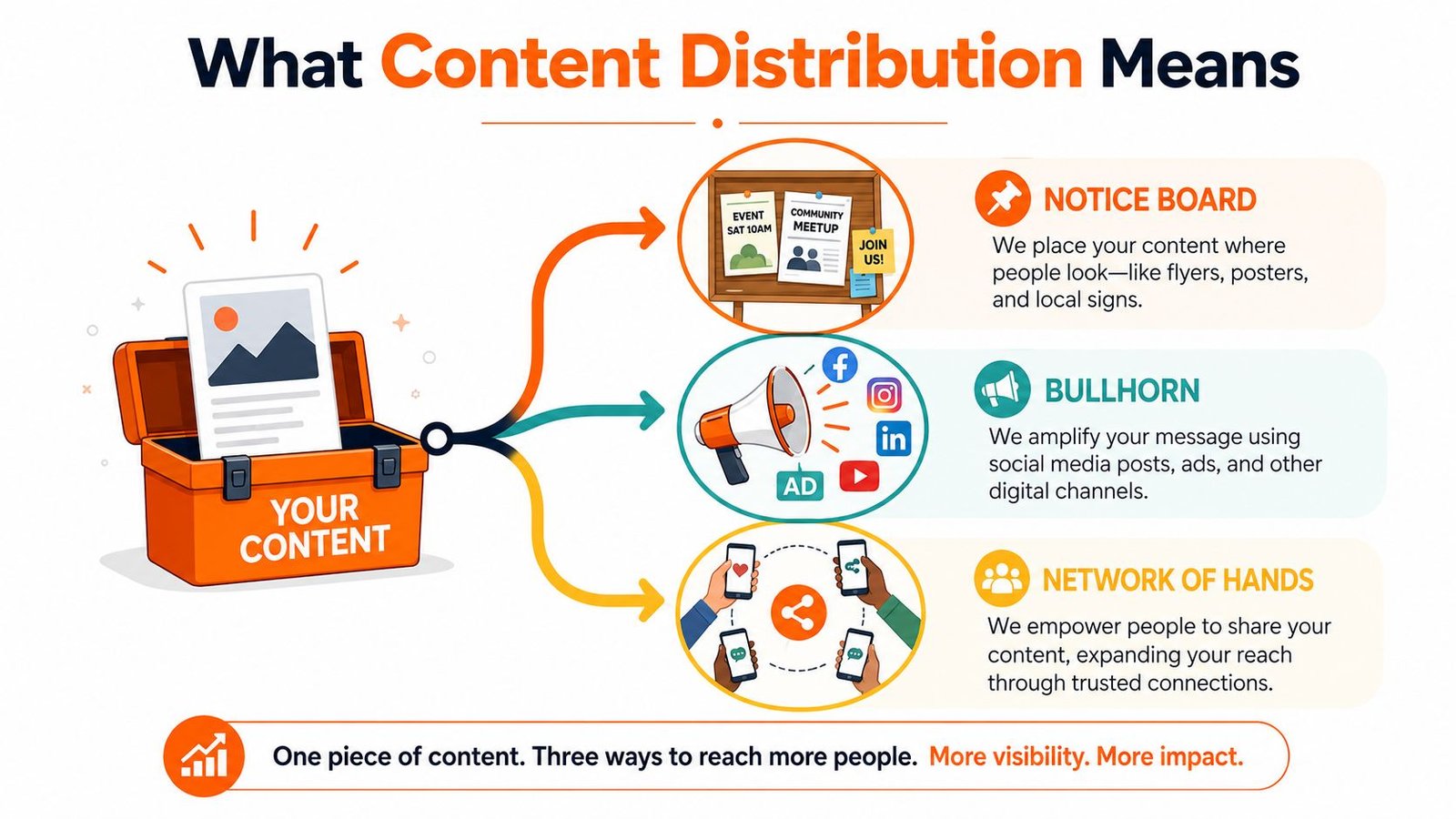
You've finished the job, now the work starts. Content distribution is the part where you get that photo, tip, offer, or job update in front of local people through posting, scheduling, sharing, repurposing, and promotion.
A finished job is the product. Distribution is the van parked on the main road with the signage on the side.
Creation and distribution are not the same job
These two get mixed up all the time. Content creation is making the asset. Content distribution is getting it seen, read, and acted on. One source puts it plainly, creation makes the asset and distribution makes it discoverable and useful, while another describes distribution as the system that turns raw creative effort into reach and results Rankyak. That split matters because plenty of tradies post once and then wonder why nothing happens.
You do not build the bathroom and leave it in the shed. You install it where the customer can use it.
The three media buckets that make sense for tradies
The cleanest framework is owned, earned, and paid media, which is the standard way industry sources break it down Outbrain.
- Owned is your turf, things like your website, Google Business Profile, Facebook page, and email list.
- Earned is what other people give you, reviews, referrals, community mentions, and word of mouth.
- Paid is where you put money behind reach, like boosted posts or local ads.
For a local tradie, that is practical. Your own channels are where you control the message. Earned channels are where trust shows up. Paid channels are what you use when the week is quiet and you need the phone to ring faster.
Content distribution is broader than social posts. It reaches websites, email, social media, and other customer touchpoints, which is why it works best as a system instead of a one-off post Contentful. If you want a broader framework for that, a small business content strategy guide helps connect planning to action.
The Three Channel Types Tradies Need to Know
Tradies don't need a marketing degree. They need a simple map for where their content goes and why it matters. The three channel types, owned, earned, and paid, give you that map without the fluff.
Owned channels are your shopfront
Owned channels are the spaces you control. Your website, Google Business Profile, Facebook page, and email list belong in this bucket. If you post a job photo on your own page, you decide what's shown, when it's shown, and how it's framed.
That control matters because it gives you a stable base. You can publish a before-and-after, a safety tip, or a seasonal reminder without asking permission from anyone else. The downside is simple, if you don't keep those channels active, they go stale.
Earned channels are trust passing through other people
Earned channels are where other people do the talking for you. That includes reviews, referrals, supplier mentions, and local community chatter. A happy customer dropping your name in a suburb group is worth more than a polished post nobody believes.
Local buyers trust signals from people they already know. That's why referrals and reviews still punch above their weight.
Paid channels jump the queue
Paid channels are how you get in front of people faster. A boosted post, local ad, or search ad can put your work in front of the right postcode while you're still on site. It's not a magic fix, but it does help when you've got a gap in the diary.
For tradies, the point isn't to split hairs between channel names. It's to know which bucket each effort belongs in and how much control you've got. Owned channels keep you visible. Earned channels build trust. Paid channels buy speed.
If you're mapping those channels to local lead flow, this local contractor guide is a helpful reference point.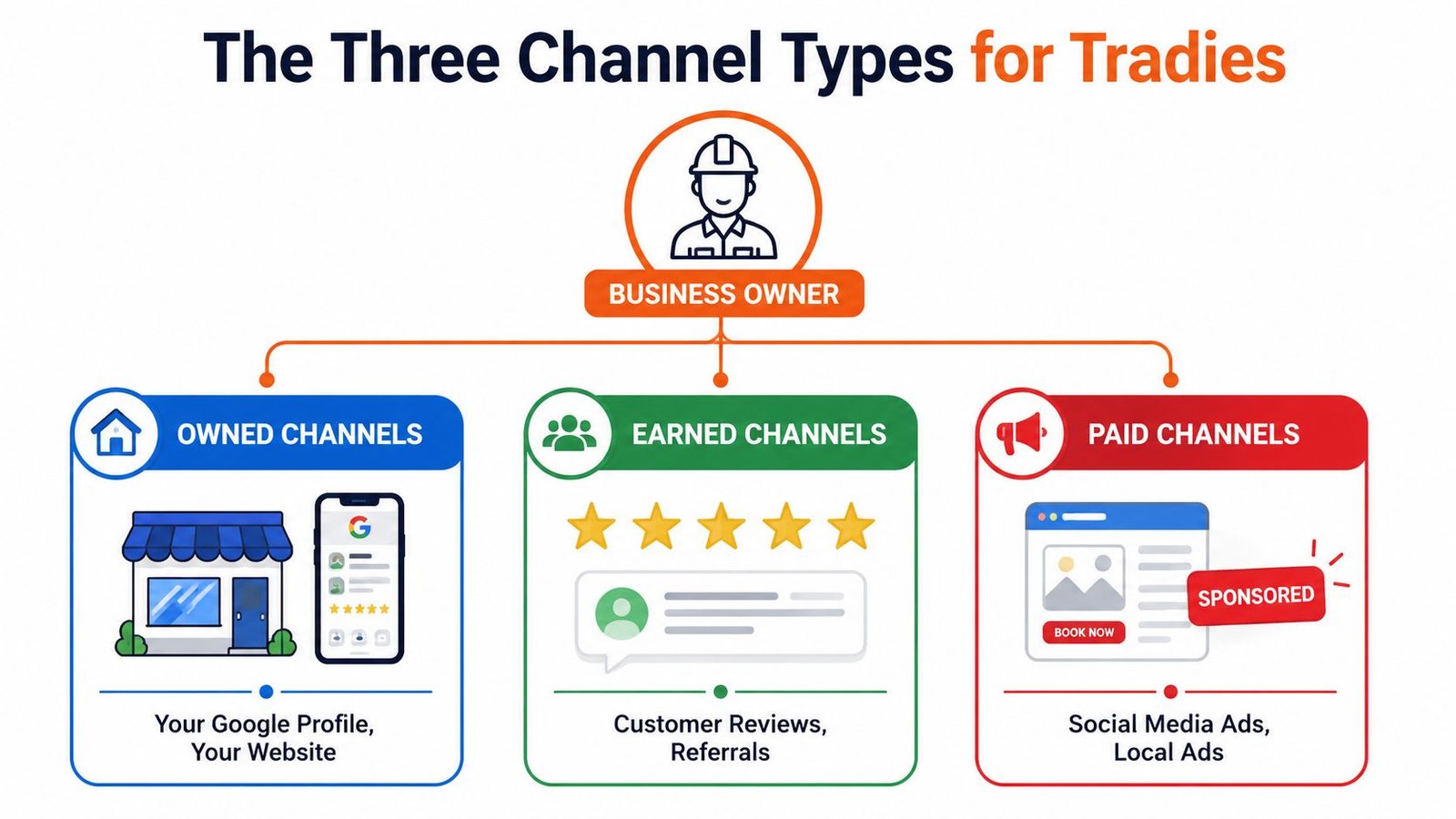
The Five Distribution Channels That Bring Local Work
If you want booked jobs, focus on five channels, social media, email, local listings, paid promotion, and syndication. The rest can wait. Tradies do not need a dozen marketing lanes, they need a small system that keeps jobs coming in while they're on the tools.
Social media keeps you visible between jobs
Facebook and Instagram are still where a lot of tradies show recent work, quick tips, and short promo offers. A before-and-after from a bathroom repair, a short clip from a switchboard upgrade, or a photo of a neat finish tells locals you're active and available. The post does not need to be clever, it needs to be clear.
One smart move this week is to post three job photos with a different angle on each one, a finished result, a common problem you solved, and a quick reminder that you cover the local area. That gives you more than one use from the same site visit, and it keeps your feed from going stale.
Email keeps past clients warm
A short email to past customers is one of the simplest ways to get repeat work. You are not writing a newsletter like a media company. You are reminding people you exist, showing one recent job, and giving them a reason to call back when something small comes up.
Email works best after the job is done and the client already trusts you. That is where repeat bookings, small fixes, and referrals start to stack up.
Local listings catch intent
Google Business Profile and trade directories are where people go when they need help now. If your profile is current, complete, and backed by solid photos and reviews, you are much easier to choose. A tradie who wants better local visibility should treat listings like digital signage, not a set-and-forget profile.
For a practical example of how local search supports lead flow, this local contractor resource is worth a look.
Paid promotion is for quiet weeks
A boosted post or local ad can fill a gap fast, especially when you want visibility in a specific suburb or service area. Use it for a clear offer, not a vague brand message. If the ad does not point to a call, message, or quote request, it is probably too soft.
Paid promotion should do one job, start conversations with people nearby who are ready to act. Anything else wastes the budget.
Syndication stretches one asset further
Syndication is just repurposing. One job photo becomes a Facebook post, an Instagram post, an email snippet, and a listing update. That is how small trade businesses stay active without burning the day.
You should not be starting from scratch every time you want to post. One good job can feed several channels, and that is how a tradie keeps marketing running without turning it into a second job.
| Channel | Effort | Typical Cost | Lead Quality |
|---|---|---|---|
| Social media | Low to medium | Low | Medium |
| Low | Low | High for repeat work | |
| Local listings | Medium | Low | High |
| Paid promotion | Low to medium | Medium | High when targeted well |
| Syndication | Low once the asset exists | Low | Medium |
A Simple Distribution Workflow Tradies Can Run Between Jobs
The biggest barrier isn't strategy. It's time. Most tradies don't need more ideas, they need a system that doesn't collapse when the day gets busy.
A one-hour Sunday setup beats daily guesswork
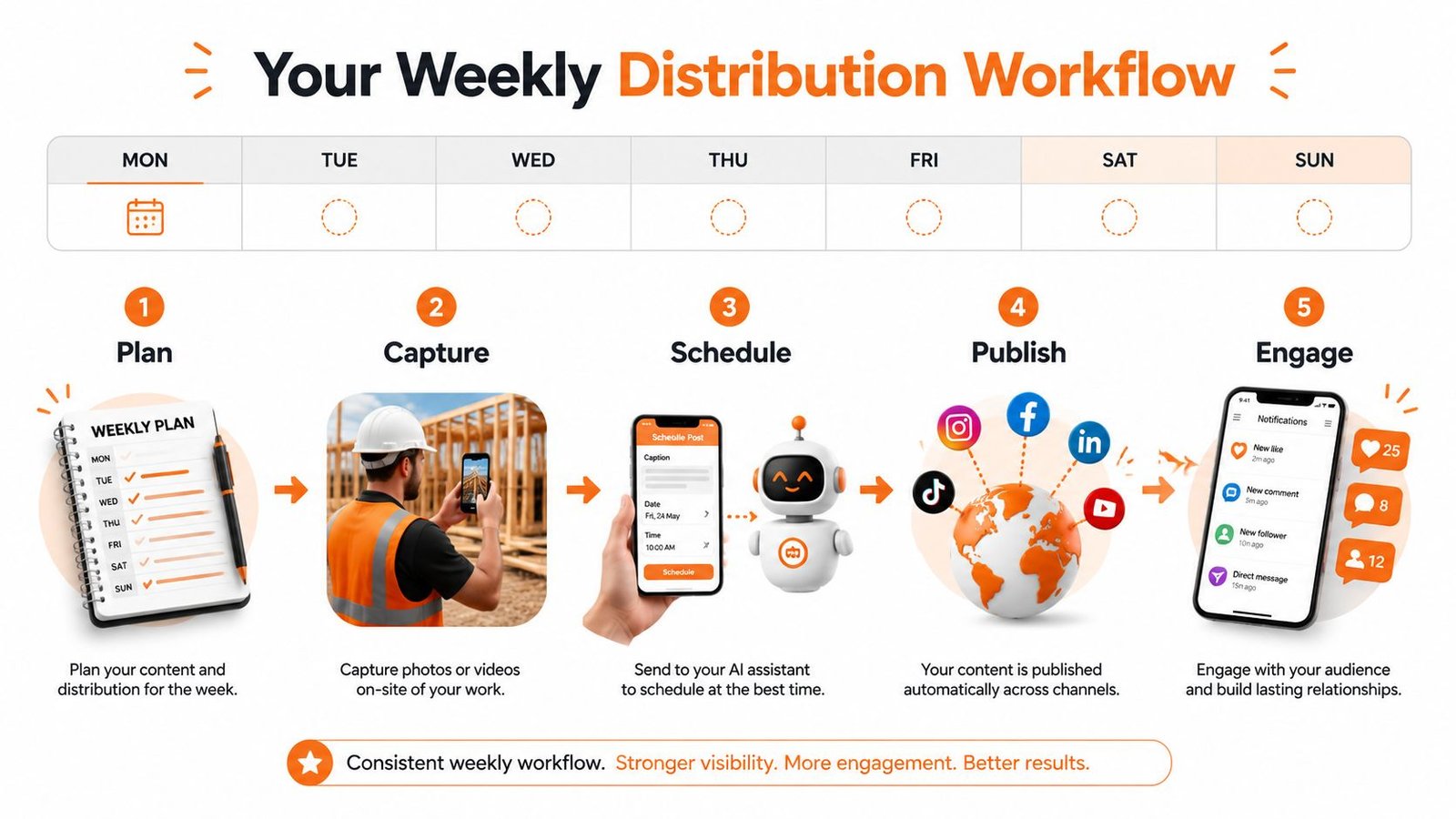
A workable routine is simple. Spend about 15 minutes planning the week, 15 minutes sorting the photos you already took, 15 minutes scheduling the posts, and 15 minutes checking what went out. That's enough to keep your presence alive without turning Monday morning into a content scramble.
One resource that fits this way of working is this batching guide, because batching is what keeps the system from becoming a daily headache.
The five steps that keep the wheels turning
- Plan the week. Pick one service, one promo, and one helpful tip.
- Capture on site. Take job photos before you pack up.
- Schedule or hand it off. Get the content lined up instead of trying to remember it later.
- Publish across channels. Push the same asset to your main places.
- Engage and review. Reply to comments, messages, and calls, then note what brought attention.
Each step should feel light. A plumber can snap three photos on a hot water job, turn one into a before-and-after, another into a tip about warning signs, and the third into a short service reminder. That's one visit turning into a week of visibility.
A good workflow removes the daily decision of “what do I post?” That's the part that kills consistency.
The system starts earning its keep. Once the routine is set, you're not trying to be a content creator. You're just turning normal jobs into ongoing proof that you're active, local, and ready for the next call.
A Week in the Life of a Tradie Running This System
A sole trader sparky doesn't need a dramatic launch. He needs a week that doesn't go silent. Monday starts with half an hour in the ute, sorting two photos from last week's jobs and choosing one service tip to pair with them.
Tuesday, the posts are scheduled before the first job starts. One goes to the main profile, one gets adapted for a listing update, and one is held back as a short reminder for later in the week. Nothing fancy, just enough movement to keep the business from looking dormant.
On Wednesday, he runs a small paid promo to the local area because the calendar has a gap. Thursday brings two quote requests through the Google Business Profile. Friday, a past customer replies to a short email and books a small repair for next month.
That's the whole point. No viral moment, no overnight flood of leads, no nonsense.
Practical rule: consistency beats intensity when the goal is booked work, because locals notice businesses that stay visible and respond quickly.
The useful metrics are the ones tied to action, not applause. Profile views, calls, messages, quote requests, and repeat bookings tell you more than a pile of likes ever will. A post with a smaller audience but two enquiries is better than a flashy post that does nothing.
This kind of week works because each channel has a job. Owned channels keep the business visible. Earned channels give it trust. Paid promotion fills the gaps. The whole thing adds up to a steady flow of enquiries instead of random bursts.
Measuring What Matters Beyond Likes and Impressions
Likes feel good. Impressions sound impressive. Neither one pays a supplier or keeps the trailer stocked.
The numbers that matter for a tradie are the ones that move a job forward, website visits from your area, quote requests, calls from new numbers, confirmed bookings, profile views, messages, and repeat work from past clients. If a post gets attention but doesn't drive one of those actions, it's not doing much for the business.
Track the path from post to job
You don't need a complicated dashboard. Use a dedicated enquiry email, a call tracking number if you can, and a five-minute weekly review. The point is to see which post, channel, or offer got someone to take the next step.
A good habit is to mark each enquiry source as soon as it comes in. If a customer says they found you through a Facebook post, write it down. If they came from your profile, note that too. That simple discipline helps you spot what's worth repeating.
Revenue metrics beat vanity metrics
| Revenue signals | Vanity signals |
|---|---|
| Calls | Likes |
| Quote requests | Impressions |
| Messages | Generic reach |
| Booked jobs | Random engagement |
The first set tells you someone moved closer to buying. The second set only tells you the content was seen. There's a place for reach, but reach without response is just noise.
The broader point is consistency. A steady system gives you cleaner data than random posting does, because you can see what changes enquiries over time. That's where a tool that handles the planning, design, and publishing work starts to matter, because the less manual grinding you do, the easier it is to stay consistent enough to measure anything properly.
Your Starter Plan and How GrowTradie Keeps It Running
Start with one month of content, one weekly setup session, and three channels, your main profile, your listings, and one paid boost when needed. Watch calls, quote requests, messages, and repeat work, because those are the signals that tell you whether the system is helping the business.
If you want a practical way to keep that running without turning into a part-time marketer, GrowTradie does the heavy lifting. It uses AI to create trade-specific posts, designs them professionally, and auto-posts them so your profiles stay active between jobs, which is exactly what a time-poor tradie needs when the diary is full and the marketing gets pushed aside.
If you want your content to keep working while you're on the tools, use GrowTradie to turn job photos and service updates into a steady posting system. It's built for tradies who need more local enquiries without the daily hassle, so visit GrowTradie and set up a workflow that keeps your business visible and ready for booked jobs.