If you're a plumber who can diagnose a problem in minutes but still ends most weeks wondering where the money went, you're not alone. A lot of owners hit the same wall. The work is solid, the phone rings, the van stays busy, yet cash flow still feels tight and every day gets pulled apart by quoting, scheduling, call-backs, invoices, and staff questions.
That's usually the point where the trade skill stops being the main problem. The problem becomes the business around the trade.
Plumbing business coaching matters when you're stuck in that gap. Not because you need motivation, and not because you've forgotten how to work hard. You need a better operating system. The right coach helps you tighten pricing, build repeatable processes, review the right numbers, and stop running the company by instinct alone. Done well, coaching leads to steadier cash flow, fewer surprises, and a business that doesn't depend on you solving every issue personally.
Table of Contents
- From Great Plumber to Great Business Owner
- What Plumbing Business Coaching Actually Is
- Core Components of a Good Coaching Program
- Expected Outcomes and Realistic Return on Investment
- Coaching Versus Other Growth Options
- How to Choose the Right Coach for Your Business Stage
- Your Simple Next Steps
From Great Plumber to Great Business Owner
Most plumbing owners start the same way. You get good on the tools, people trust your work, referrals start coming in, and before long you've got a business. On paper, that sounds like progress. In practice, it often means you've added admin, payroll pressure, quoting mistakes, customer communication problems, and after-hours stress to an already full workday.
Being a great plumber and being a great business owner are not the same job. One is technical. The other is operational. The trap is thinking you can muscle through the second one the same way you learned the first.
A well-run plumbing business needs structure in places that many owners ignore for too long:
- Quoting discipline: Jobs need prices that cover more than parts and labour.
- Schedule control: The day falls apart quickly when urgent work constantly overrides planned work.
- Cash handling: Revenue means very little if invoicing is late or margins are thin.
- Team clarity: Staff need defined expectations, not constant rescue from the owner.
Practical rule: If your business only works when you personally stay in the middle of everything, you don't own a system yet. You own a job with overhead.
That's where coaching earns its keep. Good plumbing business coaching doesn't add more noise. It removes it. The coach's role is to help you build a business that behaves predictably. That usually starts with pricing, reporting, role clarity, and simple operating rhythms.
Owners often resist coaching because they see it as another expense. That's understandable. But the true cost usually sits elsewhere. It shows up in underpriced jobs, weak follow-up, missed invoices, poor delegation, and constant decision fatigue.
The goal isn't to turn you into a corporate manager. It's to help you keep the strengths that made you successful on the tools while building systems that protect your time, your margins, and your sanity.
What Plumbing Business Coaching Actually Is
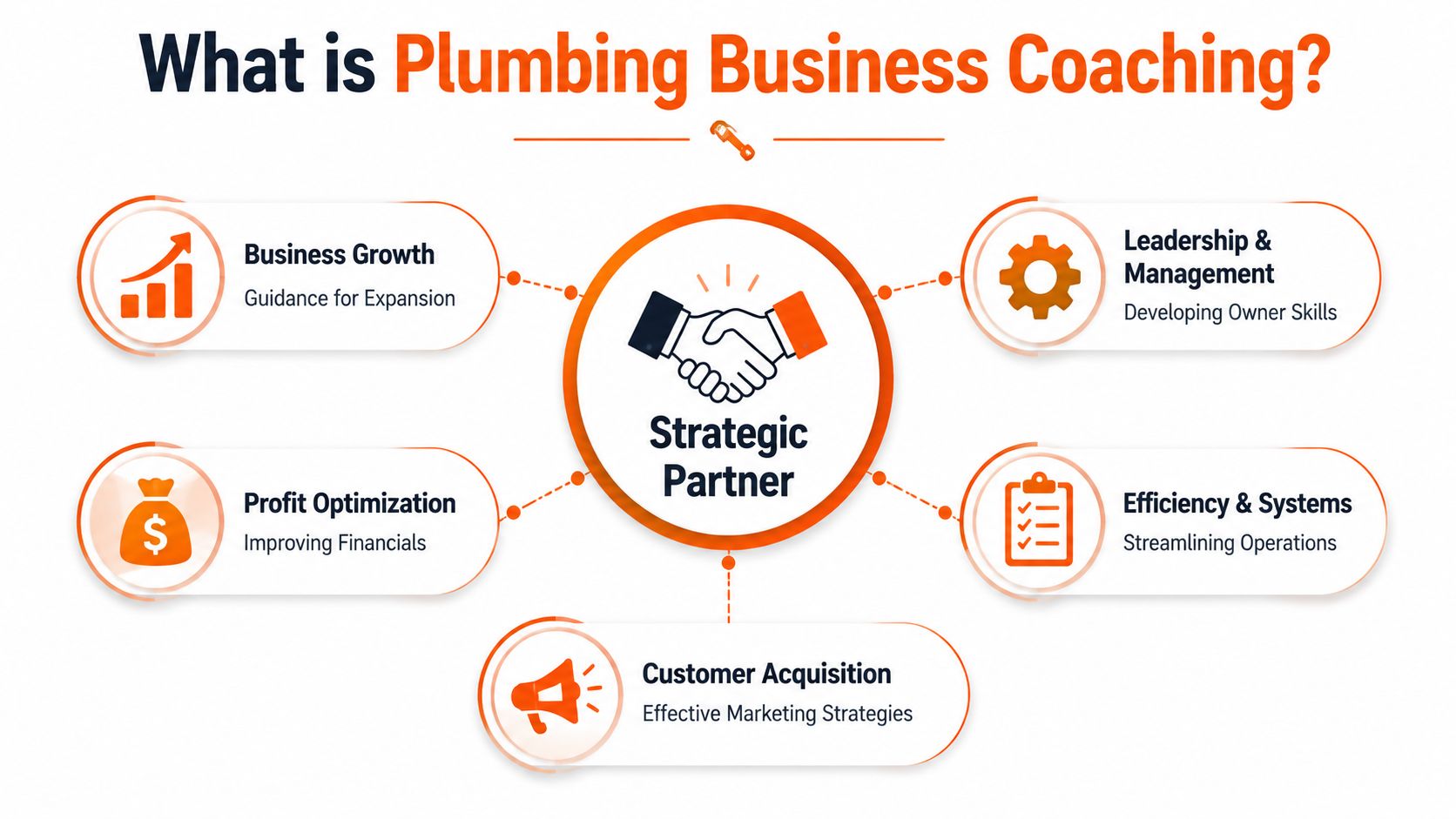
Plumbing business coaching is a structured business partnership focused on how your company operates. It isn't technical training. It isn't a mate giving advice over coffee. And it isn't someone barking orders from the sidelines.
A coach works on the business, not the wrench
A good coach looks at the parts of the business that usually create stress for owners once the work starts flowing. Pricing. Capacity. Dispatch decisions. Sales conversations. Financial visibility. Staff accountability. Owner habits.
That's why the sports analogy works. Elite athletes still use coaches, not because they don't know their craft, but because outside eyes catch blind spots. Plumbing owners have the same issue. You can be excellent at diagnostics, installs, and customer service while still leaking profit through underquoting, inconsistent follow-up, and poor job review.
A proper coaching relationship usually includes a few things:
- Accountability: Someone expects you to follow through on agreed actions.
- A playbook: You're not guessing at each problem from scratch.
- External perspective: Bad habits are easier to spot from outside the business.
- Decision support: You stop making every call in isolation.
Some owners confuse coaching with mentorship. They overlap, but they're not the same. A mentor may share useful experience. A coach should help install repeatable behaviour and measurable operating discipline.
It is a real service category, not a fad
This is not some fringe idea. The global coaching industry was valued at $5.34 billion in 2024 and is projected to reach $9.5 billion by 2032, with about 122,974 professional coaches worldwide. In that same market, about 67% identify business, leadership, or executive coaching as their main specialty, according to global coaching industry figures compiled here. That matters because it shows coaching is a mature service field with established methods, not a niche trend.
The same source reports an average coaching session rate of $234 per hour, which is a useful benchmark when you're evaluating offers and trying to separate serious operators from vague promises.
A coach should leave you with a clearer scorecard, cleaner decisions, and tighter systems. If all you get is motivation, you paid for a pep talk.
For plumbers, the best coaching lands in the day-to-day reality of a service business. It should help you answer practical questions. Are we charging enough? Which jobs make money? Where are calls dropping? Why does one tech convert well while another stays busy but unprofitable? Why is the owner still the bottleneck?
If the coach can't get into that level of detail, it's not plumbing business coaching worth paying for.
Core Components of a Good Coaching Program
The best coaching programs don't start with hype. They start with fundamentals. If pricing is wrong, overhead isn't covered, and nobody reviews the numbers properly, growth just creates bigger problems faster.
Pricing that recovers overhead
A lot of plumbing businesses undercharge without realising it. They price labour and materials, maybe add a bit for margin, and assume that's enough. It usually isn't. Good coaching tackles this head-on by forcing accurate job costing and proper overhead recovery.
That matters because many businesses ignore indirect costs such as trucks, insurance, dispatch, admin support, training, and warranty reserves. This plumbing coaching overview on overhead recovery and job costing makes the point clearly. If those costs aren't built into your pricing, a full schedule can still produce weak cash flow.
A serious coach will usually push owners to answer questions like these:
- What does one billable hour need to produce?
- Which service categories carry the strongest margin?
- Are fixed-price jobs based on real business costs or gut feel?
- Do warranty and call-back patterns need to be priced in?
For owners trying to clean up the financial side, solid bookkeeping for plumbing businesses becomes part of the same conversation. Coaching works better when the books are timely and clear enough to support decisions.
Financial review and cash discipline
Owners often say they want more profit, but what they really need first is financial visibility. A good coach won't let you stay vague. They'll want regular review of the profit and loss statement, job margins, overhead trends, and how quickly cash turns after work is completed.
Many businesses get exposed when revenue looks healthy while bank balance, tax obligations, and accounts receivable tell a different story.
If you can't explain why cash is tight after a busy month, you don't have a sales problem first. You have a visibility problem.
Good coaching usually creates a simple financial rhythm. Review results, identify leaks, fix one or two causes, repeat. No theatrics. Just numbers tied to action.
Sales process and office consistency
Plumbing owners don't always like the word sales, but every profitable service company has a sales process whether it admits it or not. Someone answers the phone. Someone explains options. Someone follows up on quotes. Someone asks for the booking.
The difference between a stressed business and a stable one often sits in how consistently those steps happen. Coaching helps standardise that process so customers get a reliable experience and the business doesn't depend on one person's memory or personality.
A solid program often works on:
| Focus area | What the coach is trying to fix |
|---|---|
| Call handling | Missed opportunities at first contact |
| Quoting | Slow turnaround or inconsistent pricing |
| Option presentation | Low acceptance because customers only hear one path |
| Follow-up | Work lost because nobody closes the loop |
| Team scripting | Techs and office staff saying different things |
The point of all this isn't to sound slick. It's to make the business easier to run and easier to trust.
Expected Outcomes and Realistic Return on Investment
Owners usually ask the right question first. Is it worth it?
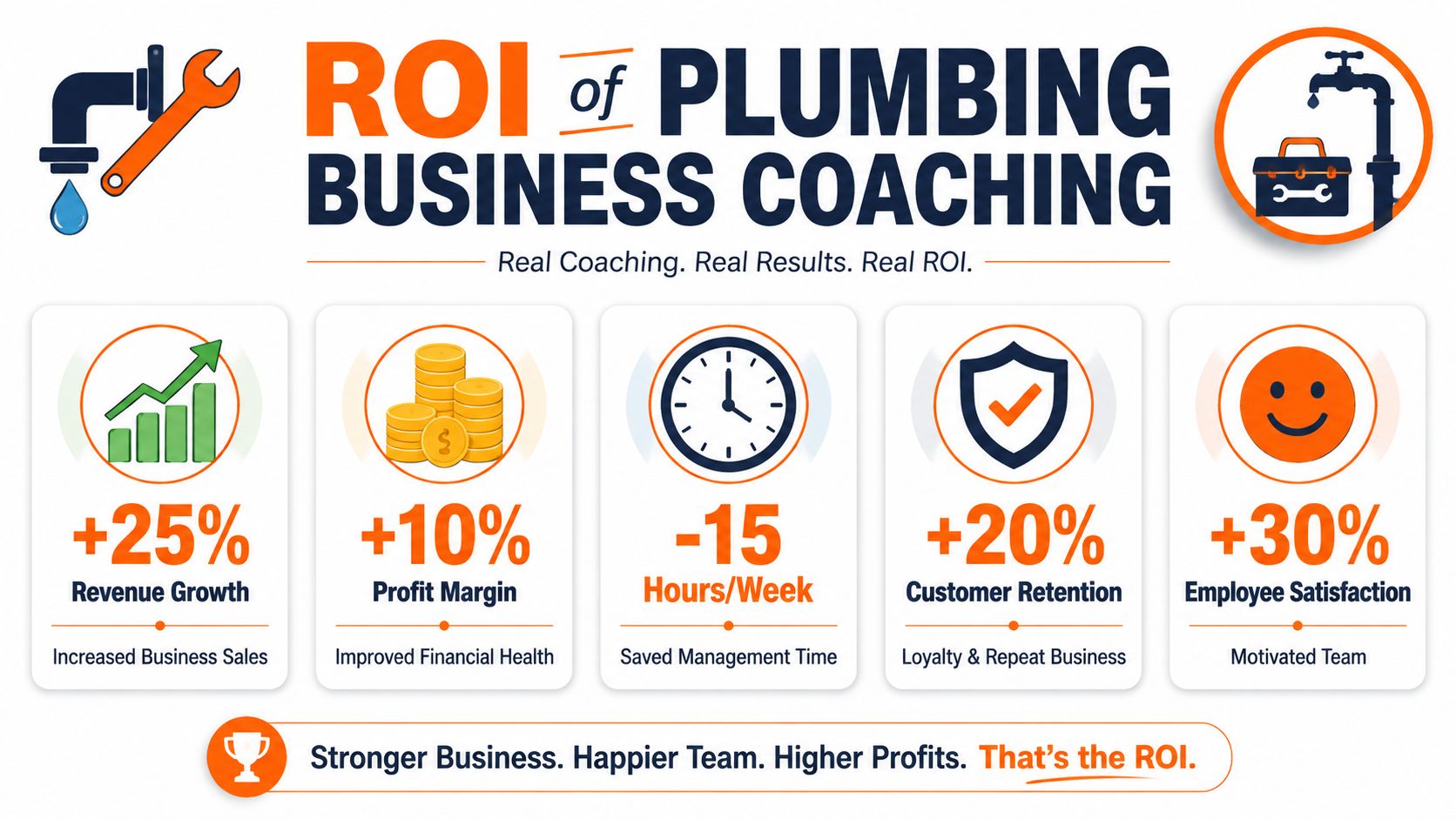
That depends on what you expect. If you want a magic shortcut, no. If you want cleaner margins, steadier cash flow, better control, and less daily chaos, coaching can be one of the better investments in the business.
What good ROI looks like in the real world
Real return on investment in plumbing business coaching usually shows up before it feels dramatic. A business starts quoting with more confidence. Office staff stop handling calls inconsistently. Fewer jobs get booked at weak margins. The owner spends less time putting out fires because there's a process to follow.
Those are commercial gains, even when they don't arrive as one headline number.
A plumbing-specific coaching provider says clients can achieve up to 69% profit growth in 12 months, and says its client base ranges from 1 truck to 5 trucks, with average ticket sizes of roughly $250 to $1,150 and annual revenue from $900K to $5M+, according to these plumbing coaching claims and client ranges. Treat provider claims like any sales claim. They show what coaching is marketed to achieve, not what every owner will get. Still, they do show that coaching in plumbing is usually tied to operational scaling, not just generic advice.
There's also a softer return that matters more than many owners admit:
- Less owner stress: Fewer surprises because the numbers get reviewed regularly.
- Better handoff: Staff can handle more without chasing you all day.
- More control: You stop guessing whether a busy week was a good week.
- Time back: The business becomes less dependent on owner heroics.
A useful side question is what the business is becoming over time. Better processes and cleaner reporting can also support a more realistic view of business worth, especially when owners eventually review what drives plumbing business valuation.
A practical example helps. This video gives a useful look at the coaching mindset and what owners are often trying to change:
Weekly KPI rhythms change how owners think
One of the strongest outcomes from good coaching is the shift from ad hoc management to weekly KPI review. In plumbing, that matters because small leaks in conversion, labour use, average ticket, or job mix can sit unnoticed for weeks if nobody reviews them consistently.
This trade advisory discussion of KPI rhythms and data-driven coaching notes that technical coaching works best when businesses use weekly KPI rhythms rather than sporadic reviews. The same source says its experts process more than 450 business financial statements per month for benchmark comparisons, which tells you what serious coaching looks like. It's data-driven, not purely motivational.
Owners who review the right numbers weekly make calmer decisions. Owners who wait for the bank balance to tell the story usually react too late.
That's the genuine ROI. Better judgment, backed by better visibility.
Coaching Versus Other Growth Options
Not every problem needs a coach. Some owners need knowledge. Some need lead flow. Some need a system that keeps the business visible while they stay focused on the work. The right choice depends on the bottleneck.
Where each option works best
DIY learning is the cheapest route in cash terms, but usually the most expensive in delay. You can learn a lot from books, courses, podcasts, and peer groups. The weakness is implementation. Most owners don't lack information. They lack time, sequence, and accountability.
A specialist agency can help when the top issue is demand generation or local visibility. That won't fix weak pricing, poor dispatch, or owner bottlenecks inside the business. If your internal systems are messy, more enquiries can make the operation feel worse, not better.
A platform can make sense when you need consistency without a lot of manual effort. If the business struggles to stay active and credible online because everyone is too busy, a service category like a plumbing digital marketing agency option may solve that specific problem better than coaching would.
Coaching is strongest when the issue is operational. It helps when the business relies too heavily on the owner, margins feel unstable, and team performance changes too much from person to person.
Here's a simple comparison.
| Approach | Best For | Typical Cost | Time Commitment |
|---|---|---|---|
| DIY learning | Owners with time, discipline, and one narrow issue to solve | Low relative cost | High owner time |
| Business coach | Owners who need accountability, pricing discipline, and operational change | Often premium relative to DIY | Moderate but consistent |
| Specialist agency | Businesses that mainly need more visibility and enquiries | Varies by service scope | Low to moderate owner time |
| Platform | Owners who want consistent activity without doing it manually | Usually more accessible than custom services | Low owner time |
Some plumbing-specific coaching providers position themselves around operators from 1 to 5 trucks and revenue from $900K to $5M+, which is a clue about where coaching often fits best in the market. It tends to become most attractive once the owner is trying to scale beyond pure self-employment.
The trade-off is simple. Coaching improves how the business runs. It doesn't replace the need for lead generation, team recruitment, or financial discipline outside the sessions. Owners get the best results when they choose support based on the problem that hurts most right now.
How to Choose the Right Coach for Your Business Stage
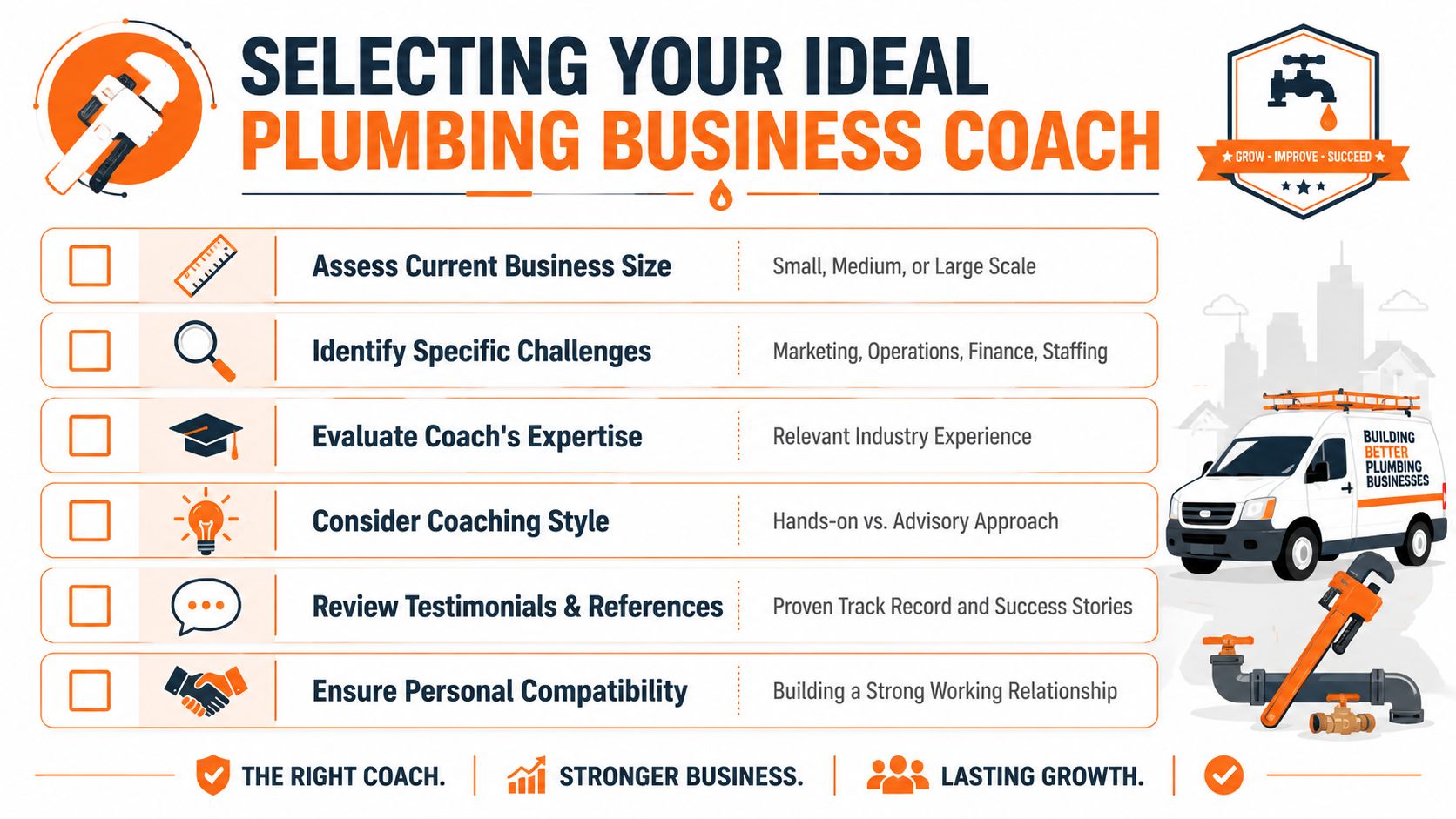
A common mistake is shopping for “the best” coach in general. That's too broad to be useful. The right coach for a solo plumber trying to get control of invoices and quoting is not automatically the right coach for a multi-crew operator trying to standardise field performance.
That gap shows up in a lot of advice. Generic tips like “find someone with industry experience” aren't enough. This trade guide on choosing a plumbing coach by business stage points out the same issue. Coaching should match the stage you're in, not just the trade you work in.
Solo owner operator
At this stage, the business usually lives and dies by the owner's personal output. The biggest risks are underpricing, inconsistent cash flow, weak admin habits, and total lack of separation between technician and owner roles.
You don't need a coach who talks like you already have layers of management. You need one who can help you stabilise the basics.
Look for a coach who can help with:
- Simple pricing structure: Not complexity for its own sake.
- Cash control: Invoicing, collections, and expense discipline.
- Time boundaries: Getting the owner out of endless reactive work.
- Basic scorecards: A few core numbers you'll review.
Ask this question early: How would you help me stop being the only person who can run the day?
Small crew
This stage usually means a few vans, a growing workload, and new people depending on your decisions. The pain changes here. Owners often struggle with delegation, inconsistent workmanship between team members, quoting bottlenecks, and office-field communication.
At this size, a coach should be able to help create structure around roles and accountability. Not corporate layers. Just enough process so the business doesn't wobble every time the owner steps away.
Good signs include a coach who talks clearly about:
- hiring standards
- technician expectations
- call handling and quote follow-up
- meeting rhythms
- team performance review
The right coach for a small crew should reduce owner dependency, not build a fancier version of it.
Scaling operator
Once you're running multiple crews, the challenge is no longer effort. It's standardisation. One branch or crew can perform well while another burns margin. If every foreman or lead tech runs jobs differently, the business starts producing random results.
At this stage, coaching should become more management-heavy. You need systems, reporting, and leadership structure that can hold up across teams.
A scaling-stage coach should be comfortable with:
| Need | Why it matters |
|---|---|
| Standard operating procedures | So service quality doesn't shift by crew |
| KPI review by team | So performance issues show up early |
| Leadership development | So supervisors can manage without owner intervention |
| Financial visibility by category | So margin leaks can be traced and fixed |
If a coach only talks about hustle, mindset, or “more leads,” that's usually not enough for a scaling operator.
A short vetting checklist
Before hiring anyone, use a short filter.
- Ask for stage relevance: Have they worked with businesses that look like yours in size and complexity?
- Ask about the first 90 days: A real coach should describe likely priorities, not stay vague.
- Ask what gets measured: If they can't explain the scorecard, the coaching may drift.
- Ask how implementation happens: Advice without follow-through usually dies in the week-to-week rush.
- Ask what they won't do: Good coaches know their lane.
A strong coaching fit feels practical very quickly. They understand your kind of business, your current pressure points, and what needs to happen first. That matters more than polished branding.
Your Simple Next Steps
If your business feels busy but not stable, don't try to fix ten things at once. Pick the pressure point that keeps showing up. For some owners, it's pricing. For others, it's cash flow, staff inconsistency, or the fact they can't step away for a day without the whole schedule bending around them.
Start with three steps:
- Name the biggest pain point. One sentence is enough. “We stay busy but cash is still tight.” “I can't trust quoting unless I do it.” “My team works hard but results are all over the place.”
- Speak to two coaches who work at your stage. Not just plumbers in general. Coaches who understand whether you're solo, running a small crew, or trying to scale.
- Ask one direct question. “Based on my main issue, what would the first 90 days look like together?”
That question does a lot of work. It shows whether the coach has a process, whether they understand prioritisation, and whether they can translate advice into action.
Plumbing business coaching is worth considering when you don't just want more work. You want a business that produces reliable profit, creates breathing room, and stops leaning on your personal stamina as the main operating system.
If you want more consistent visibility for your trade business without having to write posts, design graphics, or remember to publish anything, GrowTradie is built for that job. It helps tradies stay active online with custom content and auto-posting, so your business keeps showing up even when you're flat out on the tools.