
You know the situation. You're better on the tools than half the companies in your area, but the phone still goes to the business that shows up first, answers fast, and looks more trustworthy on a small screen. The customer doesn't know your workmanship yet. They only know what they can find in under a minute.
That isn't a talent problem. It's a visibility problem. The U.S. electrical services market is projected to reach $347.5 billion in 2026 across more than 262,000 businesses, according to IBISWorld's electrician industry outlook. There is plenty of work. The fight is over who gets considered first.
Good electrician company marketing isn't about acting like a full-time marketer. It's about building a simple system that helps the right people find you, trust you, and call you when they need work done.
Table of Contents
- Why the Best Electrician Does not Always Win the Job
- Get Found First with a Powerful Google Business Profile
- Turn Clicks into Calls with a High-Converting Website
- Build a Five-Star Reputation with Reviews and Social Proof
- Win More Work with Simple Ads and Strategic Partnerships
- Your 90-Day Electrician Marketing Action Plan
- Putting It All Together
Why the Best Electrician Does not Always Win the Job
A homeowner needs a switchboard upgrade. They search, skim a few listings, see one company with complete business details, fresh photos, and recent reviews, then tap call. Another electrician nearby may do better work, quote more accurately, and show up cleaner. It doesn't matter if the customer never gets that far.
That's how most local buying decisions happen. Not through a long research process. Through quick comparison under time pressure.
A lot of tradies still think marketing means flashy branding, a pile of posts, or paying someone to make noise online. In practice, electrician company marketing is much simpler than that. It means removing friction between "I need an electrician" and "I'm calling this one."
The first company that looks legitimate and easy to contact often gets the job before workmanship is ever compared.
That matters even more in a large, fragmented market. There is no shortage of demand. There is a shortage of attention. If your business details are inconsistent, your website is clunky, or your proof is thin, the customer moves on.
The upside is that you don't need a complex strategy to compete. You need a few assets that work hard every day. A strong Google Business Profile. A website built to generate calls. A repeatable review process. A small number of lead channels you can manage.
Get Found First with a Powerful Google Business Profile
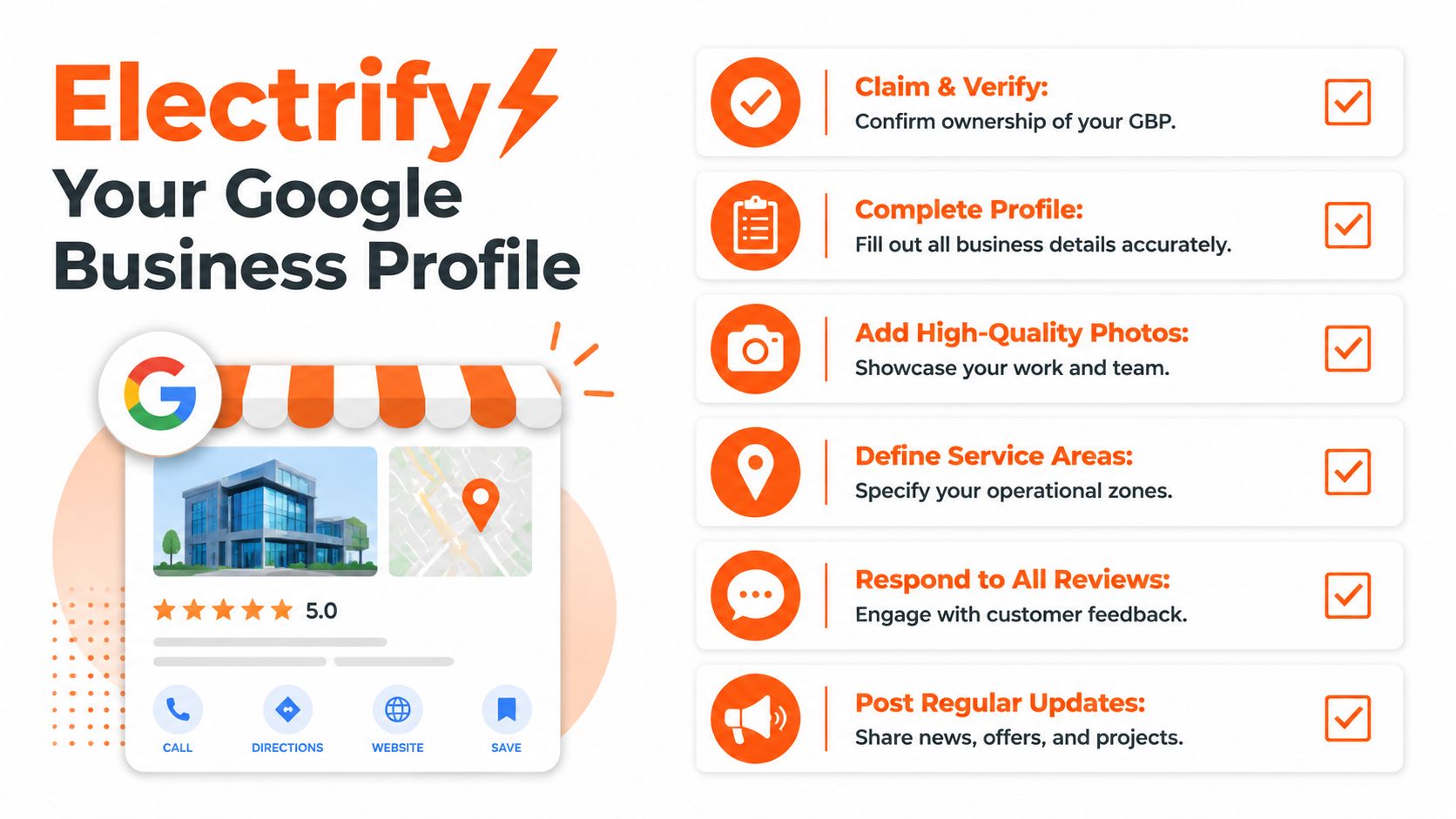
For most electricians, the Google Business Profile is the main conversion point. Not the website. Not a brochure. Not a social page. A well-built profile often decides whether someone calls you at all. Ironistic's guidance for electricians is clear on this point: treat the Google Business Profile as the primary conversion asset, with complete business details, photos, and regular updates.
Start with the visual checklist below, then work through the details.
Treat your profile like your real storefront
If your profile is half-finished, Google and customers both read that as neglect. An incomplete listing suggests an unreliable business, even if the work is excellent.
Think about how a customer sees it. They want to know three things fast. Do you service their area. Do you handle their job type. Can they trust you enough to call right now.
A good profile answers those questions before they ask them.
- Ownership and verification: Claim the profile and make sure you're the one controlling updates, photos, and responses.
- Core business details: Get the business name, phone number, hours, and service area exactly right. Inconsistent details cost trust.
- Relevant categories: Don't stop at a broad category if your work includes specific services such as EV charger installation, switchboard upgrades, lighting, fault finding, or commercial maintenance.
Practical rule: If a customer can ask "Do they do my kind of work?" your profile should answer it without making them click around.
What to put in the profile
Photos matter more than most electricians think. Skip stock images and post real ones. Vans with branding. Team on site. Finished switchboards. Lighting installs. Meter upgrades. Tidy cable runs. The point isn't artistic perfection. It's evidence that you're a real operator doing real jobs.
Use the Q&A area to answer common buying questions in plain English. Keep the language customer-friendly. Don't write for another electrician. Write for a property owner, site manager, or office admin trying to solve a problem.
Good answers usually cover things like:
- Service coverage: Which suburbs or regions you service.
- Job types: Emergency faults, renovations, test and tag, commercial fit-outs, maintenance, or new installations.
- Practical expectations: Whether customers can call, request a quote, or send photos first.
For businesses that want more help with local visibility basics, this guide on electrician local marketing is useful as a practical companion.
A short explainer can also help if you're setting this up for the first time.
Keep it active without making it a second job
Most electricians don't need to "post content" every day. They do need signs of life. Add updates when you finish a notable job, answer new questions, upload fresh photos, and respond to every review.
Here's the simple version:
| Task | What good looks like |
|---|---|
| Profile completeness | Every field filled accurately and consistently |
| Photos | Real job photos, team photos, branded vehicle photos |
| Reviews | Asked for after completed work, replied to promptly |
| Updates | Short job updates, FAQs, service reminders |
| Messaging | Fast, clear, local, and easy to understand |
What doesn't work is letting the profile sit untouched for months, using weak descriptions, or listing services so broadly that nobody can tell what you're best at.
Turn Clicks into Calls with a High-Converting Website
A lot of electrician websites are built to impress the owner, not help the customer. They look expensive, use oversized banners, and bury the phone number under design clutter. That setup loses jobs on mobile.
Your website has one job. Turn interest into contact.
What the site needs to do
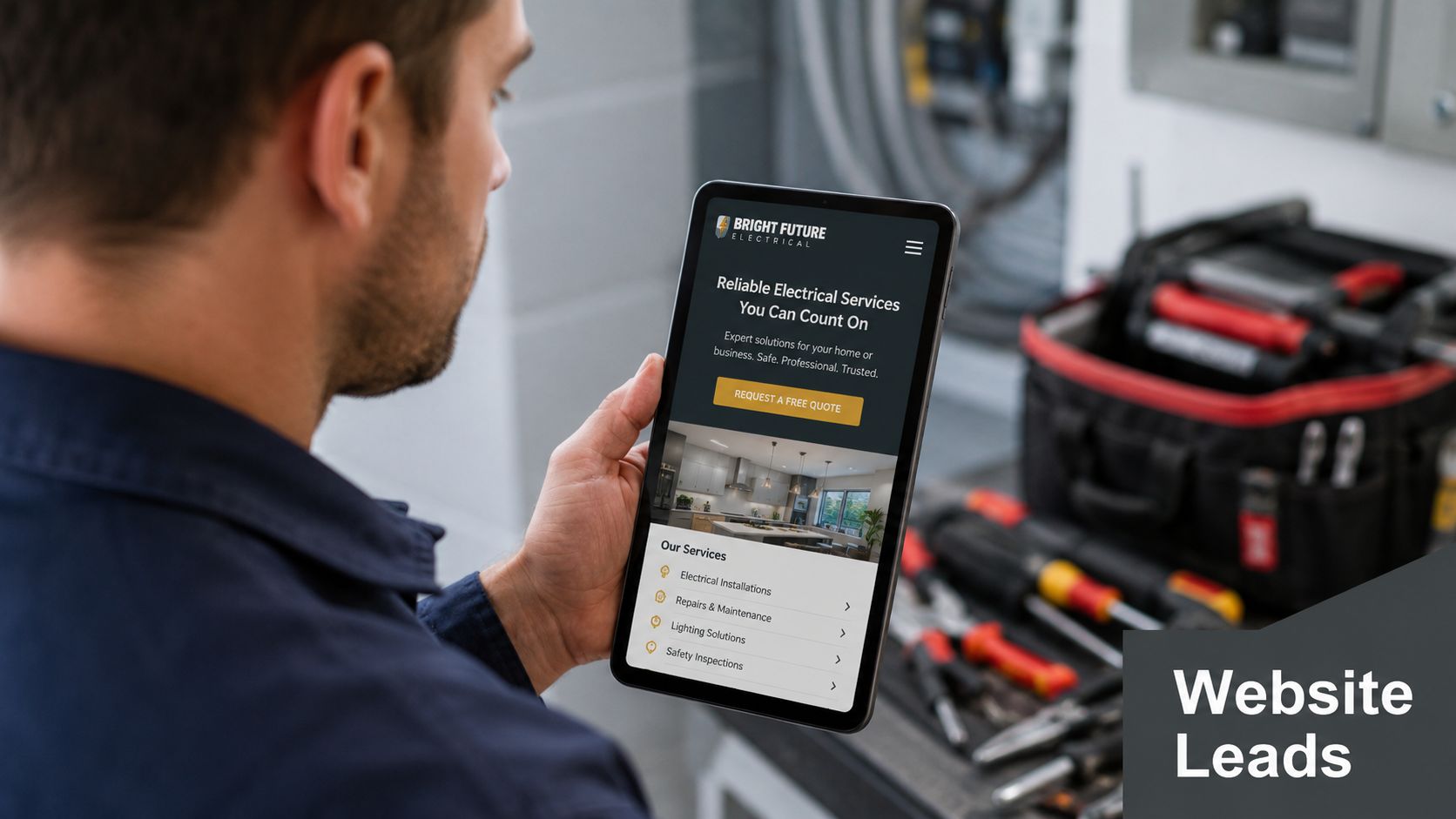
A strong electrician site isn't complicated. It is fast, clear, and easy to use with one hand on a phone. The customer should know within seconds whether you cover their area and whether you do the work they need.
The essentials are straightforward:
- A visible phone number: Put click-to-call at the top of every page.
- A short contact form: Name, suburb, phone, job type. That's enough to start.
- Clear service pages: Separate your main work categories so customers don't have to guess.
- Trust signals: Licence details, insurance, trade memberships, service areas, and real project photos.
- A practical homepage: Tell people what you do, where you work, and how to contact you.
A simple site that gets calls beats a polished site that makes visitors hunt for basic information.
If you want to build follow-up into your website enquiries, this resource on electrician email marketing gives a useful next step for staying in touch with leads who don't book immediately.
What usually gets in the way
Most underperforming sites fail for boring reasons. Slow load times. Tiny text. Too many menu items. Vague service copy. A hero section that talks about "quality solutions" instead of saying "switchboard upgrades in Melbourne's west" or whatever your real work and area are.
Commercial and residential visitors also need different proof. A homeowner often wants speed, reviews, and reassurance. A facility manager or builder wants scope fit, reliability, compliance confidence, and evidence that your crew can handle repeat work without drama.
Use that difference on the page. Residential pages should reduce urgency and uncertainty. Commercial pages should show capability, communication, and reliability.
A good website behaves like a steady office admin. It picks up basic questions, qualifies the lead, and sends the prospect toward a call or enquiry without wasting their time.
Build a Five-Star Reputation with Reviews and Social Proof
Most electricians ask for reviews when they remember. That's too random. Reviews should be part of the closeout process, just like sending an invoice or packing up tools. Then your visual proof should extend the same trust onto the platforms customers check before calling.
That combination matters more now because search behaviour is changing. Superpath's guidance on electrical marketing notes that modern electrician marketing needs to account for AI search and review-driven decisions, with the focus shifting toward short-form proof content such as reviews, before-and-after photos, and quick helpful answers.
Make reviews part of the job closeout
The best time to ask is right after a successful job, when the customer is relieved and the result is visible. Don't make the process awkward or long. Send a direct review link by text or email while the experience is fresh.
A simple system works best:
- Finish the job and confirm the customer is happy.
- Ask in person with one sentence.
- Send the review link immediately.
- Reply to every review, even short ones.
Use a script that sounds like a person, not a campaign. Something as plain as: "Thanks again for the work today. If you'd be happy to leave a quick Google review, here's the link."
For trade businesses trying to stay consistent with that kind of trust-building content, this guide on electrician social media marketing offers practical ideas.
Use proof content instead of filler posts
A lot of electricians waste time posting generic tips that nobody saves and nobody calls about. Better content is job proof. Show the outcome. Show the improvement. Show the type of work you want more of.
The most useful posts are usually:
- Before and after job photos: Panel upgrades, new lighting, neat rewires, EV charger installs.
- Short customer video clips: A few seconds of a happy client saying what was done and why it helped.
- Quick answers: Plain-language responses to common questions, such as whether a switchboard needs upgrading before adding new circuits.
- Team and process posts: Van signage, site setup, tidy workmanship, safety-conscious habits.
Reviews get you shortlisted. Visual proof gets you trusted.
The mistake is treating social platforms like entertainment channels. You're not trying to go viral. You're building a public record of competence. When a prospect checks your business after seeing your name elsewhere, that proof can settle the decision.
Win More Work with Simple Ads and Strategic Partnerships
Once the foundation is solid, paid leads and referral channels start working much better. If your profile is weak and your proof is thin, ads just send more people to a poor first impression. Fix the basics first. Then add fuel.
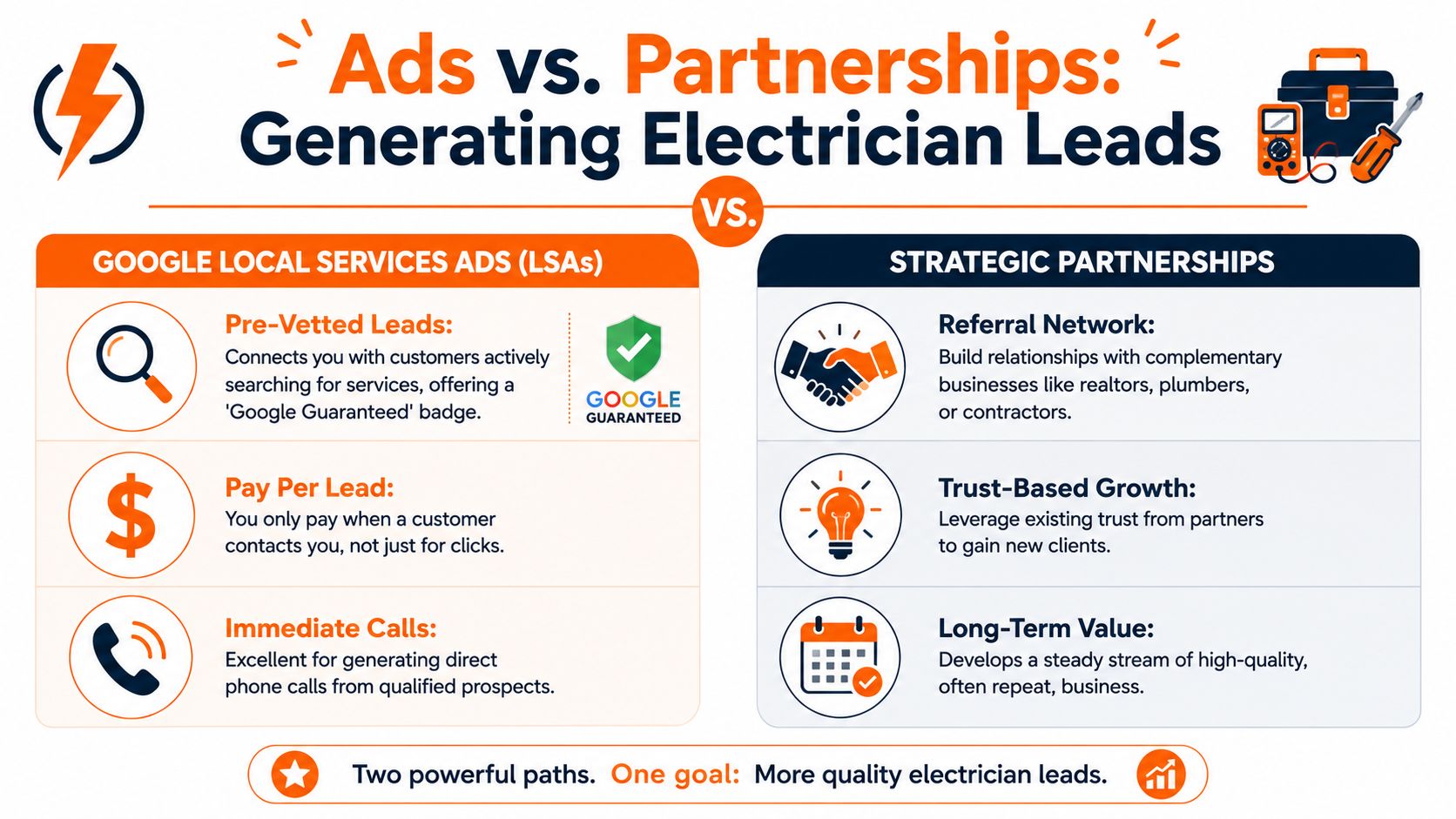
The most practical paid starting point for many electricians is Local Services Ads. Standard Google Ads can also work, but they demand tighter control over keywords, landing pages, and follow-up.
When Local Services Ads make sense
Local Services Ads are useful when your goal is straightforward. More direct calls from people already looking for an electrician. According to electrician marketing benchmark data, Google Local Services Ads can generate 90%+ of leads through direct phone calls in some benchmarked campaigns, which suits service businesses that close work best on the phone.
This channel usually fits electricians who want:
- Phone-first leads: Good for urgent jobs and straightforward service calls.
- Simpler buying flow: The customer wants to talk now, not browse for ages.
- A lower-friction ad format: Easier to understand than a more technical ad account setup.
When standard Google Ads make sense
Google Ads can be stronger when you want control over specific services, locations, and landing pages. The same benchmark source reports an average $93.69 cost per lead for well-optimized electrical contractor campaigns, along with a $12.18 cost per click and 7.5% to 9% conversion rates in optimized campaigns in the cited benchmark set.
That doesn't mean every electrician should jump in immediately. Standard Google Ads are less forgiving. If the website is weak or the service pages are vague, you can spend money fast without enough booked work to justify it.
Use them when you want to push a specific service line, such as commercial maintenance, EV chargers, switchboard upgrades, or another clearly defined offer.
Partnerships that bring better jobs
The overlooked growth channel is partnerships. Good referral relationships often bring steadier work than pure emergency traffic, especially if you want less stop-start residential demand.
Look at businesses and people who already meet your ideal client before you do:
- Other trades: Plumbers, HVAC techs, roofers, solar installers, and builders.
- Property professionals: Property managers, strata managers, commercial landlords, and facilities teams.
- General contractors: Useful if you want fit-out work, maintenance contracts, or new construction opportunities.
A homeowner lead often decides quickly. Commercial buyers usually move slower and care about different proof. They want to know whether you'll communicate well, show up reliably, and handle the scope without creating headaches. Your outreach should reflect that. Keep it plain. Show the kind of work you want, the areas you service, and why referring to you makes their job easier.
The best lead source is often the one your competitors ignore because it takes a few conversations to build.
Your 90-Day Electrician Marketing Action Plan
Most businesses don't need more ideas. They need a sequence. The mistake is trying five channels at once, then deciding "marketing doesn't work" when none of them get enough attention to produce a result.
The better approach is to run electrician company marketing like a lead system. Koalendar's electrician marketing guidance recommends starting with a modest test budget, tracking conversion rates and enquiries, and shifting spend toward the channels that produce booked jobs rather than clicks. That mindset matters more than any single tactic.
90-Day Marketing Action Plan
| Phase | Focus | Key Actions | Main KPI to Track |
|---|---|---|---|
| Days 1 to 30 | Foundation | Fully complete Google Business Profile, fix business details, upload real job photos, set up a review request process, reply to all existing reviews | Phone calls and direction requests from your profile |
| Days 31 to 60 | Conversion assets | Launch or tighten a mobile-friendly website, simplify contact forms, create clear service pages, publish proof content from recent jobs | Enquiry form submissions and call volume |
| Days 61 to 90 | Growth channels | Test paid lead generation with a small budget, review lead quality, reach out to trade partners and property contacts, keep the review system running | Booked jobs by source |
A few rules make this easier to manage.
- Track source properly: Ask every lead how they found you. Write it down.
- Judge quality, not noise: A channel that brings fewer but better jobs can beat one that fills the phone with bad-fit work.
- Run one test at a time: If you change the profile, website copy, ad setup, and offer all at once, you won't know what moved the result.
A lot of electricians stay stuck in the emergency-call cycle because it feels immediate. Fair enough. But if you want steadier, higher-value work, month three should include outreach beyond homeowners. Builders, facility managers, and property managers often need reliable electrical partners, not just one-off fixes. That work usually takes more trust and more follow-through to win, but it can reduce the feast-or-famine pattern that many service businesses live with.
Putting It All Together
The businesses that win local work aren't always the best on the tools. They're the easiest to find, the easiest to trust, and the easiest to contact. That's what effective electrician company marketing really is.
Keep it simple. Build a strong Google Business Profile. Use a website that drives calls. Ask for reviews every time. Show proof of real work. Add paid leads and partnerships once the basics are in place. Then track what turns into booked jobs and do more of that.
GrowTradie helps trade businesses stay visible without turning marketing into another job on your list. If you want consistent content, professional post design, and auto-posting built for tradies, have a look at GrowTradie.