
You can be flat out busy in a plumbing business and still feel broke. The phone rings, the vans are moving, suppliers are getting paid, payroll keeps coming due, and yet you look at the bank balance and wonder where the money went.
That usually isn't a work problem. It's an accounting problem.
Good accounting for plumbing business isn't about making the books look tidy for tax time. It's about knowing which jobs make money, which ones only look good on paper, and where cash gets stuck between finishing work and getting paid. If you don't have that visibility, pricing turns into guesswork and growth gets stressful fast.
Table of Contents
- Setting the Foundation for Financial Clarity
- Your Plumbing Business Chart of Accounts
- The Secret to Profitability Is True Job Costing
- Fast Invoicing for Healthy Cash Flow
- Staying Compliant with Payroll and Tax
- Reading the Numbers to Grow Your Business
Setting the Foundation for Financial Clarity
A lot of plumbing owners hit the same wall. The phone is ringing, the vans are out, invoices are going out, yet the bank balance still feels tight at the end of the month. Usually, the problem is not a lack of work. It is a messy system that hides where the money is going and which jobs are paying off.

Clear books give you two things every plumbing business needs. Better cash control now, and cleaner job cost data later. If the setup is sloppy, true job costing falls apart before it starts. Labour, materials, fuel, merchant fees, and supplier purchases end up scattered or missing, and you are left guessing which work is profitable.
Software beats spreadsheets once the jobs start stacking up
Spreadsheets can work for a one-person operation with a low job count and tight habits. Once the business gets busier, they usually become a catch-up tool instead of a live record. That is where mistakes creep in. A missed supplier receipt here, a forgotten card charge there, and your numbers stop matching reality.
Accounting software earns its keep because it keeps the books current. Xero and QuickBooks are common choices for plumbers for a reason. They pull in bank activity, store invoices and bills in one place, and make it easier to trace costs back to the right job.
There is a real trade-off here.
- Spreadsheets cost less: Good for simple operations, but easy to break and hard to keep current when more than one person touches the numbers.
- Accounting software costs more: Better for daily use, cleaner records, and less time spent rebuilding the month from bank statements.
- Connected tools reduce leakage: When your quoting, dispatch, invoicing, and bookkeeping systems share data, fewer job costs get missed.
If you are comparing field and office tools together, this guide to apps for plumbing business is a practical place to start.
A simple rule applies. If your office is typing the same figures into two or three systems, the process is already costing you margin.
Keep business money separate from day one
Mixed spending creates bad reports. It also creates bad decisions.
Use one business bank account for business income and expenses only. Pay for materials, fuel, software, wages, and subcontractors through the business. Stop using personal cards for quick supplier runs unless there is a clear process to record and repay them.
This matters for more than tidy bookkeeping. If personal and business spending are mixed together, your profit report gets noisy, your tax work takes longer, and your job costing loses accuracy. A business can look profitable on paper while cash is leaking into untracked spending.
Bank feeds cut out the memory test
Connect your bank account directly to your accounting software. Bank feeds bring transactions in automatically, which means you are working from what transpired, not what someone remembers at the end of the week.
You still need to code each transaction properly. Software does not fix bad habits by itself. But it does remove a lot of manual entry and makes monthly reconciliation much faster.
A clean setup usually includes:
- A dedicated business bank account for all business money in and out.
- Connected accounting software so transactions flow in automatically.
- Consistent payment methods so expenses are not spread across random cards, cash, and personal accounts.
- A monthly reconciliation routine to confirm the books match the bank.
That foundation saves time, but the bigger payoff is accuracy. If the inputs are clean, you can trust the reports. And when you can trust the reports, you can finally see whether a busy month was a profitable one.
Your Plumbing Business Chart of Accounts
A Chart of Accounts is just your money map. It tells your software where to file every dollar that comes in and every dollar that goes out.
If the chart is too generic, your reports become vague. You'll see income and expenses, but you won't see the shape of the business. A plumber needs categories that reflect how plumbing work is sold and delivered.
What a useful chart looks like
A poor chart of accounts usually has broad buckets like “Sales,” “Materials,” and “Expenses.” That's not enough. You want categories that help you spot patterns without becoming so detailed that nobody uses them properly.
A good plumbing chart usually separates revenue by service line and expenses by the cost drivers that can swing job profit.
When the chart of accounts is built properly, your P&L stops being a tax document and starts becoming a management tool.
For example, don't lump all income into one line if you do very different work. Service calls, installations, maintenance work, and larger project work behave differently. The same goes for costs. Van fuel is not the same as copper, and copper is not the same as subcontractor labour.
Sample Chart of Accounts for a Plumbing Business
| Account Type | Account Name | Description |
|---|---|---|
| Income | Service & Repair Income | Revenue from callouts, repairs, and small reactive jobs |
| Income | Drain Cleaning Income | Revenue from drain clearing and related work |
| Income | New Installation Income | Revenue from installs, fit-outs, and replacement jobs |
| Income | Maintenance Plan Income | Recurring service agreement revenue |
| Cost of Goods Sold | Material Costs – Copper | Copper pipe, fittings, valves, and related materials |
| Cost of Goods Sold | Material Costs – PVC | PVC pipe, fittings, waste line materials |
| Cost of Goods Sold | Direct Labour | Technician labour assigned directly to jobs |
| Cost of Goods Sold | Subcontractor Fees | External labour tied to specific jobs |
| Cost of Goods Sold | Equipment Rental | Hired gear charged to a work order |
| Cost of Goods Sold | Permits and Job Fees | Permit charges and one-off job compliance costs |
| Expenses | Van Fuel and Maintenance | Fuel, servicing, tyres, repairs |
| Expenses | Tools and Small Equipment | Hand tools, replacements, consumables |
| Expenses | Insurance | Business, vehicle, liability, workers' comp-related policies |
| Expenses | Office and Admin | Software, phone, stationery, admin overhead |
| Expenses | Payroll Tax and On-Costs | Employer payroll-related costs not allocated directly |
| Current Assets | Bank Account | Main operating bank account |
| Current Assets | Accounts Receivable | Customer invoices still unpaid |
| Current Liabilities | Accounts Payable | Supplier bills not yet paid |
| Current Liabilities | Tax Payable | Taxes collected or owed |
| Equity | Owner's Equity | Owner investment and retained earnings |
Keep it detailed where decisions happen
The point isn't to create endless categories. The point is to create enough structure so that the reports answer real questions.
Use these rules:
- Split income by service line: You want to know which type of work carries the business.
- Separate direct job costs from overhead: If materials, direct labour, permits, and subcontractors are buried in general expenses, job profit becomes fuzzy.
- Track vehicle costs clearly: Plumbing businesses live and die by trucks, travel, and field movement.
- Name accounts the way you think: If your team says “water heater installs” every day, your system should reflect that language somewhere.
The best chart of accounts is the one your office can maintain without constant cleanup. Fancy structure that nobody uses correctly is worse than a simpler chart that stays accurate.
The Secret to Profitability Is True Job Costing
A week can look full on the calendar and still come up thin in the bank account.
That usually happens when you judge performance from the total profit and loss only. The business may be bringing in sales, but that report will not show whether the emergency callout on Tuesday paid well, or whether the water heater install on Friday chewed up half the margin in labour, fittings, travel, and callbacks.
True job costing fixes that. It shows the actual profit on each job, not just the business as a whole. For plumbers, that matters because being busy is easy. Being busy and properly paid is the hard part.
Every job needs a clean cost trail
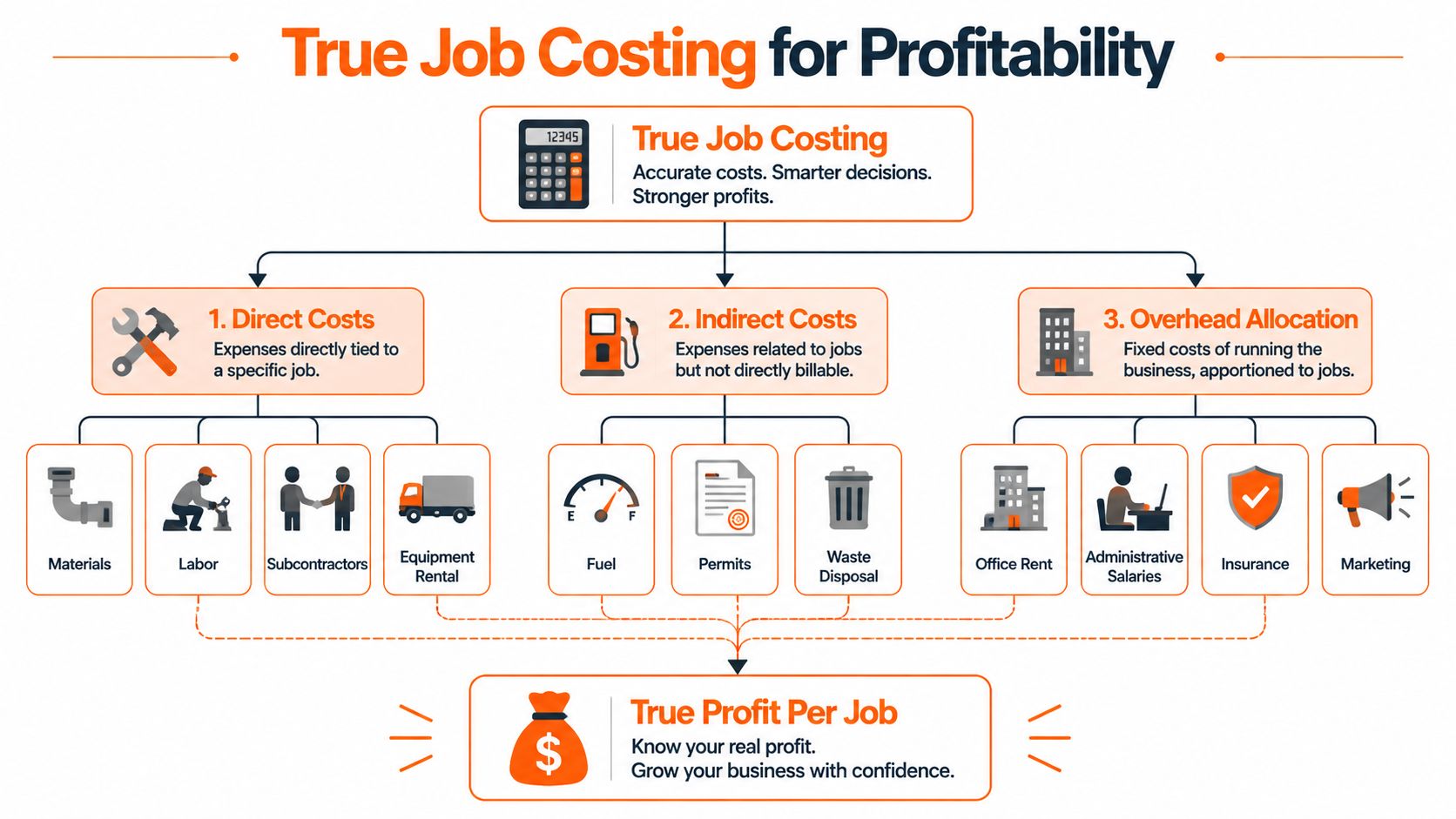
True job costing only works if every cost can be traced back to a specific job. If that link is weak, the numbers turn into guesses.
That means each job record should capture:
- Materials used: What went into that job, including van stock and small fittings that often get missed.
- Labour hours: Who worked it, how long it took, and whether time was spent on site, in travel, or waiting on parts.
- Subcontractor charges: Drain camera work, excavation help, electrical, or any outside trade tied to the job.
- Vehicle and travel costs: Fuel, mileage, tolls, and the cost of getting a truck to site.
- Permits and equipment hire: Costs that can wipe out a decent-looking margin fast.
That job record becomes your scoreboard. Without it, direct costs slip into overhead, and low-profit work hides inside a “good” month.
Wages are only the starting point
A lot of plumbing owners price work off the tech's hourly wage. That is where margin leaks start.
Actual labour cost is higher because the business pays more than wages to put that technician on the road. Payroll tax, workers' comp, super or benefits, paid leave, truck costs, admin support, and unbilled time all sit on top of the base rate. If you ignore those costs, the job can look profitable on paper while the bank balance tells a different story.
If you price from wage rate alone, you can stay flat out and still end up underpaid.
Here is the difference in plain terms:
| Cost view | What it includes | What it leaves out |
|---|---|---|
| Wage-only view | Hourly pay rate | On-costs, paid leave, workers' comp, vehicle cost, admin time, unproductive hours |
| True labour cost view | The full cost of employing and deploying that technician | Gives you a realistic base for pricing, quoting, and checking margin |
This is the number that helps you decide whether a one-hour service call is worth taking, whether installs are priced properly, and whether a maintenance agreement pays off. It also helps when you offer customer financing options for larger plumbing jobs, because you can structure the sale around a margin you know is real.
What good job costing looks like in practice
The best systems are simple enough that the office and field team will use them.
- Set the job number at dispatch: Costs need a home from the start.
- Track labour daily: Same day entries beat Friday afternoon guesswork every time.
- Record van stock and small parts: These are the silent margin killers on service work.
- Separate quoted extras and variations: Extra work should add revenue, not disappear into the original scope.
- Review profit by job type: Compare service, installs, maintenance, drain work, and after-hours callouts.
Patterns show up fast when the coding is clean. You may find drain clearing makes solid money, while small quoted jobs with too many trips keep missing target. You may find one tech is highly productive on installs but loses time on service diagnostics. Those are decisions you can act on.
The goal is better pricing, better scheduling, and fewer surprises
True job costing is not bookkeeping for bookkeeping's sake. It is how you find out which work deserves more attention, which jobs need a price rise, and which customers or job types create stress without enough return.
That level of visibility gives you two things every plumbing business needs. Better cash flow. Less second-guessing.
Fast Invoicing for Healthy Cash Flow
Friday afternoon is a bad time to discover three finished jobs were never billed. The work is done, the wages are due, the supplier account needs paying, and your money is still sitting in someone else's bank account.
That is why invoicing speed matters so much in plumbing. Cash usually goes out before it comes in. If the invoice is late, even a profitable week can feel tight.
Build the invoice from the job record
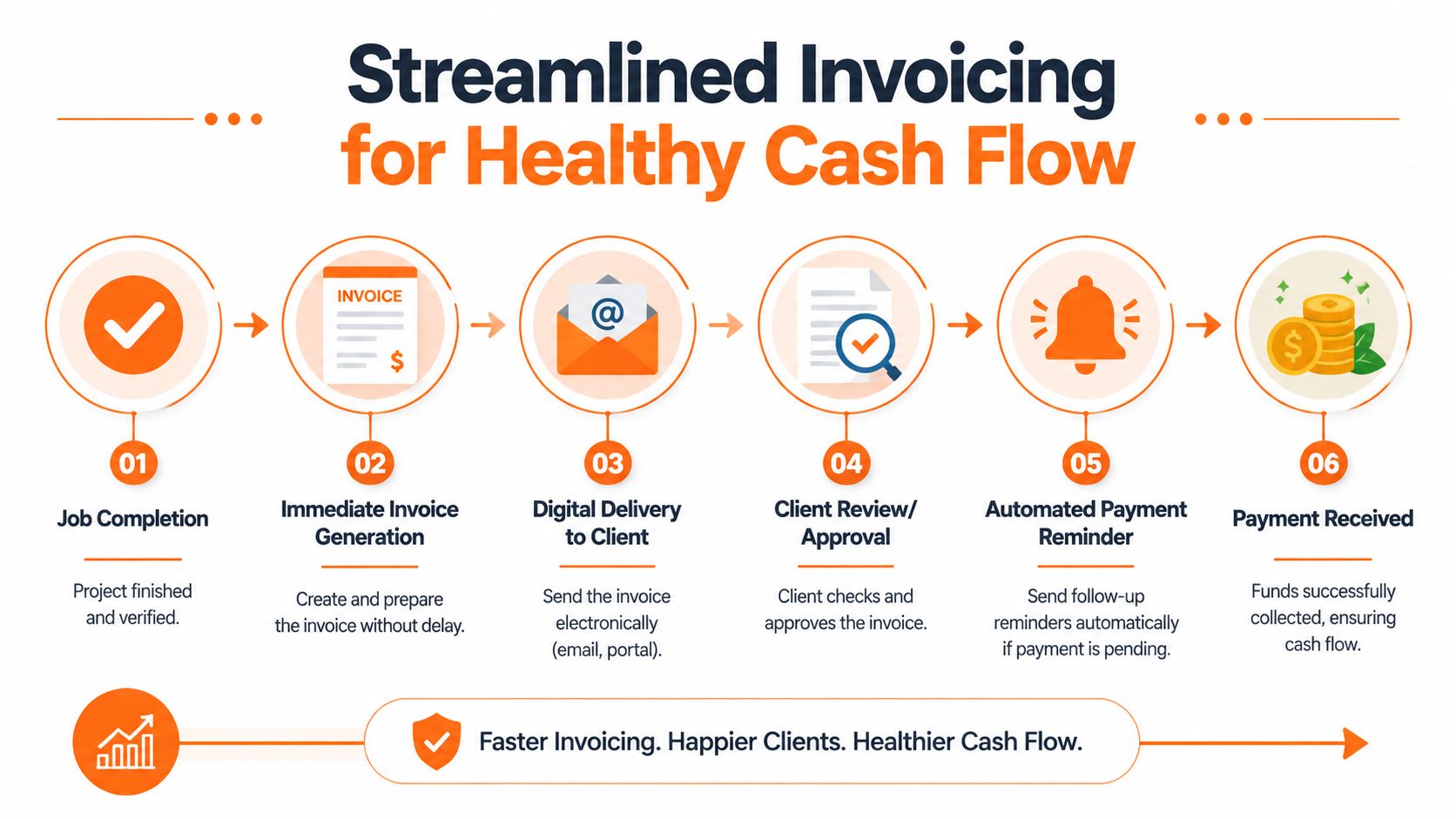
Fast invoicing starts on site, not back in the office. If the tech closes the job with labour, parts, notes, photos, and approved variations recorded properly, the invoice is nearly done before the van leaves.
That matters for more than speed. It protects margin. If the office has to rebuild the job later from memory, text messages, and supplier dockets, small charges get missed. On service work, those small misses add up fast.
A practical process looks like this:
- Close the work order properly: Confirm hours, parts, notes, and any extra approved work before the job is marked complete.
- Raise the invoice the same day: The longer it sits, the harder it gets to bill accurately and collect quickly.
- Send it digitally: Email with a payment link beats paper invoices that end up on a passenger seat.
- Make payment easy: Card, bank transfer, and mobile payment options remove excuses.
- Set reminder rules: Follow-up should happen automatically, not only when someone remembers.
For larger installs or bigger repair jobs, it also helps to shorten the gap between doing the work and getting paid. Progress claims, deposits, and customer financing options for larger plumbing jobs can all reduce pressure on cash flow if they are priced properly.
Here's a walkthrough worth watching if you want to tighten up the handoff from completed job to paid invoice:
Clear invoices get paid faster than messy ones
Customers pay faster when the invoice is easy to understand. They also argue less.
A good plumbing invoice should show:
- What you found and what you fixed: Keep the description plain and specific.
- Parts and materials used: Enough detail to justify the charge.
- Labour billed: Especially where the scope changed after diagnosis.
- Payment terms: State the due date clearly.
- How to pay: Put the button, link, or bank details where nobody can miss them.
Clear invoicing also ties back to true job costing. If labour hours or materials are vague on the invoice, they are often vague in your records too. That makes it harder to compare quoted margin with actual margin by job type, technician, or customer.
Clean invoicing is cash-flow control.
Plumbers who stay busy but still feel broke often have the same pattern. Jobs are completed. Paperwork lags. Follow-up is patchy. Money arrives later than it should. Fix the handoff from finished job to sent invoice, and the business gets easier to run.
Staying Compliant with Payroll and Tax
Friday hits, the vans are out, the week was busy, and payroll is due. Then someone's timesheet is missing, overtime was scribbled on a job card, and the tax money in the bank already feels half-spent. That is how a profitable week turns into stress.
Payroll and tax work best as a standing routine, not a rescue job. In a plumbing business, that matters because wages go out on schedule whether customers have paid you yet or not. If this part slips, cash gets tight fast and your job costing gets distorted at the same time.
Payroll accuracy protects more than compliance
Payroll is not just an admin task. It is one of the main inputs in true job costing.
If an installer clocks 8 hours on the wrong job, or the business misses super, payroll tax, workers comp, leave loading, or other on-costs in the records, the books can still look tidy while the job margin is wrong. That is how owners stay flat out and still wonder where the money went.
Good payroll records should let you answer three questions without digging around:
- Who worked, and for how long
- What that labour really cost the business, not just the hourly rate
- Which job, department, or cost code that labour belongs to
That last point matters more than many plumbers realise. True job costing only works when labour burden is included. Base wages alone are not enough. If your quoted margin looks fine but your loaded labour cost says otherwise, the job was less profitable than it seemed.
Keep payroll on a tight process
The practical fix is simple. Build a process that does the same thing every pay cycle.
- Capture time daily: Use timesheets or field software tied to jobs, not memory at the end of the week.
- Check pay categories: Ordinary hours, overtime, allowances, leave, and apprentice rates need to be coded properly.
- Review classifications: Employees and contractors must be set up correctly from the start.
- Process payroll on set dates: Late pay damages trust and creates extra admin.
- File supporting records: Keep pay runs, leave balances, tax filings, and approval notes in one place.
I have seen plenty of businesses chase small savings on materials while payroll leaks through bad coding and weak records. The loss is not only compliance risk. It also wrecks pricing decisions because the labour number feeding your reports is wrong.
Tax gets easier when you stop treating the whole bank balance as available
A full bank account can lie to you.
Part of that money belongs to the tax office already. GST, PAYG withholding, payroll liabilities, and income tax do not feel urgent until the due date lands. By then, the cash may already be spoken for through stock, wages, or a new machine.
The safer habit is to transfer tax money into a separate reserve as receipts come in. Then review liabilities through the month instead of waiting for the quarter or year-end rush. That gives you cleaner cash visibility and fewer ugly surprises.
It also helps if you ever plan to sell, bring in a partner, or borrow against the business. Clean payroll and tax records support a stronger plumbing business valuation because they make your profit numbers easier to trust.
If payroll is late or tax is guessed, the stress shows up in cash flow first.
A monthly compliance rhythm that holds up
You do not need a big admin catch-up day. You need a short routine that happens on time.
| Timing | Task | Why it matters |
|---|---|---|
| Weekly | Review timesheets, allowances, and missed job allocations | Catches labour costing errors before payroll is final |
| After each pay cycle | Check payroll reports, super, tax withholdings, and leave balances | Fixes mistakes while they are still small |
| Monthly | Reconcile payroll accounts and review tax set-asides | Keeps liabilities visible and cash planning realistic |
| Before hiring or major purchases | Check the wage impact, on-costs, and tax timing | Prevents growth decisions from squeezing working capital |
Owners who stay on top of this usually are not more organised by nature. They just use a process that does not rely on memory. That saves time, protects compliance, and gives you labour numbers you can use when judging whether a type of job is worth doing.
Reading the Numbers to Grow Your Business
Friday afternoon. The phones have not stopped, the team has been flat out all week, and the bank balance still feels tighter than it should. That usually means one thing. The business is busy, but the work mix, pricing, or labour use is off.
Once the books are clean, the reports help you spot that problem early.

What each report is really showing you
The Profit and Loss shows whether you made money over a period. Useful, but only as a starting point. On its own, it can hide a bad month of quoting or a service line that stays busy while eroding margin.
The Balance Sheet shows the pressure building underneath. Equipment finance, supplier bills, customer debts, tax liabilities, and available cash all sit there. A lot of owners only look at this report when cash gets tight, but by then the pressure has already been building for weeks.
The Cash Flow view shows timing. That matters because profit on paper does not pay wages on Thursday. If you are buying materials now, paying labour every week, and waiting on customer payments, timing can squeeze a business that still looks profitable in the P and L.
Read job profitability, not just business profitability
True job costing earns its keep.
A plumbing business can have a decent month overall and still lose money on a chunk of the work. If labour burden is missing, if callbacks are sitting in overhead instead of against the original job, or if truck and consumable costs never get allocated properly, the wrong jobs look healthy. That is how owners stay busy and still wonder where the money went.
Look at the reports with questions that tie back to real jobs:
- Which job types leave the best gross profit after labour burden, not just wages?
- Which quoted jobs regularly blow out on hours?
- Where are callbacks, discounts, and write-offs hitting?
- Which customers pay slowly enough to create cash pressure, even when the work is profitable?
- Are material cost increases being passed on fast enough in your pricing?
Those questions lead to better decisions than just checking whether sales were up.
Turn reports into decisions
A monthly review should end with a short list of actions.
If maintenance work keeps producing cleaner margins than larger quoted jobs, put more effort into selling that work. If bathroom renovations look profitable until you include supervision time, travel, and rework, fix the pricing or stop chasing the wrong jobs. If one tech sells well but burns too many hours on certain tasks, that is a training or dispatch issue, not just a payroll cost.
This is the practical use of accounting. It helps you choose better work, price it properly, and protect cash before the problem turns into stress.
Clean reporting also matters if you plan to sell, bring in a partner, or borrow against the business. Clear numbers and consistent job costing make a plumbing business valuation easier to defend because the profit story holds up under scrutiny.
The owners who feel in control are usually not better guessers. They review the numbers, see the actual profit by job type, and act on it.
If you want the front end of the business to run as cleanly as the back end, GrowTradie is one option to look at. It's built for trade businesses and includes tools around job management, online booking, and payment collection, which can support the day-to-day workflow that sits upstream of invoicing and bookkeeping.