
Some weeks the phone won't stop. Emergency calls come in, small repairs stack up, and the schedule looks healthy. Then a gap opens. A couple of quotes don't convert, one installer gets rained off another job, and suddenly you're wondering where next week's work is coming from.
That cycle wears plumbers down because it creates two bad habits at once. When work is busy, marketing gets ignored. When work slows down, money gets thrown at whatever promises quick leads. That usually means paying for noise, not buying certainty.
Plumbing lead generation services matter because they're supposed to solve that exact problem. The good ones help keep your diary full with the right kind of jobs. The bad ones send price shoppers, duplicate enquiries, or leads you can't service profitably.
For a time-poor plumber, that's the true test. Not “Did the phone ring?” but “Was this lead worth the interruption?” If a lead creates admin, wasted driving, no-shows, or low-margin jobs, it's not helping your business grow. It's just keeping you busy.
A better approach is to treat lead generation like a system. You want a mix of channels that bring in work, fit your service area, and don't create chaos in the office. If you want a practical overview of that bigger system, this guide on plumber lead generation is a useful starting point.
Table of Contents
- Introduction Keeping Your Job Schedule Full
- What Is a Plumbing Lead and Where Does It Come From
- Exploring Different Types of Lead Generation Services
- How to Evaluate a Lead Generation Provider
- Your Plan for Onboarding and Measuring Success
- Practical Recommendations for Busy Plumbers
- Frequently Asked Questions
Introduction Keeping Your Job Schedule Full
A lot of plumbing businesses don't have a lead problem. They have a predictability problem.
The trade skill is already there. The team can diagnose leaks, replace water heaters, clear drains, and handle emergency work. What's missing is a steady pipeline that feeds the schedule without forcing the owner to become a full-time marketer between callouts.
That's where plumbing lead generation services come in. At their best, they act like a support system behind the scenes. They help your business show up when someone has an urgent plumbing issue, make it easier for that person to trust you, and turn that moment into an actual booking.
Feast-or-famine usually comes from bad lead mix
The common pattern looks like this. A plumber gets most work from repeat customers and referrals. That works well until there's a quiet patch. Then they buy a batch of leads, boost a few ads, or sign up with a provider that promises “more calls.”
The calls may come. The jobs often don't.
Some are outside the service area. Some are shopping around. Some are tiny jobs with big travel time. Some call three providers at once and take the cheapest. The result is activity without much profit.
Practical rule: A full schedule only helps if the jobs on it make sense for your team, your margins, and your travel radius.
Good lead generation creates control
The right setup gives you more control over three things:
- Job type: You attract the services you want, such as repair work, emergency callouts, or replacements.
- Location: You reduce wasted travel by focusing on the suburbs and areas you service best.
- Workflow: You stop relying on random enquiries and start building a repeatable pipeline.
That shift matters. Once you stop judging lead services by raw call count, better decisions become easier. You can compare channels by hassle factor, admin load, close quality, and whether they bring in profitable work instead of just “interest.”
What Is a Plumbing Lead and Where Does It Come From
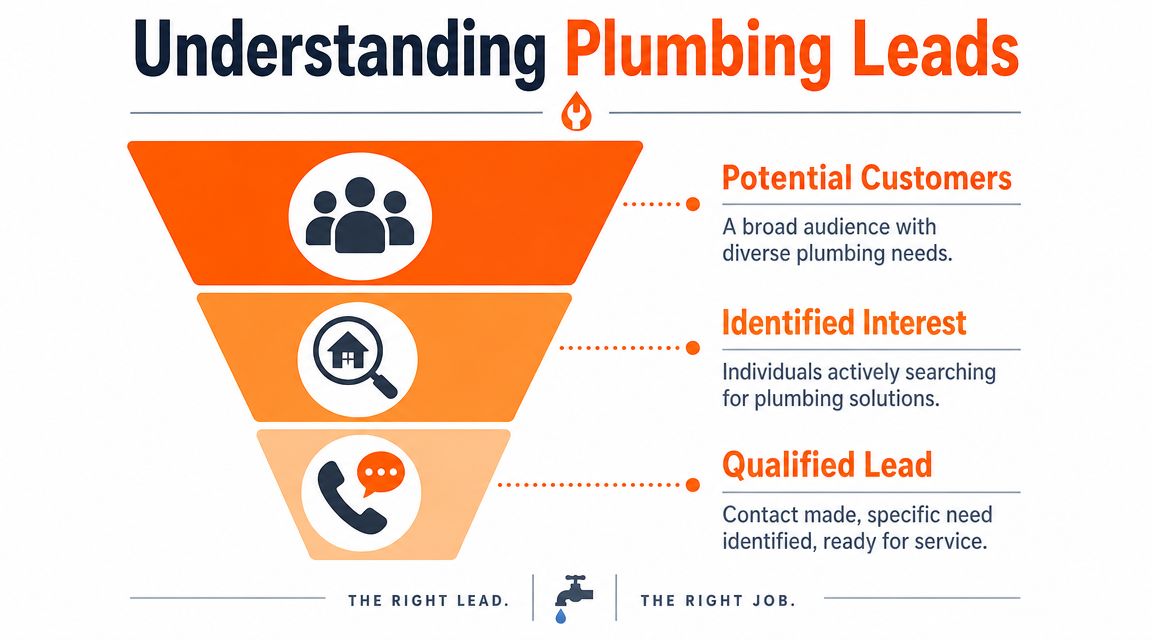
A plumbing lead is a person or business with a plumbing problem who has shown interest in hiring someone to fix it. That interest might look like a phone call, a form submission, a text, a message through a directory, or a direct booking request.
The important part is this. A lead is not yet a job. It's an opportunity.
Some leads are urgent and ready to book. Others are still comparing options. Some are clear about the issue. Others only know that something is leaking, blocked, or making noise. A lead generation service exists to bring those opportunities to your business at the moment they're most likely to act.
The digital storefront idea
Think of your business like a shop on a busy street. In the old model, people drove past, saw your van, or got your number from a neighbour. Now the “street” is digital.
A homeowner notices water around the base of the heater. They search for help, check who looks credible, compare service descriptions, and contact one or more plumbers. Your online presence acts as your storefront, signage, receptionist, and first impression all at once.
If your service information is vague, your contact options are clunky, or your message doesn't match the problem they have, you lose the chance before anyone speaks to you.
Where leads usually come from
Most plumbing leads come from a small set of sources:
- Direct searches: Someone has a problem and looks for a plumber nearby.
- Maps and business listings: They want a local provider and compare profiles quickly.
- Paid placements: Your business appears because you're paying for visibility.
- Referral-style platforms: A directory or marketplace sends the enquiry through.
- Existing customers: Someone remembers you from a previous job and gets back in touch.
Not all of these leads are equal. A repeat customer asking for the same team is very different from a shared directory lead where several plumbers get the same contact details.
A lead becomes valuable when the need is real, the location fits, the service requested matches your work, and the customer can be contacted without delay.
Why understanding the source matters
If you don't know where a lead came from, you can't judge whether the service behind it is worth paying for. A provider might send plenty of enquiries, but if those enquiries are low quality, hard to reach, or wrong for your business, you're buying distraction.
That's why smart plumbers separate enquiry volume from usable demand. A good lead source doesn't just produce contacts. It produces people you can book and serve profitably.
Exploring Different Types of Lead Generation Services
There isn't one lead source that suits every plumbing business. A solo operator doing emergency repairs needs something different from a multi-truck company pushing replacement work. The best channel often depends on how fast you need work, how much follow-up capacity you have, and how much hassle you can tolerate.
A useful way to think about plumbing lead generation services is by how they behave operationally. Some channels rent attention. Some build your own visibility over time. Some create good leads but need solid office handling. Others create lots of noise and force you to sort through it.
Service pages and local intent
One of the strongest long-term setups is a website built around what people search for when they need help. According to Gushwork's guide to plumbing lead generation, plumbing lead generation performs best when the website is structured around search intent and local specificity rather than generic brand messaging. Dedicated pages for services like leak repair, drain cleaning, water heater repair, and emergency plumbing help make relevance clearer, while long-tail and symptom-based searches capture higher-intent traffic.
In plain terms, a general “we do all plumbing” page is weak. A focused page about blocked drains in your service area is stronger. A page that addresses symptoms a homeowner is dealing with is stronger again.
That's not theory. It matches how customers behave. Customers typically don't search by trade language. They search by problem.
For plumbers, this channel usually has a lower hassle factor once it's set up properly. The trade-off is time. It doesn't produce the same instant jolt as buying leads.
A practical companion to this approach is a managed paid traffic campaign. If you're comparing providers or want to understand how campaign structure affects lead flow, this overview of plumbing PPC marketing helps frame what to look for.
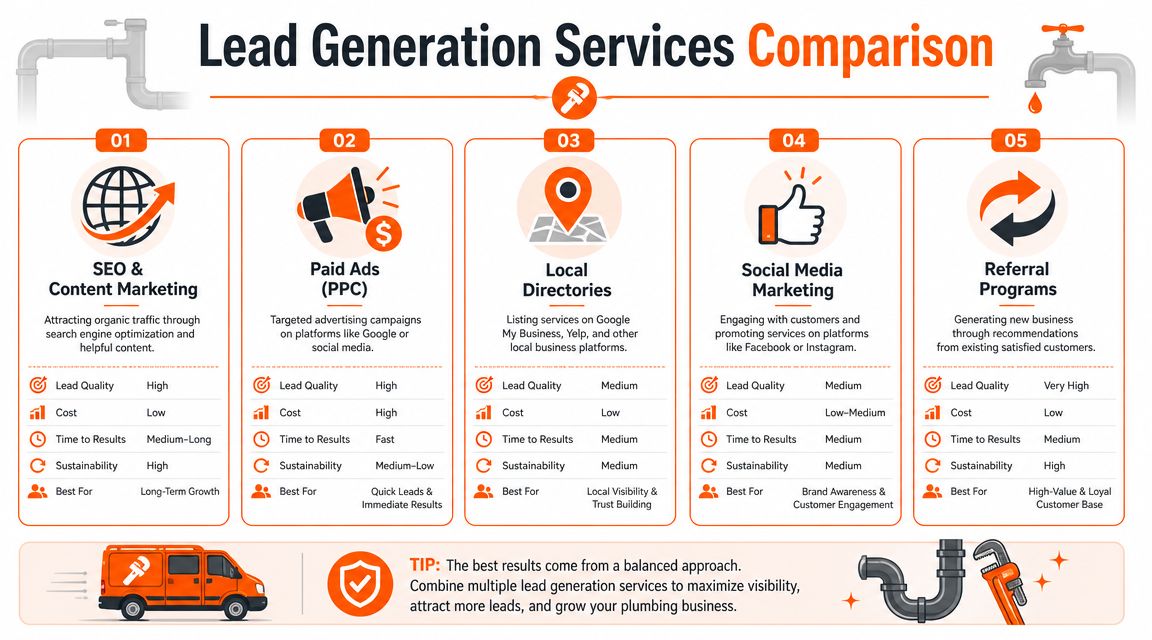
Here's a simple comparison of the main channels:
| Channel | Average Lead Quality | Typical Cost | Time / Effort Required | Best For |
|---|---|---|---|---|
| Service-specific website pages | High when pages match real customer problems | Setup and ongoing content or agency cost | Medium to high upfront | Long-term owned lead flow |
| Paid ads | Mixed to high depending on setup and follow-up | Ongoing spend | Medium | Fast demand capture |
| Local directories | Mixed | Listing fees or lead fees | Low to medium | Extra visibility |
| Referral programs | Often high | Low direct cost | Medium operational effort | Trust-based growth |
| Bought leads marketplaces | Mixed to low | Per lead or subscription | Low setup, high follow-up friction | Filling short-term gaps |
Paid lead channels and fast demand
Paid channels are useful when you need work now. They put your business in front of people who are actively looking for a plumber.
The upside is speed. The downside is pressure. If your office misses calls, follows up late, or sends people to weak jobs, paid channels become expensive very quickly. They also require tighter campaign control than many plumbers expect. Broad targeting, generic ad copy, and weak landing pages usually produce low-quality enquiries.
This section is worth seeing in action:
Paid ads can work well for emergency work, urgent repair demand, and filling schedule gaps. They are less forgiving if your admin team is stretched or if you haven't defined your service area tightly.
Directories referrals and visibility channels
Directories and marketplace platforms sit in the middle. They can produce leads, but the experience varies a lot.
Some are useful because they help customers discover you. Others create a race where several plumbers chase the same prospect. That's where the hassle factor rises. Your team spends time calling, quoting, and following up, only to find the customer has already booked someone else.
Referral channels are different. They tend to produce warmer leads because trust already exists. A recommendation from a customer, supplier, local group, or nearby business often closes better than a cold enquiry. The challenge is that referrals are less controllable. You can encourage them, but you can't switch them on at will.
The most reliable lead mix usually combines one fast channel, one owned channel, and one trust channel. That gives you speed, stability, and better job quality.
How to Evaluate a Lead Generation Provider
Most providers sell the easy promise first. More leads. More calls. More visibility. That sounds good until you realise none of those words guarantee profitable work.
The right question is not “How many leads will you send me?” The right question is “What kind of jobs are these likely to become, and how much waste sits in the process?”
Volume is not the main metric
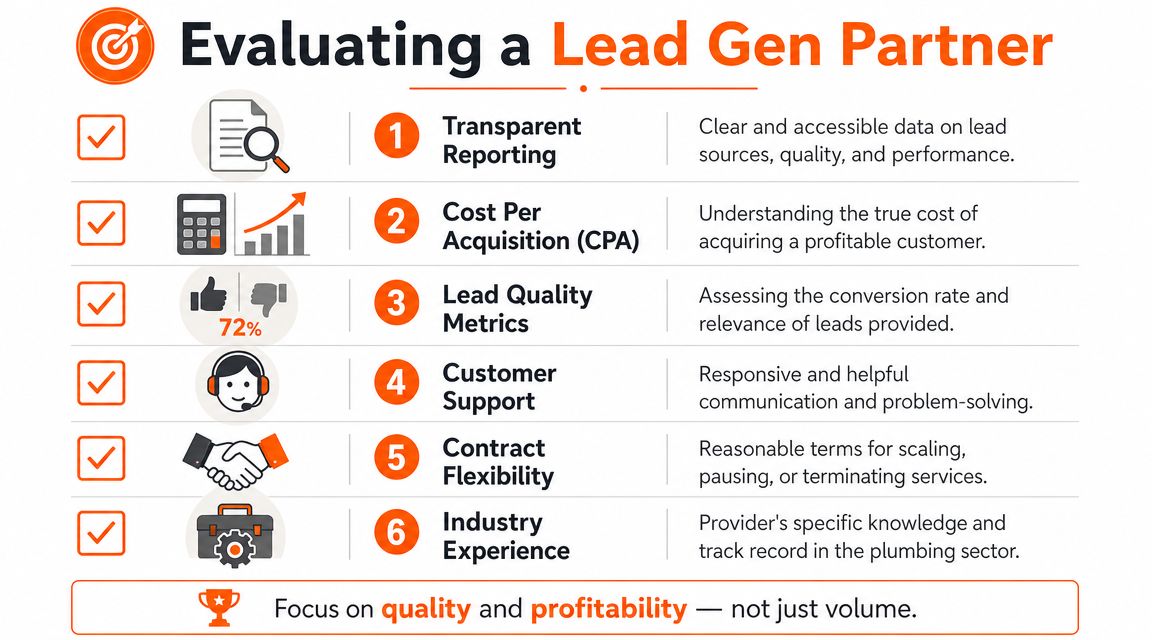
ServiceTitan's plumbing leads guide makes an important point that most public advice skips. Plumbing lead generation services should be judged by lead quality and closing economics, not just lead volume. A slower lead source with stronger close rates and lower wasted dispatch time can beat a higher-volume source that creates admin and margin loss.
That's exactly how a plumber should think about it.
If one provider sends constant low-intent enquiries, your team gets tied up answering calls, quoting jobs that won't close, and dispatching to work that shouldn't have been taken in the first place. Another provider may send fewer enquiries, but they fit your area, your service mix, and your pricing better. That second provider often wins.
Questions worth asking before you sign
Don't let a sales rep keep the conversation at the level of impressions, clicks, or “activity.” Ask practical questions that affect the diary and the bank account.
- Are the leads exclusive or shared? Shared leads create instant competition and often turn the first few minutes into a speed contest.
- How are enquiries delivered? Calls, forms, text messages, and directory messages each create different admin demands.
- Can the campaign focus on specific services? You want control over whether you're chasing repairs, emergencies, installs, or broader maintenance work.
- What reporting will I see? A useful report should show lead source, booking outcome, and which jobs turned into revenue.
- What happens if the quality drops? Good providers will explain how they review targeting, call handling, and service alignment.
Red flags that usually mean trouble
Some warning signs show up again and again:
- Long lock-in contracts: If they need a long contract to keep you in, they may not trust results to keep you there.
- Vague answers about quality: If they can't explain where leads come from and how they're filtered, expect noise.
- No discussion of office handling: Lead quality and response handling are connected. A provider that ignores your internal process is only telling half the story.
- Too much focus on top-line volume: More enquiries isn't automatically better if your team can't service them properly.
A provider is only useful if their system fits your operations. Good marketing cannot rescue bad routing, weak call handling, or poor follow-up.
If you want outside help comparing channels or tightening the commercial side of your marketing setup, a specialist plumbing digital marketing agency can help frame the decision more clearly. The key is to stay focused on booked jobs, not vanity metrics.
Your Plan for Onboarding and Measuring Success
Once you choose a provider or a lead channel, the important work starts. Plenty of plumbing businesses buy a service, hand over the budget, and then hope the phone sorts itself out. That's usually where disappointment begins.
Lead generation works best when onboarding is operational, not just promotional. Your office needs to know what's coming in, where it lands, who handles it, and what counts as a win.

What onboarding should look like
A proper setup should cover the basics quickly and without confusion.
First, define the target jobs. Decide what you want more of. Emergency repairs, drain work, water heater jobs, leak detection, or something else. If you skip this step, the campaign usually defaults to broad traffic and mixed lead quality.
Second, sort your intake process. Every enquiry should land in one place. Calls, forms, texts, and directory messages need to feed a single pipeline so nothing gets lost.
Third, assign ownership. Someone has to respond, book, update status, and chase anything that doesn't convert on first contact. If everyone owns it, no one owns it.
What to track in the first 90 days
In the first phase, keep the scorecard simple. Don't drown in dashboards.
Track:
- Lead source: Where did the enquiry come from?
- Lead type: What service did they ask for?
- Booking outcome: Did it become an appointment?
- Job value quality: Was it the type of work you want more of?
- Sales friction: Did the lead stall because of price shopping, no answer, bad fit, or slow response?
This gives you a practical read on performance. A source that sends fewer enquiries but books solid repair work may be better than one that floods the office with weak enquiries.
The response system that protects lead value
Many plumbers often fail to convert opportunities. Thryv's plumbing lead generation strategies notes that speed-to-lead is a measurable conversion lever, with a common operational benchmark of responding within an hour because plumbing enquiries are often high-intent and time-sensitive. Faster contact improves the chances of reaching the homeowner before they call the next provider, while delays increase lead loss.
That should shape your process.
A solid response setup includes:
Instant acknowledgement
Every web form, text, or missed call should trigger a quick confirmation so the customer knows the enquiry landed.Single pipeline entry
All enquiries should enter one CRM or lead board. Separate inboxes create dropped leads.Stage-based follow-up
Use simple stages such as new, contacted, quoted, booked, lost, and follow-up required.Same-day callback priority
Emergency and repair leads need attention first. They go cold fast.Reminder tasks
If a customer doesn't answer, the system should prompt another contact attempt instead of relying on memory.
Fast follow-up isn't just customer service. It's part of the lead generation system itself.
If you fix this part, the same number of leads often becomes more valuable. If you ignore it, even a good provider will look worse than they really are.
Practical Recommendations for Busy Plumbers
If time is your main constraint, don't try to run every channel at once. That usually creates admin overload and inconsistent follow-up.
The better move is to choose a path that matches your current situation.
If you need work quickly
Use a do-it-for-me setup. That usually means paid lead channels or managed ad campaigns that can drive enquiries faster. Keep expectations realistic. Fast channels require disciplined intake, quick callbacks, and tight service-area control. Without that, the hassle factor climbs fast.
This route suits plumbers with open schedule capacity right now and someone available to answer or return leads properly.
If you want something more durable
Build your own visibility assets over time. That means better service pages, stronger local messaging, cleaner listings, and a review process that supports trust. This path is slower, but it gives you more control and reduces dependence on rented leads.
It also tends to produce less chaos once the system is established.
If you want the safest middle ground
Use a hybrid approach. Buy enough short-term demand to keep the phone moving, but invest at the same time in channels you control long-term. That way you're not trapped paying forever just to stand still.
For most plumbers, that middle ground is the practical answer. It reduces panic spending, improves lead quality over time, and keeps marketing from becoming another full-time job.
Frequently Asked Questions
Are bought plumbing leads worth it
They can be, especially if you need calls quickly. The risk is that they often come with more competition, more admin, and more wasted follow-up. They work best as a short-term lever, not your entire growth plan.
How should I set a budget for plumbing lead generation services
Start from cost per booked job, not cost per lead. A cheap lead that never books is expensive. A more costly lead that turns into profitable work may be the better buy.
How long does it take to know if a provider is working
You should see whether lead quality, response handling, and booking flow are improving fairly early. Some channels need more time than others, but you shouldn't accept months of vague reporting without clear movement in booked jobs and job fit.
Should I manage leads myself or hire help
That depends on time and discipline. If you're on the tools all day and nobody owns follow-up, leads will get missed. In that case, outside help or a cleaner internal system usually pays for itself by reducing waste.
GrowTradie helps trade businesses stay visible without adding more marketing work to an already packed week. If you want a simpler way to keep your business active online with customized content, professional post design, and auto-posting built for tradies, take a look at GrowTradie.