

You might be at the point where the phone still rings, the vans still go out, and the business still makes money, but your mind has started asking a different question. How long do I want to keep doing this?
For a lot of plumbing owners, that question doesn't arrive in a neat, tidy way. It shows up after another late-night callout, after a tough hiring stretch, after a good year that makes you think maybe now is the right time, or after you realize your business is worth more than the tools and trucks sitting in the yard. Selling sounds simple until you remember what you're selling. Not just a company. Your name, your systems, your team, your reputation, and years of problem-solving built one job at a time.
That is why a good Plumbing Business Broker matters. Not because they put a listing online, but because they help turn a working trade business into something a buyer can understand, trust, finance, and take over without breaking it.
Table of Contents
- Introduction When Is It Time to Sell Your Plumbing Business
- What a Plumbing Business Broker Actually Does
- How Your Plumbing Business Is Valued
- The Process of Selling Your Business With a Broker
- How to Choose a Trustworthy Plumbing Business Broker
- Tips for Tradies Preparing a Business for Sale
- FAQ and Your Next Steps
Introduction When Is It Time to Sell Your Plumbing Business
It often starts on an ordinary day. You're chasing approvals, a tech calls in sick, two quotes still need to go out, and a customer asks to speak with you personally because "you know the job." At some point, the question shifts from "How do I keep this running?" to "Do I want to keep doing this for another three, five, or ten years?"
That question is not only about age or retirement. I see owners raise it when the business is profitable but too dependent on them, when the paperwork in their head has outgrown the systems in the office, or when they can feel the strain of carrying the team's decisions, customer relationships, and local reputation at the same time.
Selling a plumbing business is part financial decision, part handover problem.
A buyer is not only looking at revenue and profit. They are looking at whether the jobs will still be booked when you step back, whether the team will stay, whether licenses, records, maintenance logs, and supplier relationships are in order, and whether the business name means something in the suburbs you serve. In the trades, value lives in the day-to-day operation, not only in the numbers on a profit and loss statement.
Signs you're closer than you think
The timing gets real when several of these show up together:
- You want a choice about your future: Retirement, a new venture, a management role instead of field work, or fewer hours starts to sound better than another year of firefighting.
- You are still the glue holding everything together: Staff come to you for answers, customers ask for you by name, and key accounts feel tied to your mobile number instead of the company.
- The business is becoming transferable: Financials are clean, the crew is stable, repeat work is consistent, and more of the operation is written down instead of stored in your head.
- Your reputation can stand without you on site every day: Reviews are solid, referral partners know the brand, and supervisors or senior plumbers can represent the business well.
- You want to sell from a position of control: Owners who prepare early have more room to fix weak spots and choose terms that suit them.
The best exits happen before burnout, not after it.
That matters because buyers pay for certainty. A plumbing business with documented systems, dependable staff, and a known local name is easier to hand over than one where the owner is the quoting manager, operations manager, and rainmaker all at once. The difference can show up in price, deal structure, and how much money is held back against transition risk.
Why owners bring in a broker
A specialist broker helps turn a vague idea into a practical plan. The first questions are rarely "How fast can this sell?" They are more grounded.
| Question | Why it matters |
|---|---|
| Is the business sale-ready today | Readiness affects value, buyer confidence, and how disruptive the process becomes |
| What will a buyer see as a risk | Owner reliance, weak records, and staff uncertainty can drag on price and terms |
| What should be fixed before going to market | Simple improvements, like updated procedures or cleaner reporting, can make the business easier to transfer |
| Who is the right buyer | A competitor, an investor, or an owner-operator will each view the same plumbing business differently |
The earlier you ask those questions, the more options you have. That is the practical advantage. You get time to sort out the key value drivers in a trade business: records, team stability, customer mix, equipment condition, and the reputation you built job by job.
What a Plumbing Business Broker Actually Does
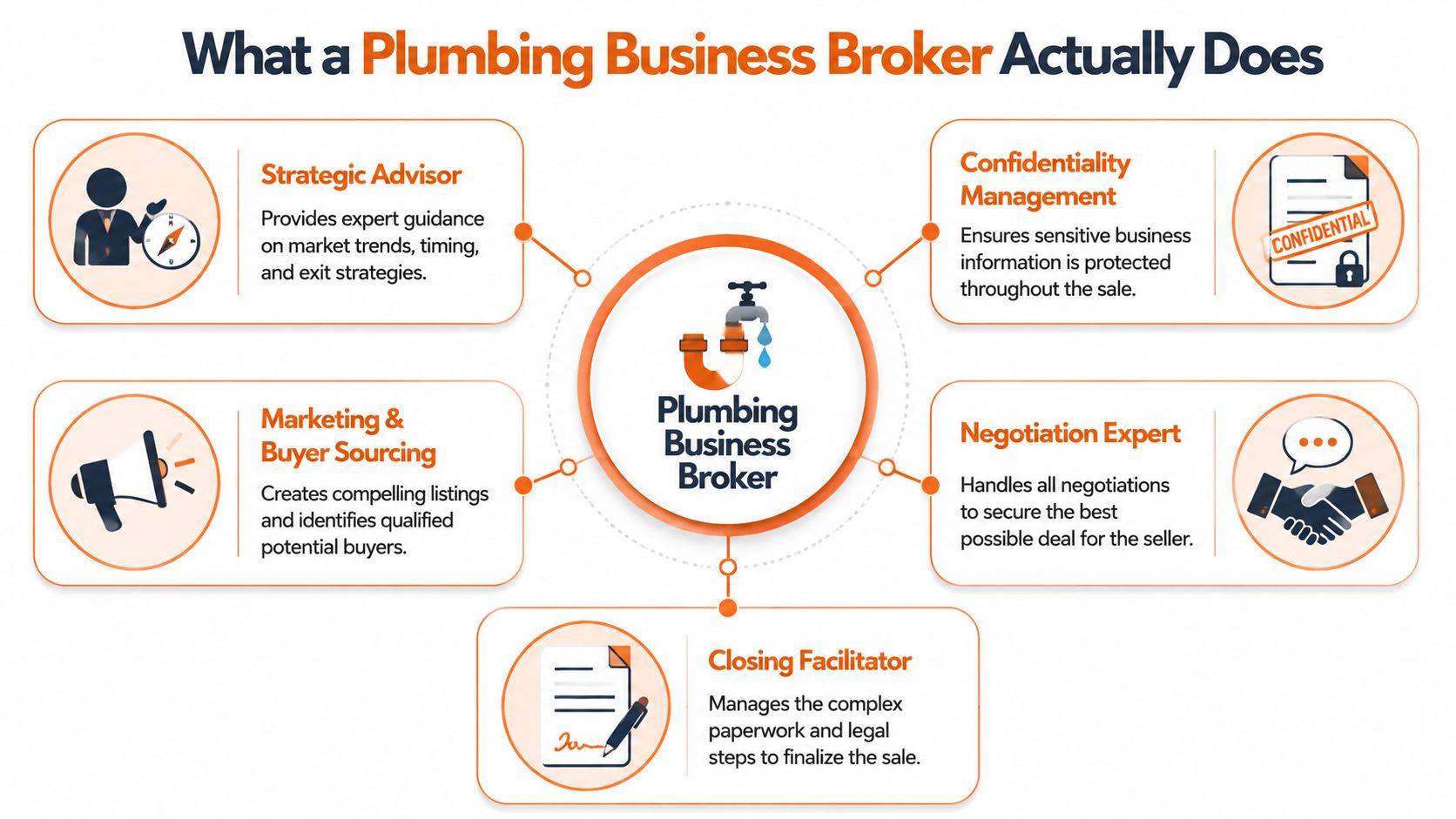
A lot of owners think a broker's job is to find a buyer. That's part of it, but it's a small part.
A good Plumbing Business Broker acts more like the general contractor on a complex build. You still own the asset. Your accountant still handles accounting. Your lawyer still handles legal documents. But the broker keeps the whole job moving, sequences the work, filters problems early, and keeps bad surprises from blowing up the deal.
They price risk, not just revenue
This is the first place many sellers get caught out. Buyers don't pay top dollar just because the top line looks strong. They want to know what the business earns, how dependable those earnings are, and what changes when you leave.
A specialist broker helps frame the business around cash flow quality and owner-transition risk. That means they deal with buyer questions about employee structure, equipment condition, and how the company will perform after the seller steps away, all of which can affect price and terms, as discussed in this buyer review of plumbing businesses for sale.
They package the business properly
Most owners know their business well, but they don't present it the way a buyer needs to see it. A broker usually gathers financials, operating details, staff information, fleet and equipment lists, customer mix, and the story behind the numbers. Then they turn that into a confidential package, often called a CIM.
That package should answer questions before they become objections.
A useful CIM doesn't just say, "profitable plumbing business for sale." It shows what work the business does, how jobs are won, who runs the day-to-day, where margins come from, and how a new owner could step in with manageable risk.
They protect confidentiality and your time
Selling confidentially is essential in the trades. If staff hear rumours too early, some start looking elsewhere. If competitors hear you're selling, they may circle your customers or team. If weak buyers get too much detail too soon, they waste months.
A solid broker controls that flow.
- They vet buyers first: Not everyone with interest is capable of closing.
- They release information in stages: Buyers earn more detail as they show seriousness.
- They buffer negotiations: You don't want every price conversation running directly through you.
- They keep you focused on operations: The business still has to perform while it's being sold.
Practical rule: If the sale process starts dragging your attention away from service quality, collections, and team management, the business can get weaker while you're trying to sell it.
They keep the deal alive when it gets awkward
Almost every deal gets awkward. A buyer asks for more detail. A lender wants clarification. A due diligence issue appears. The first offer looks good on price but weak on terms. Staff retention becomes a concern. That's where specialist experience pays for itself.
The broker's real value often shows up after the first offer arrives. Anyone can pass along buyer interest. Not everyone can hold a deal together when the buyer starts pushing on risk.
How Your Plumbing Business Is Valued
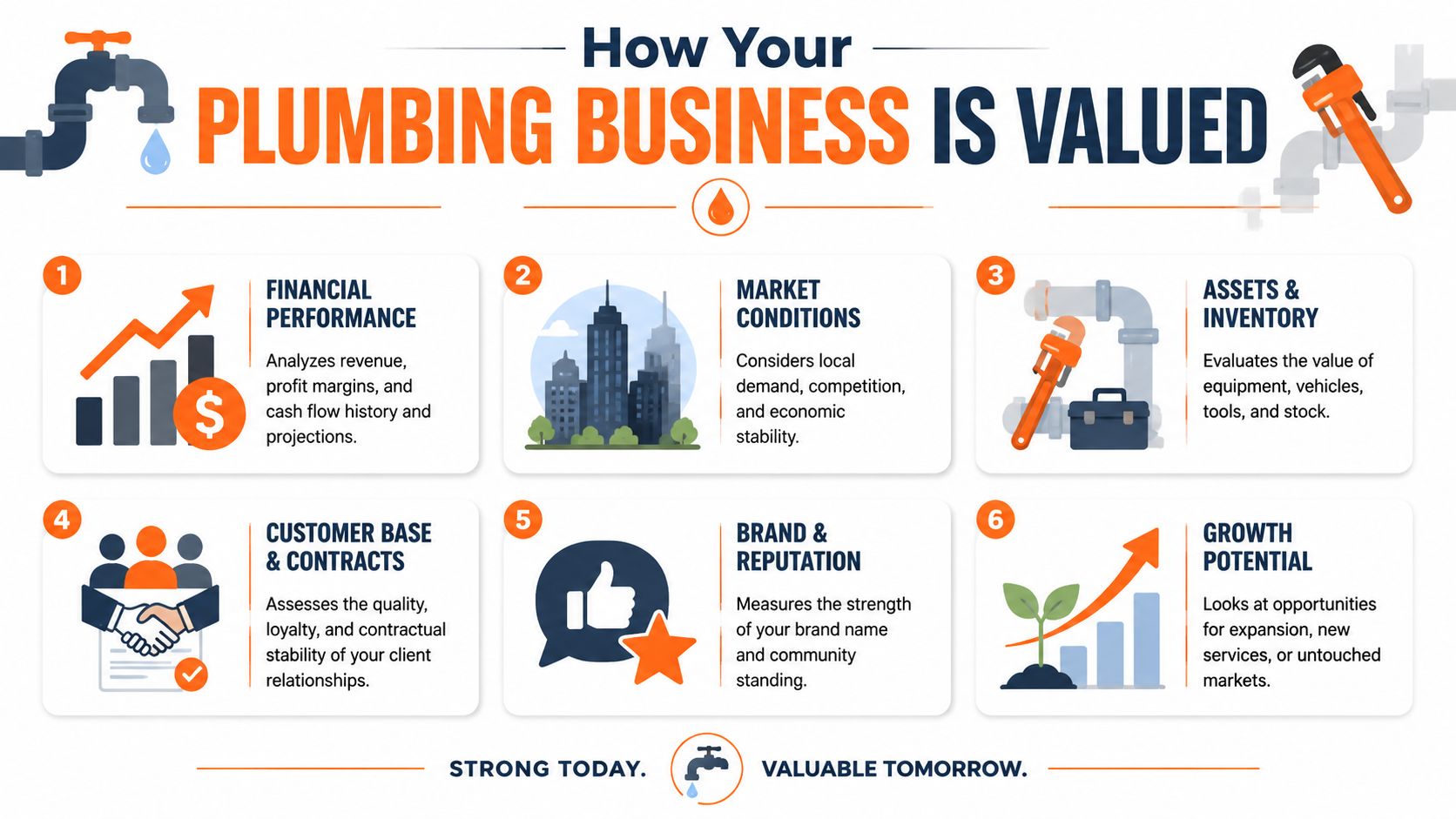
A buyer walks through your business and sees more than last year's sales. They look at whether the work keeps flowing when you're off-site, whether the team knows the drill without chasing you, and whether the numbers match what happens on the tools.
That is why two plumbing businesses with similar revenue can sell for very different prices. Value comes from earnings, yes, but also from how reliable those earnings look after handover. Clean books matter. So do documented processes, a steady crew, and a local reputation that is likely to hold up under new ownership.
SDE and EBITDA in plain English
For smaller owner-led plumbing businesses, buyers often use Seller's Discretionary Earnings, or SDE. SDE is the profit available to one working owner after adjusting for owner wages, personal expenses run through the business, and one-off costs that will not continue after the sale.
For larger companies with office management, field supervision, or multiple crews operating with less owner input, buyers often focus on EBITDA. That measure strips out financing, tax, depreciation, and amortisation so they can judge the operating performance of the business itself.
The choice matters because it changes how buyers frame risk. A business built around one owner's effort is valued differently from one that runs through team structure and systems. If you want a clearer breakdown before speaking with a broker, this guide to plumbing business valuation gives a solid starting point.
What the multiple is really pricing
A multiple is a risk score with a price attached.
Higher multiples go to plumbing businesses that a buyer can take over without nasty surprises. Lower multiples show up where too much sits in the owner's head, the books need explaining, or key relationships could disappear after settlement.
Here is the practical version:
| Lower multiple businesses | Higher multiple businesses |
|---|---|
| Owner handles most quoting, sales, and problem jobs | Team can run the day-to-day work without constant owner input |
| Financials need cleanup or heavy explanation | Clean books with clear add-backs |
| Processes live in the owner's head | Processes are documented and followed |
| Key staff could leave after a sale | Licensed plumbers and office leaders are stable |
| Revenue is hard to break down | Profit drivers are clear by service line, customer type, or contract base |
That last point gets missed all the time. If you can show where margin comes from, drain work, maintenance, emergency call-outs, renovations, commercial service, a buyer gets more confidence in the earnings. Confidence lifts value.
Commercial and residential buyers assess risk differently
Commercial-focused plumbing businesses often get assessed through a different lens than residential service businesses. CTA Acquisitions explains in this commercial plumbing valuation discussion that buyers pay close attention to the mix between commercial and residential work, the strength of service agreements, licensed-plumber retention, and customer concentration.
Those points show up in real deals. A business with recurring maintenance income, spread across several customers, often looks safer than one tied to a few large project jobs. On the residential side, a strong database, repeat customers, fast quoting, and a good review profile can carry real weight because they support future lead flow after the owner exits.
What lifts value in a plumbing business
Owners often focus only on profit. Buyers do not.
They also look at how hard that profit is to keep.
What helps most:
- Documented earnings. A buyer should be able to trace sales, margins, wages, and add-backs without detective work.
- Transferable operations. Dispatch, quoting, job notes, invoicing, supplier ordering, and follow-up need to be written down and used.
- Team stability. If your leading hand, scheduler, or licensed plumbers are likely to stay, the business is easier to transfer.
- Customer spread. Heavy reliance on one builder, strata manager, or facility group increases risk.
- Reputation in the local market. Reviews, referral sources, and repeat customers matter because they reduce the cost of replacing work after handover.
I often explain it this way. Buyers are not purchasing your past effort. They are purchasing the likelihood that the business keeps producing under new ownership. A plumbing business with decent profit but weak systems can still be discounted hard. A business with slightly lower earnings but tight documentation, a settled team, and a trusted name in the area can command stronger interest because it is easier to step into and keep running.
The Process of Selling Your Business With a Broker
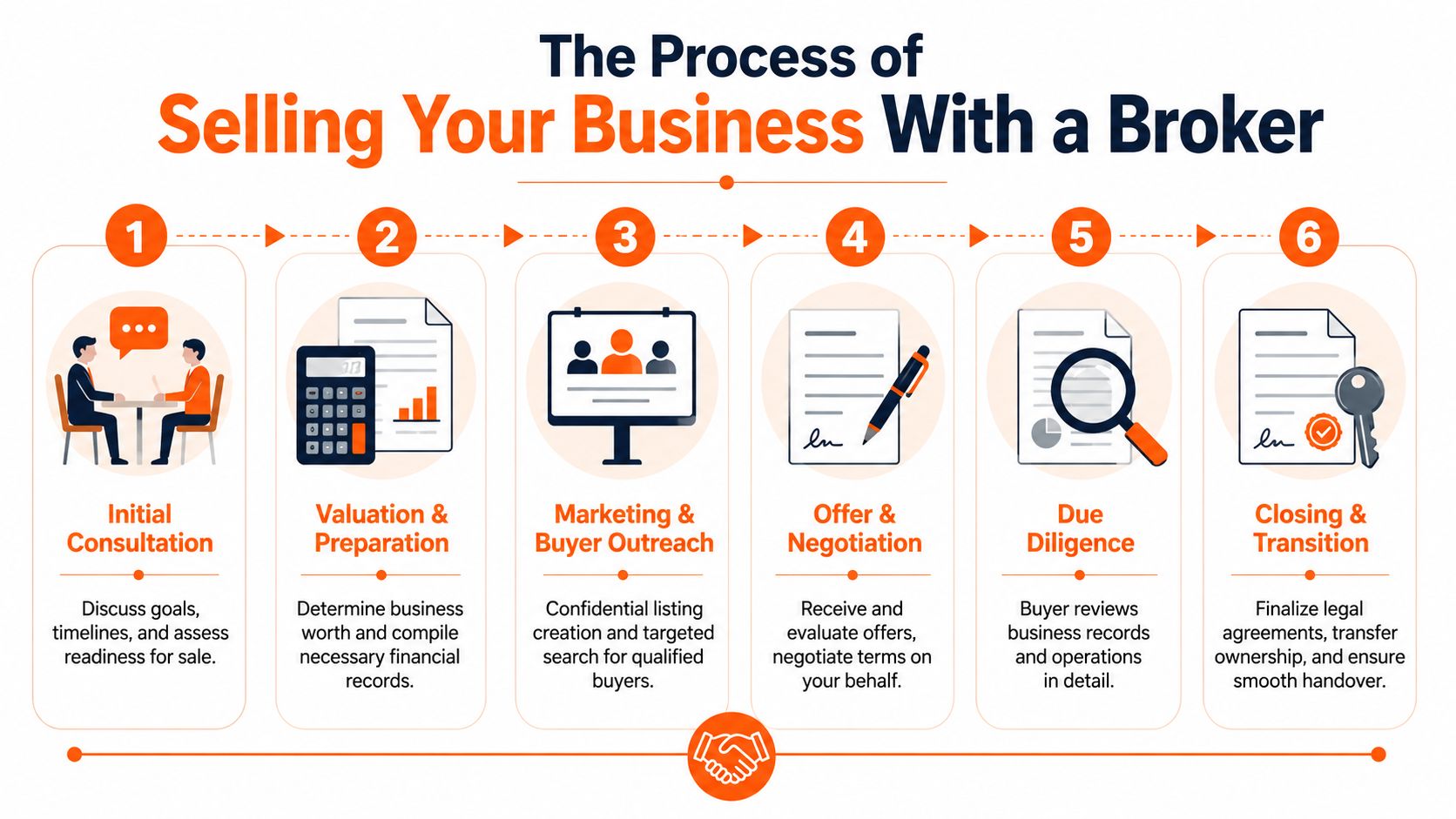
The sale process feels less intimidating when you see it as a sequence, not one giant event.
Early on, most of the work happens behind the scenes. You speak with the broker confidentially, share financials and operating details, and get an honest view of readiness. Sometimes the answer is "go now." Sometimes it's "fix a few things first."
This visual gives a straightforward view of the path from first conversation to handover.
From preparation to market
After the initial review, the broker usually starts assembling the sale package, cleaning up the story around the numbers, and identifying likely buyer types. Then comes confidential outreach.
That doesn't mean blasting your business everywhere. It usually means controlled conversations with qualified buyers who fit the size, type, and structure of your business.
If you want a broader overview before entering that process, this guide on how to sell a plumbing business covers the seller's side well.
A short video can also help put the stages into context.
Offers are not just about headline price
When offers arrive, sellers naturally focus on the top number. That's understandable, but it can be a mistake.
A lower offer with cleaner terms, a better buyer fit, and a more realistic transition plan may beat a higher offer loaded with contingencies, holdbacks, or unrealistic expectations about your post-sale involvement.
Things a broker helps compare include:
- Cash at closing: How much do you receive when the deal completes.
- Risk in the structure: Deferred payments and earn-outs can look good on paper and disappoint later.
- Transition burden: Some buyers need more hand-holding than others.
- Likelihood of closing: A credible buyer is worth more than a shaky one.
Due diligence is where weak preparation gets exposed
This is the stage owners underestimate. Buyers dig into the records and test whether the business performs the way it was presented. Profitability Partners advises sellers to show 12 to 24 months of trending metrics such as average ticket, conversion rate, revenue per technician, cost per lead, and job-level profitability by segment, and notes that if more than 20% to 25% of revenue comes from a single customer, buyers often reduce valuation or require earn-outs in this plumbing business sale preparation guide.
The smoother due diligence feels, the more confidence the buyer has that your business will keep working after handover.
Closing then becomes a legal and operational handoff. Documents are signed, funds move, staff communication is managed, and the transition starts. The cleaner the preparation, the less drama at the end.
How to Choose a Trustworthy Plumbing Business Broker
Not every broker is built for trade businesses. Some understand service companies on paper but don't understand how plumbing businesses run. That gap shows up fast when they value the company too loosely, ask the wrong questions, or fail to explain your operation in a way buyers respect.
A trustworthy Plumbing Business Broker should make you feel clearer, not more confused.
Green flags worth looking for
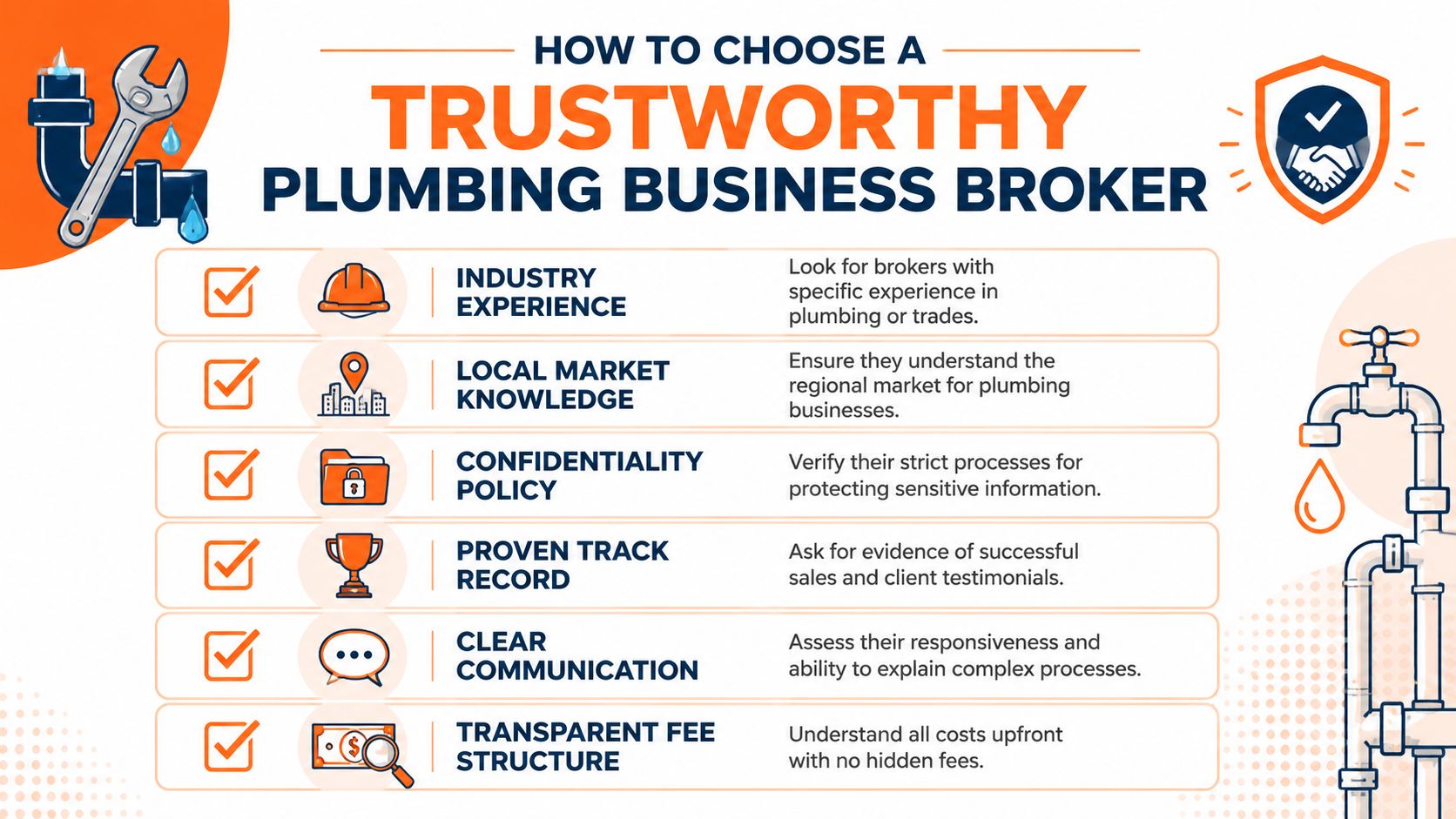
Start with fit. A broker doesn't need to have sold your exact business in your exact suburb, but they should understand the trades, local service operations, and the difference between an owner-dependent shop and a transferable one.
Good signs include:
- Relevant trade experience: They ask about licensed staff, dispatch, fleet condition, service mix, and customer concentration without prompting.
- A grounded view of valuation: They explain what will support the number, not just what you want to hear.
- A clear confidentiality process: They can tell you who sees what, and when.
- Strong communication: They answer directly, explain terms plainly, and don't hide behind jargon.
- Evidence of process discipline: They talk through preparation, buyer screening, diligence, and transition, not just marketing.
Red flags that usually cost sellers money
Some warning signs are subtle at first. Others are obvious.
| Red flag | Why it's a problem |
|---|---|
| Promises of an unusually high price without detail | Inflated expectations often lead to a stale listing or a painful price drop |
| Pressure to sign quickly | Rushed engagement usually benefits the broker more than the seller |
| Generic talk about "lots of buyers" | Buyer quality matters more than broad claims |
| Weak questions about the business | If they don't probe risk early, buyers will later |
| Vague fee explanations | Surprises in the agreement usually arrive at the worst time |
Ask a broker how they would explain your business to three different buyer types. Their answer tells you how well they understand the market and your sale.
Questions worth asking in the first meeting
Keep it practical. You are not hiring a motivator. You are hiring someone to guide a major transaction.
Ask things like:
- What concerns would a buyer raise about my business first
- What would you need from me before going to market
- How do you screen buyers
- How do you handle staff confidentiality
- What kind of transition do you think a buyer will expect
The best answers are usually balanced. They won't be all sunshine. They should show judgment.
Tips for Tradies Preparing a Business for Sale
Owners often think preparation means tidying up the profit and loss statement. That's part of it, but buyers of plumbing businesses look deeper. They want proof that the business can keep producing work, cash flow, and customer trust after you're gone.
Clean up what lives in your head
If your office manager knows how things work but nothing is written down, that's a risk. If only you know how quotes are approved, how after-hours calls get handled, or how warranty issues are tracked, that's a risk too.
Write down the core operating routines:
- Booking and dispatch: Who takes calls, how jobs are prioritized, how work is assigned
- Quoting and approval: What needs your sign-off and what doesn't
- Invoicing and collections: When invoices go out and how overdue accounts are followed up
- Supplier and stock routines: How parts are ordered, stored, and tracked
A buyer doesn't expect a perfect corporate manual. They do expect enough documentation that the business won't wobble the minute you step back.
Make the team look stable and transferable
Licensed plumbers, key apprentices, office staff, and field leaders all matter. A buyer will ask who keeps the work moving without the owner. If the answer is nobody, value suffers.
Useful preparation includes a simple staff summary covering role, tenure, licence status, main responsibilities, and whether customer relationships rely heavily on that person. This isn't fluff. It helps a buyer judge continuity.
Show that work comes from systems, not personality alone
Midstreet highlights why this matters. It cites search-behavior data showing 93% of consumers looking for a plumber call after making a search, and 40% of consumers who call from a search make a purchase. The same source notes that in the $1 million to $5 million sales range, many plumbing and HVAC businesses sell for roughly 31% to 60% of sales, with management depth, marketing systems, and online reviews flagged as major value drivers in this guide to valuing and selling a plumbing business.
That means buyers want evidence that enquiries keep coming in because the business has a repeatable local presence, documented reviews, and a system for handling inbound demand. Not just because everyone in town knows your mobile number.
A buyer is more comfortable paying for a machine than a personality. If the business wins work through repeatable habits, it's easier to transfer.
If you're tightening up that side of the operation, tools can help. Some owners use job management software to track enquiries and follow-up, while platforms like GrowTradie for plumbing businesses are built to keep local trade businesses consistently visible online without the owner having to create posts manually.
Get your records buyer-ready
Before sale discussions get serious, gather:
- Financial statements that match reality
- Vehicle, tool, and equipment lists
- Major customer and supplier summaries
- Lease, licence, and insurance documents
- A simple explanation of your service mix
Buyers are far more confident when records are easy to find and easy to reconcile. That's not admin for admin's sake. It's risk reduction.
FAQ and Your Next Steps
A few questions come up in almost every sale conversation.
Can a small plumbing business be sold
Yes, provided there's real cash flow, a clear customer base, and some level of transferability. Small businesses often depend heavily on the owner, so the issue is usually not whether the business can sell, but how much transition support the buyer will want.
Who is buying plumbing businesses now
The buyer pool is wider than many owners expect. Current market commentary points to interest from non-technical buyers, private equity, and multi-location operators looking to acquire established firms, which is one reason seller positioning and transition planning matter so much, as outlined in this overview of plumbing business buyers and brokerage.
Is the highest offer always the best one
No. Terms matter. The buyer's experience matters. Financing matters. Your role after closing matters. A strong broker helps you compare the actual outcome, not just the headline number.
What should I do first if I'm not ready to sell yet
Start with the basics:
- Gather financial records: Make sure your books are current and understandable.
- List your key dependencies: Note which customers, staff, and routines depend too heavily on you.
- Document core processes: Focus on quoting, dispatch, invoicing, and customer follow-up.
- Speak with your accountant: Ask what would need cleaning up before a buyer reviews the business.
- Interview brokers early: A good early conversation can help you spot value gaps well before sale day.
The owners who get the best outcomes usually don't start with a listing. They start with preparation. They make the business easier to understand, easier to transfer, and easier for a buyer to trust.
If you're serious about exiting in the next chapter of your working life, that's the next step. Not hype. Not guesswork. Just getting the business into a shape that sells well.
If you're building a plumbing business that needs to look strong, consistent, and transferable to a future buyer, GrowTradie can help you keep your local presence active without adding more work to your week. For trade businesses, that kind of consistency can support the broader goal of making the company less dependent on the owner and easier to hand over.